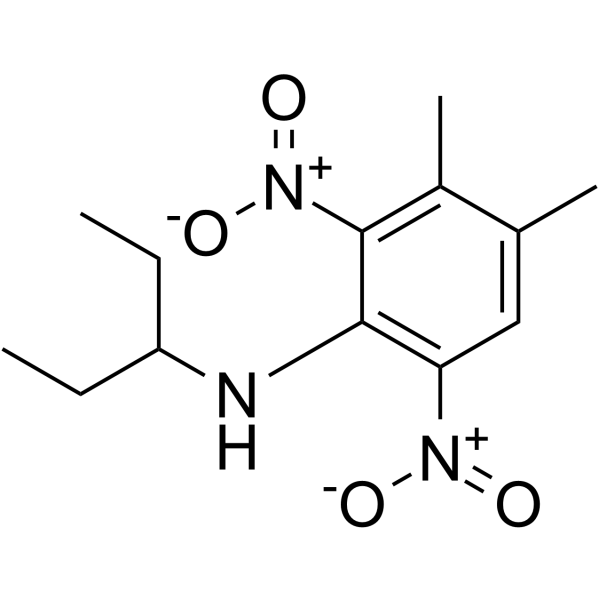
Physicochemical Properties
| Molecular Formula | C13H19N3O4 |
| Molecular Weight | 281.31 |
| Exact Mass | 281.137 |
| CAS # | 40487-42-1 |
| Related CAS # | Pendimethalin-d5;1219803-39-0 |
| PubChem CID | 38479 |
| Appearance | Orange to red solid powder |
| Density | 1.2±0.1 g/cm3 |
| Boiling Point | 421.0±45.0 °C at 760 mmHg |
| Melting Point | 56-57°C |
| Flash Point | 208.4±28.7 °C |
| Vapour Pressure | 0.0±1.0 mmHg at 25°C |
| Index of Refraction | 1.580 |
| LogP | 5.56 |
| Hydrogen Bond Donor Count | 1 |
| Hydrogen Bond Acceptor Count | 5 |
| Rotatable Bond Count | 4 |
| Heavy Atom Count | 20 |
| Complexity | 349 |
| Defined Atom Stereocenter Count | 0 |
| InChi Key | CHIFOSRWCNZCFN-UHFFFAOYSA-N |
| InChi Code | InChI=1S/C13H19N3O4/c1-5-10(6-2)14-12-11(15(17)18)7-8(3)9(4)13(12)16(19)20/h7,10,14H,5-6H2,1-4H3 |
| Chemical Name | 3,4-dimethyl-2,6-dinitro-N-pentan-3-ylaniline |
| HS Tariff Code | 2934.99.9001 |
| Storage |
Powder-20°C 3 years 4°C 2 years In solvent -80°C 6 months -20°C 1 month |
| Shipping Condition | Room temperature (This product is stable at ambient temperature for a few days during ordinary shipping and time spent in Customs) |
Biological Activity
| ADME/Pharmacokinetics |
Absorption, Distribution and Excretion Pendimethalin is eliminated from body with 70% being excreted in feces, primarily parent compound, and 20% in urine within 24 hr /in rats/. By 24 hr after the administration of 37 mg/kg of radio-labeled pendimethalin to rats, 90.3% of the dose was recovered in the feces and urine. After 96 hr, 95.8% of the dose was recovered in the urine (20.9%) and feces (74.9%). When a lower dose was administered (7.3 mg/kg), 99.8% was recovered in the urine (21.8%) and feces (78.0%) after 12 hr. After 96 hr, residues were less than 0.3 ppm in all body tissues except fat, which had 0.9 ppm. This study indicates that ingested pendimethalin is largely unabsorbed by the bloodstream and excreted through the feces. Pendimethalin which does become absorbed into the bloodstream from the gastrointestinal tract is rapidly metabolized in the kidneys and liver and is then excreted in the urine. Metabolism / Metabolites The metabolism of the dinitroaniline herbicide pendimethalin was investigated in rats with emphasis on the identification of metabolites in tissues and urine. Royal Hart Wistar rats were administered a single oral dose of radiolabeled methyl labeled or ethyl labeled pendimethalin. Radioactivity was excreted rapidly both in urine and feces at dosage levels of 7.3 and 37 mg/kg of radiolabeled pendimethalin. After 96 hr, the residues were less than 0.3 ppm in all tissues except fat, which had a residue of 0.9 ppm. The major metabolic routes of pendimethalin involved hydroxylation of the 4-methyl and the N-1-ethyl group, oxidation of these alkyl groups to carboxylic acids, nitro reduction, cyclization, and conjugation based on the identification of the 12 metabolites in urine and tissues. Products of cyclization reactions giving rise to methylbenzimidazole carboxylic acids were unique to liver and kidney. All major metabolites retained both radioactive labels of pendimethalin, indicating that N-dealkylation of the isopentyl group was not significant. This investigation extends the knowledge on the fate of dinitroanilines in the rat and demonstrates that pendimethalin is metabolized by several major pathways. Pendimethalin which does become absorbed into the bloodstream from the gastrointestinal tract is rapidly metabolized in the kidneys and liver and is then excreted in the urine. The major metabolic routes of pendimethalin involved hydroxylation of the 4-methyl and the N-1-ethyl group, oxidation of these alkyl groups to carboxylic acids, nitro reduction, cyclization, and conjugation based on the identification of the 12 metabolites in urine and tissues. Products of cyclization reactions giving rise to methylbenzimidazole carboxylic acids were unique to liver and kidney (A624, L1133). |
| References |
[1]. Effect of adjuvant on pendimethalin and dimethenamid-P behaviour in soil. J Hazard Mater. 2018 Jul 15;354:266-274. |
| Additional Infomation |
Pendimethalin appears as orange-yellow crystals. Non corrosive. Used as an herbicide. Pendimethalin is a member of the class of substituted anilines that is N-(pentan-3-yl)aniline bearing two additional nitro substituents at positions 2 and 6 as well as two methyl substituents at positions 3 and 4. A herbicide used to control most annual grasses and many annual broad-leaved weeds. It has a role as a herbicide, an environmental contaminant and an agrochemical. It is a substituted aniline, a secondary amino compound and a C-nitro compound. Pendimethalin is a preemergent herbicide used to prevent crabgrass from germinating. Pendimethalin was included in a biocide ban proposed by the Swedish Chemicals Agency and approved by the European Parliament in January 13, 2009 (L800). |
Solubility Data
| Solubility (In Vitro) | DMSO: 50 mg/mL (177.74 mM) |
| Solubility (In Vivo) |
Solubility in Formulation 1: ≥ 2.5 mg/mL (8.89 mM) (saturation unknown) in 10% DMSO + 40% PEG300 + 5% Tween80 + 45% Saline (add these co-solvents sequentially from left to right, and one by one), clear solution. For example, if 1 mL of working solution is to be prepared, you can add 100 μL of 25.0 mg/mL clear DMSO stock solution to 400 μL PEG300 and mix evenly; then add 50 μL Tween-80 to the above solution and mix evenly; then add 450 μL normal saline to adjust the volume to 1 mL. Preparation of saline: Dissolve 0.9 g of sodium chloride in 100 mL ddH₂ O to obtain a clear solution. Solubility in Formulation 2: 2.5 mg/mL (8.89 mM) in 10% DMSO + 90% (20% SBE-β-CD in Saline) (add these co-solvents sequentially from left to right, and one by one), suspension solution; with ultrasonication. For example, if 1 mL of working solution is to be prepared, you can add 100 μL of 25.0 mg/mL clear DMSO stock solution to 900 μL of 20% SBE-β-CD physiological saline solution and mix evenly. Preparation of 20% SBE-β-CD in Saline (4°C,1 week): Dissolve 2 g SBE-β-CD in 10 mL saline to obtain a clear solution. (Please use freshly prepared in vivo formulations for optimal results.) |
| Preparing Stock Solutions | 1 mg | 5 mg | 10 mg | |
| 1 mM | 3.5548 mL | 17.7740 mL | 35.5480 mL | |
| 5 mM | 0.7110 mL | 3.5548 mL | 7.1096 mL | |
| 10 mM | 0.3555 mL | 1.7774 mL | 3.5548 mL |