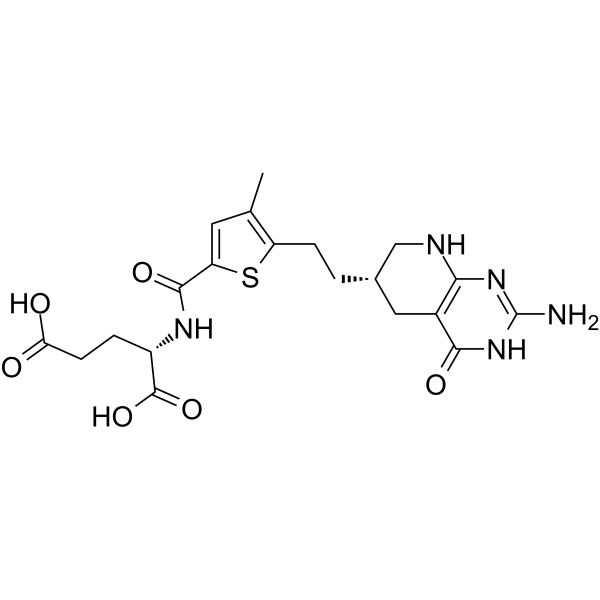
Physicochemical Properties
| Molecular Formula | C20H25N5O6S |
| Molecular Weight | 463.5074 |
| Exact Mass | 463.152 |
| CAS # | 446022-33-9 |
| PubChem CID | 135431074 |
| Appearance | Off-white to light yellow solid powder |
| Density | 1.6±0.1 g/cm3 |
| Index of Refraction | 1.743 |
| LogP | -0.58 |
| Hydrogen Bond Donor Count | 6 |
| Hydrogen Bond Acceptor Count | 9 |
| Rotatable Bond Count | 9 |
| Heavy Atom Count | 32 |
| Complexity | 859 |
| Defined Atom Stereocenter Count | 2 |
| SMILES | CC1=C(SC(=C1)C(=O)N[C@@H](CCC(=O)O)C(=O)O)CC[C@H]2CC3=C(NC2)N=C(NC3=O)N |
| InChi Key | QXOPTIPQEVJERB-JQWIXIFHSA-N |
| InChi Code | InChI=1S/C20H25N5O6S/c1-9-6-14(18(29)23-12(19(30)31)3-5-15(26)27)32-13(9)4-2-10-7-11-16(22-8-10)24-20(21)25-17(11)28/h6,10,12H,2-5,7-8H2,1H3,(H,23,29)(H,26,27)(H,30,31)(H4,21,22,24,25,28)/t10-,12-/m0/s1 |
| Chemical Name | (2S)-2-[[5-[2-[(6S)-2-amino-4-oxo-5,6,7,8-tetrahydro-3H-pyrido[2,3-d]pyrimidin-6-yl]ethyl]-4-methylthiophene-2-carbonyl]amino]pentanedioic acid |
| HS Tariff Code | 2934.99.9001 |
| Storage |
Powder-20°C 3 years 4°C 2 years In solvent -80°C 6 months -20°C 1 month |
| Shipping Condition | Room temperature (This product is stable at ambient temperature for a few days during ordinary shipping and time spent in Customs) |
Biological Activity
| ln Vitro | Pelitrexo (150 nM; 24 h) significantly suppresses mTORC1 activity in A549 cells by lowering intracellular guanine nucleotide and GTP-bound Rheb protein levels [1]. In NCI-H460 cells, pelitrexo (0-1000 mM; 16 h) dose-dependently and potently suppresses the phosphorylation levels of ribosomal protein S6 (S6RP), S6K1, and Chk1 [1]. In NCI-H460 cells, pelitrexo (100 nM; 48 h) stops the cell cycle in the G1 phase [1]. |
| ln Vivo | Pelitrexo (10 mg/kg, 20 mg/kg; i.p.; every 4 days for 3 weeks) inhibits the growth of tumors and mTORC1 in mice with xenografts of non-small cell lung cancer (NSCLC) [1]. Pelitrexo (20 mg/kg; i.p.; every 4 days for 3 weeks) suppresses the function of mTORC1 and inhibits purine biosynthesis that is dependent on GARFT [1]. |
| Cell Assay |
Cell cycle analysis[1] Cell Types: NCI-H460 NSCLC Tested Concentrations: 100 nM Incubation Duration: 4, 8, 24, 48 hrs (hours) Experimental Results: 63% of cells accumulated in the G1 phase of the cell cycle. Cell cycle analysis[1] Cell Types: NCI-H460 NSCLC Tested Concentrations: 0, 10, 30, 100, 300, 1000 nM Incubation Duration: 16 hrs (hours) Experimental Results: Inhibition of p-S6RP, p-S6K1 and p-Chk1 levels. |
| Animal Protocol |
Animal/Disease Models: Mouse non-small cell lung cancer (NSCLC) xenograft model [1] Doses: 10 mg/kg, 20 mg/kg Route of Administration: intraperitoneal (ip) injection; Group 1 once every 4 days for 3 weeks; Group 2 The results of administration on days 1, 4, and 7 of each group: In group 1, 10 mg/kg and 20 mg/kg inhibited tumor growth by 64% and 69%, respectively. Inhibits mTORC1-dependent phosphorylation of S6K1, S6RP and CAD Group 2 20 mg/kg. |
| References |
[1]. Purine Nucleotide Availability Regulates mTORC1 Activity through the Rheb GTPase. Cell Rep. 2017 Jun 27;19(13):2665-2680. |
| Additional Infomation |
Pelitrexol has been used in trials studying the treatment of Unspecified Adult Solid Tumor, Protocol Specific. Pelitrexol is a water soluble antifolate with anti-proliferative activity. Pelitrexol inhibits activity of glycinamide ribonucleotide formyltransferase (GARFT), the first folate-dependent enzyme of the de novo purine synthesis pathway essential for cell proliferation. Enzyme inhibition reduces the purine nucleotides pool required for DNA replication and RNA transcription. As a result, this agent causes cell cycle arrest in S-phase, and ultimately inhibits tumor cell proliferation |
Solubility Data
| Solubility (In Vitro) | DMSO : ~25 mg/mL (~53.94 mM) |
| Solubility (In Vivo) |
Solubility in Formulation 1: ≥ 2.08 mg/mL (4.49 mM) (saturation unknown) in 10% DMSO + 40% PEG300 + 5% Tween80 + 45% Saline (add these co-solvents sequentially from left to right, and one by one), clear solution. For example, if 1 mL of working solution is to be prepared, you can add 100 μL of 20.8 mg/mL clear DMSO stock solution to 400 μL PEG300 and mix evenly; then add 50 μL Tween-80 to the above solution and mix evenly; then add 450 μL normal saline to adjust the volume to 1 mL. Preparation of saline: Dissolve 0.9 g of sodium chloride in 100 mL ddH₂ O to obtain a clear solution. Solubility in Formulation 2: ≥ 2.08 mg/mL (4.49 mM) (saturation unknown) in 10% DMSO + 90% (20% SBE-β-CD in Saline) (add these co-solvents sequentially from left to right, and one by one), clear solution. For example, if 1 mL of working solution is to be prepared, you can add 100 μL of 20.8 mg/mL clear DMSO stock solution to 900 μL of 20% SBE-β-CD physiological saline solution and mix evenly. Preparation of 20% SBE-β-CD in Saline (4°C,1 week): Dissolve 2 g SBE-β-CD in 10 mL saline to obtain a clear solution. Solubility in Formulation 3: ≥ 2.08 mg/mL (4.49 mM) (saturation unknown) in 10% DMSO + 90% Corn Oil (add these co-solvents sequentially from left to right, and one by one), clear solution. For example, if 1 mL of working solution is to be prepared, you can add 100 μL of 20.8 mg/mL clear DMSO stock solution to 900 μL of corn oil and mix evenly. (Please use freshly prepared in vivo formulations for optimal results.) |
| Preparing Stock Solutions | 1 mg | 5 mg | 10 mg | |
| 1 mM | 2.1575 mL | 10.7873 mL | 21.5745 mL | |
| 5 mM | 0.4315 mL | 2.1575 mL | 4.3149 mL | |
| 10 mM | 0.2157 mL | 1.0787 mL | 2.1575 mL |