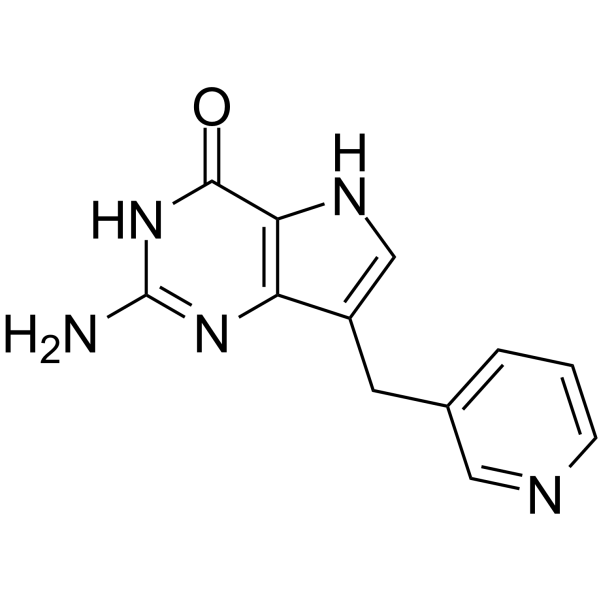
Physicochemical Properties
| Molecular Formula | C12H11N5O |
| Molecular Weight | 241.24864 |
| Exact Mass | 241.096 |
| CAS # | 133432-71-0 |
| Related CAS # | Peldesine dihydrochloride;2772702-10-8 |
| PubChem CID | 135413525 |
| Appearance | Light yellow to yellow solid powder |
| Density | 1.57g/cm3 |
| Boiling Point | 534ºC at 760mmHg |
| Flash Point | 276.7ºC |
| Vapour Pressure | 1.76E-11mmHg at 25°C |
| Index of Refraction | 1.794 |
| LogP | 1.161 |
| Hydrogen Bond Donor Count | 3 |
| Hydrogen Bond Acceptor Count | 3 |
| Rotatable Bond Count | 2 |
| Heavy Atom Count | 18 |
| Complexity | 370 |
| Defined Atom Stereocenter Count | 0 |
| InChi Key | DOHVAKFYAHLCJP-UHFFFAOYSA-N |
| InChi Code | InChI=1S/C12H11N5O/c13-12-16-9-8(4-7-2-1-3-14-5-7)6-15-10(9)11(18)17-12/h1-3,5-6,15H,4H2,(H3,13,16,17,18) |
| Chemical Name | 2-amino-7-(pyridin-3-ylmethyl)-3,5-dihydropyrrolo[3,2-d]pyrimidin-4-one |
| HS Tariff Code | 2934.99.9001 |
| Storage |
Powder-20°C 3 years 4°C 2 years In solvent -80°C 6 months -20°C 1 month |
| Shipping Condition | Room temperature (This product is stable at ambient temperature for a few days during ordinary shipping and time spent in Customs) |
Biological Activity
| ln Vitro | Peldesine (BCX 34; 0-50 μM; 72 hours; Jurkat cells) totally suppresses T cell proliferation in the presence of dGuo (10 μM) at doses below 10 μM. Peldesine, on the other hand, has no effect on B cell proliferation [1]. Peldesine (BCX 34) may influence late rather than early phases of T cell activation since it decreases T cell immunological responses in an IL-2-independent way [1]. With an IC50 of 0.57 μM, pendelasine also reduced the proliferation of human leukemia CCRF-CEM T cells, but not that of rat or mouse T cells, when deoxyguanosine was present. As much as 30 μM[3]. |
| ln Vivo | Rats have a 76% oral bioavailability of Peldesine. Peldesine can be taken orally and have the following effects: it can decrease rat RBC PNP activity in vitro (98% at 100 mg/kg in 3 hours), increase rat plasma inosine (2-fold at 30 mg/kg), and prevent mice from expressing isolated skin PNP. Medium (39% at 3 hours, 100 mg/kg) [3]. |
| Cell Assay |
Cell Proliferation Assay[1] Cell Types: Jurkat Cell Tested Concentrations: 0 µM, 10 µM, 20 µM, 30 µM, 40 µM, 50 µM Incubation Duration: 72 hrs (hours) Experimental Results: Complete inhibition in the presence of 10 µM dCuo for T Cell lines. |
| References |
[1]. BCX-34: a novel T-cell selective immunosuppressant: purine nucleoside phosphorylase (PNP) inhibitor. Artif Organs. 1996 Aug;20(8):849-52. [2]. A phase III, randomized, double-blind, placebo-controlled study of peldesine (BCX-34) cream as topical therapy for cutaneous T-cell lymphoma. J Am Acad Dermatol. 2001 Jun;44(6):940-7. [3]. In vivo and in vitro pharmacologic activity of the purine nucleoside phosphorylase inhibitor BCX-34: the role of GTP and dGTP. Immunopharmacology. 1996 Oct;35(1):53-63. [4]. New AIDS study suppresses T cells to stop viral growth. AIDS Alert. 1997 Jul;12(7):77-8. |
| Additional Infomation |
Peldesine is a potent inhibitor of human CCRF-CEM T-cell proliferation. It has undergone phase I trials for the treatment of Human Immunodeficiency Virus (HIV) infections. Peldesine is a pyrimidine analogue and purine nucleoside phosphorylase inhibitor with immunosuppressive and antineoplastic properties. Peldesine inhibits purine nucleoside phosphorylase (PNP) that plays a pivotal role in T-cell proliferation and is responsible for the catalysis of the reversible phosphorolytic cleavage of purine ribonucleosides and 2'-deoxyribonucleosides. Inhibition of PNP results in accumulation of dGTP and the subsequent failure of DNA synthesis. This agent maybe used in T-cell related autoimmune diseases including psoriasis, rheumatoid arthritis and Crohn s disease and T-cell cancers |
Solubility Data
| Solubility (In Vitro) | DMSO : ~200 mg/mL (~829.02 mM) |
| Solubility (In Vivo) |
Solubility in Formulation 1: ≥ 5 mg/mL (20.73 mM) (saturation unknown) in 10% DMSO + 40% PEG300 + 5% Tween80 + 45% Saline (add these co-solvents sequentially from left to right, and one by one), clear solution. For example, if 1 mL of working solution is to be prepared, you can add 100 μL of 50.0 mg/mL clear DMSO stock solution to 400 μL PEG300 and mix evenly; then add 50 μL Tween-80 to the above solution and mix evenly; then add 450 μL normal saline to adjust the volume to 1 mL. Preparation of saline: Dissolve 0.9 g of sodium chloride in 100 mL ddH₂ O to obtain a clear solution. Solubility in Formulation 2: ≥ 5 mg/mL (20.73 mM) (saturation unknown) in 10% DMSO + 90% (20% SBE-β-CD in Saline) (add these co-solvents sequentially from left to right, and one by one), clear solution. For example, if 1 mL of working solution is to be prepared, you can add 100 μL of 50.0 mg/mL clear DMSO stock solution to 900 μL of 20% SBE-β-CD physiological saline solution and mix evenly. Preparation of 20% SBE-β-CD in Saline (4°C,1 week): Dissolve 2 g SBE-β-CD in 10 mL saline to obtain a clear solution. Solubility in Formulation 3: ≥ 5 mg/mL (20.73 mM) (saturation unknown) in 10% DMSO + 90% Corn Oil (add these co-solvents sequentially from left to right, and one by one), clear solution. For example, if 1 mL of working solution is to be prepared, you can add 100 μL of 50.0 mg/mL clear DMSO stock solution to 900 μL of corn oil and mix evenly. (Please use freshly prepared in vivo formulations for optimal results.) |
| Preparing Stock Solutions | 1 mg | 5 mg | 10 mg | |
| 1 mM | 4.1451 mL | 20.7254 mL | 41.4508 mL | |
| 5 mM | 0.8290 mL | 4.1451 mL | 8.2902 mL | |
| 10 mM | 0.4145 mL | 2.0725 mL | 4.1451 mL |