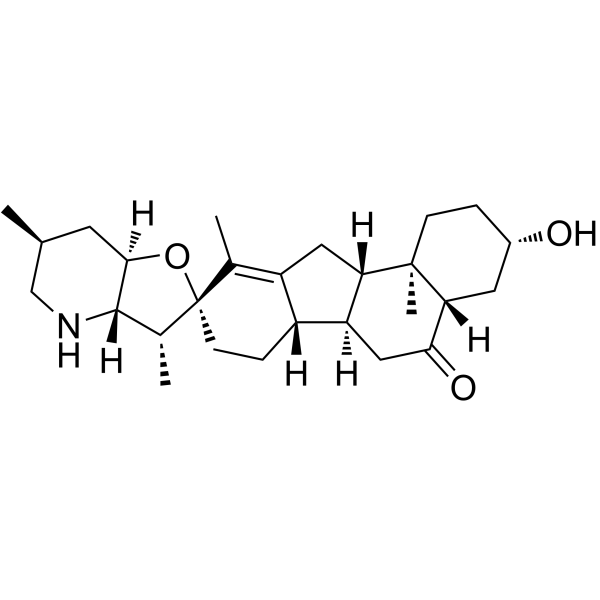
Physicochemical Properties
| Molecular Formula | C27H41NO3 |
| Molecular Weight | 427.6193 |
| Exact Mass | 427.308 |
| CAS # | 19773-24-1 |
| Related CAS # | Peimisine hydrochloride;900498-44-4 |
| PubChem CID | 161294 |
| Appearance | White to off-white solid powder |
| Density | 1.2±0.1 g/cm3 |
| Boiling Point | 573.0±50.0 °C at 760 mmHg |
| Melting Point | 270℃ |
| Flash Point | 300.3±30.1 °C |
| Vapour Pressure | 0.0±3.6 mmHg at 25°C |
| Index of Refraction | 1.578 |
| LogP | 3.7 |
| Hydrogen Bond Donor Count | 2 |
| Hydrogen Bond Acceptor Count | 4 |
| Rotatable Bond Count | 0 |
| Heavy Atom Count | 31 |
| Complexity | 821 |
| Defined Atom Stereocenter Count | 11 |
| SMILES | C[C@H]1C[C@@H]2[C@H]([C@H]([C@]3(O2)CC[C@H]4[C@@H]5CC(=O)[C@H]6C[C@H](CC[C@@]6([C@H]5CC4=C3C)C)O)C)NC1 |
| InChi Key | KYELXPJVGNZIGC-GKFGJCLESA-N |
| InChi Code | InChI=1S/C27H41NO3/c1-14-9-24-25(28-13-14)16(3)27(31-24)8-6-18-19(15(27)2)11-21-20(18)12-23(30)22-10-17(29)5-7-26(21,22)4/h14,16-18,20-22,24-25,28-29H,5-13H2,1-4H3/t14-,16+,17-,18+,20-,21-,22+,24+,25-,26+,27-/m0/s1 |
| Chemical Name | (3S,3'R,3'aS,4aS,6'S,6aR,6bS,7'aR,9R,11aS,11bR)-3-hydroxy-3',6',10,11b-tetramethylspiro[1,2,3,4,4a,6,6a,6b,7,8,11,11a-dodecahydrobenzo[a]fluorene-9,2'-3a,4,5,6,7,7a-hexahydro-3H-furo[3,2-b]pyridine]-5-one |
| HS Tariff Code | 2934.99.9001 |
| Storage |
Powder-20°C 3 years 4°C 2 years In solvent -80°C 6 months -20°C 1 month |
| Shipping Condition | Room temperature (This product is stable at ambient temperature for a few days during ordinary shipping and time spent in Customs) |
Biological Activity
| ln Vitro |
Peimisine (17.43-92.07 μg/mL; 72 h) reveals strong cytotoxic effects [3]. Peimisine (15 μg/mL; 24, 48 and 72 hours) promotes G0/G1 phase arrest and boosts the apoptotic rate [3]. 1. On tumor cell lines: Peimisine exhibited dose-dependent anti-proliferative activity against HepG2 (human hepatocellular carcinoma) and MCF-7 (human breast cancer) cells; the IC50 values for HepG2 and MCF-7 cells were 42.6 μM and 58.3 μM respectively after 48 h of treatment; it also induced early apoptosis in HepG2 cells (apoptotic rate increased from 3.2% in control group to 18.7% at 50 μM concentration) and downregulated the expression of anti-apoptotic protein Bcl-2, while upregulating pro-apoptotic protein Bax at both mRNA and protein levels[3] |
| Cell Assay |
Apoptosis analysis [3] Cell Types: A2780 Cell Tested Concentrations: 15 μg/mL Incubation Duration: 24, 48 and 72 hrs (hours) Experimental Results: G0/G1 phase arrest of A2780 cells was induced in a time-dependent manner. Cytotoxicity assay [3] Cell Types: LLC, A2780, HepG2 and A549 Cell Tested Concentrations: 17.43-92.07 μg/mL Incubation Duration: 72 hrs (hours) Experimental Results: Inhibition of LLC, A2780, HepG2 and A549 cells, IC50 value is 20.75 μg/mL, 17.43 μg/mL, 92.07 μg/mL, 36.11 μg/mL respectively. 1. Tumor cell anti-proliferation and apoptosis assay: Seed HepG2 and MCF-7 cells into 96-well or 6-well culture plates and incubate until reaching logarithmic growth phase; treat the cells with gradient concentrations of Peimisine (0-100 μM) for 48 h; for cell viability detection, add cell proliferation assay reagent to the 96-well plates and incubate for 4 h, then measure absorbance at 450 nm using a microplate reader to calculate cell viability and IC50 values; for apoptosis analysis, harvest cells from 6-well plates, stain with annexin V-fluorescein isothiocyanate and propidium iodide, then detect apoptotic cell ratio via flow cytometry; for gene and protein expression detection, extract total RNA and protein from treated HepG2 cells, perform quantitative real-time PCR to determine mRNA levels of Bcl-2 and Bax, and conduct Western blot to quantify their protein expression levels[3] |
| References |
[1]. Peimisine and peiminine production by endophytic fungus Fusarium sp. isolated from Fritillaria unibracteata var. wabensis. Phytomedicine. 2014 Jul-Aug;21(8-9):1104-9. [2]. Peimine, an Anti-Inflammatory Compound from Chinese Herbal Extracts, Modulates Muscle-Type Nicotinic Receptors. Int J Mol Sci. 2021 Oct 19;22(20):11287. [3]. Evaluation of antitumor property of extracts and steroidal alkaloids from the cultivated Bulbus Fritillariae ussuriensis and preliminary investigation of its mechanism of action. BMC Complement Altern Med. 2015 Feb 21;15:29. |
| Additional Infomation |
Peimisine is an alkaloid. Peimisine has been reported in Fritillaria ebeiensis, Fritillaria monantha, and other organisms with data available. 1. Peimisine can be biosynthesized by endophytic fungus Fusarium sp. isolated from Fritillaria unibracteata var. wabensis; the fungus was cultured in potato dextrose broth (PDB) medium, and after 14 days of fermentation, the yields of Peimisine and peiminine in the fermentation broth were 0.082 mg/L and 0.056 mg/L respectively[1] 2. The anti-tumor mechanism of Peimisine in HepG2 cells is associated with the regulation of Bcl-2/Bax apoptotic pathway, which promotes mitochondrial-dependent apoptosis and thereby inhibits tumor cell proliferation[3] |
Solubility Data
| Solubility (In Vitro) | DMSO : ~12.5 mg/mL (~29.23 mM) |
| Solubility (In Vivo) |
Solubility in Formulation 1: ≥ 1.25 mg/mL (2.92 mM) (saturation unknown) in 10% DMSO + 40% PEG300 + 5% Tween80 + 45% Saline (add these co-solvents sequentially from left to right, and one by one), clear solution. For example, if 1 mL of working solution is to be prepared, you can add 100 μL of 12.5 mg/mL clear DMSO stock solution to 400 μL PEG300 and mix evenly; then add 50 μL Tween-80 to the above solution and mix evenly; then add 450 μL normal saline to adjust the volume to 1 mL. Preparation of saline: Dissolve 0.9 g of sodium chloride in 100 mL ddH₂ O to obtain a clear solution. Solubility in Formulation 2: ≥ 1.25 mg/mL (2.92 mM) (saturation unknown) in 10% DMSO + 90% (20% SBE-β-CD in Saline) (add these co-solvents sequentially from left to right, and one by one), clear solution. For example, if 1 mL of working solution is to be prepared, you can add 100 μL of 12.5 mg/mL clear DMSO stock solution to 900 μL of 20% SBE-β-CD physiological saline solution and mix evenly. Preparation of 20% SBE-β-CD in Saline (4°C,1 week): Dissolve 2 g SBE-β-CD in 10 mL saline to obtain a clear solution. Solubility in Formulation 3: ≥ 1.25 mg/mL (2.92 mM) (saturation unknown) in 10% DMSO + 90% Corn Oil (add these co-solvents sequentially from left to right, and one by one), clear solution. For example, if 1 mL of working solution is to be prepared, you can add 100 μL of 12.5 mg/mL clear DMSO stock solution to 900 μL of corn oil and mix evenly. (Please use freshly prepared in vivo formulations for optimal results.) |
| Preparing Stock Solutions | 1 mg | 5 mg | 10 mg | |
| 1 mM | 2.3385 mL | 11.6926 mL | 23.3852 mL | |
| 5 mM | 0.4677 mL | 2.3385 mL | 4.6770 mL | |
| 10 mM | 0.2339 mL | 1.1693 mL | 2.3385 mL |