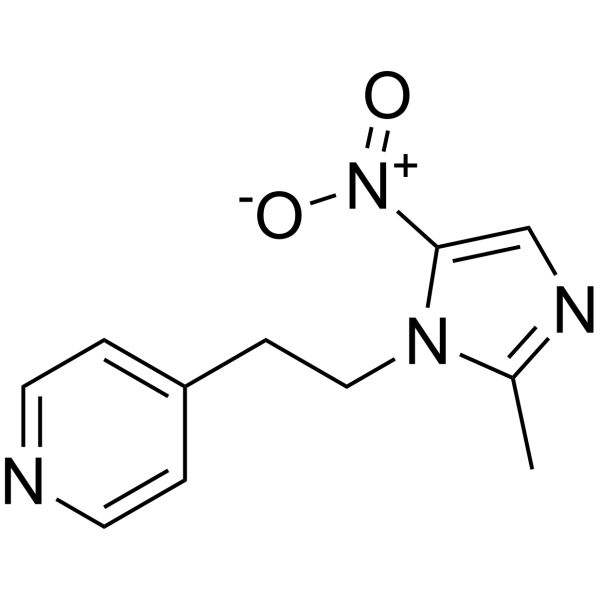
Physicochemical Properties
| Molecular Formula | C11H12N4O2 |
| Molecular Weight | 232.23858 |
| Exact Mass | 232.096 |
| CAS # | 13752-33-5 |
| PubChem CID | 72080 |
| Appearance | White to off-white solid powder |
| LogP | 2.26 |
| Hydrogen Bond Donor Count | 0 |
| Hydrogen Bond Acceptor Count | 4 |
| Rotatable Bond Count | 3 |
| Heavy Atom Count | 17 |
| Complexity | 263 |
| Defined Atom Stereocenter Count | 0 |
| SMILES | O=[N+](C1=CN=C(C)N1CCC2=CC=NC=C2)[O-] |
| InChi Key | ARYPMCPJIWUCIP-UHFFFAOYSA-N |
| InChi Code | InChI=1S/C11H12N4O2/c1-9-13-8-11(15(16)17)14(9)7-4-10-2-5-12-6-3-10/h2-3,5-6,8H,4,7H2,1H3 |
| Chemical Name | 4-[2-(2-methyl-5-nitroimidazol-1-yl)ethyl]pyridine |
| HS Tariff Code | 2934.99.9001 |
| Storage |
Powder-20°C 3 years 4°C 2 years In solvent -80°C 6 months -20°C 1 month |
| Shipping Condition | Room temperature (This product is stable at ambient temperature for a few days during ordinary shipping and time spent in Customs) |
Biological Activity
| ln Vitro | Phandazole, at concentrations of 0.02-1 mM, increased the frequency of streptomycin-resistant mutations in Klebsiella pneumoniae, E. Coli in Luria and Delbrück's fluctuation assay. Citrobacter freundii, K12 E. Coli, and Streptomyces dependence [1]. |
| ln Vivo | Half of the 100 patients with vaginal trichomoniasis received 1.0 g of panidazole daily for seven days, while the other half received it for ten days. 50% and 60% of cases were cured, respectively [3]. |
| References |
[1]. Voogd CE, et al. The mutagenic action of nitroimidazoles. II. Tinidazole, ipronidazole, panidazole and ornidazole. Mutat Res. 1977 Apr;48(2):155-61. [2]. Botero D, et al. Treatment of intestinal amoebiasis and vaginal trichomoniasis with panidazole and its comparison with metronidazole. Trans R Soc Trop Med Hyg. 1977;71(6):508-11. |
Solubility Data
| Solubility (In Vitro) | DMSO : ≥ 125 mg/mL (~538.24 mM) |
| Solubility (In Vivo) |
Solubility in Formulation 1: ≥ 2.08 mg/mL (8.96 mM) (saturation unknown) in 10% DMSO + 40% PEG300 + 5% Tween80 + 45% Saline (add these co-solvents sequentially from left to right, and one by one), clear solution. For example, if 1 mL of working solution is to be prepared, you can add 100 μL of 20.8 mg/mL clear DMSO stock solution to 400 μL PEG300 and mix evenly; then add 50 μL Tween-80 to the above solution and mix evenly; then add 450 μL normal saline to adjust the volume to 1 mL. Preparation of saline: Dissolve 0.9 g of sodium chloride in 100 mL ddH₂ O to obtain a clear solution. Solubility in Formulation 2: ≥ 2.08 mg/mL (8.96 mM) (saturation unknown) in 10% DMSO + 90% (20% SBE-β-CD in Saline) (add these co-solvents sequentially from left to right, and one by one), clear solution. For example, if 1 mL of working solution is to be prepared, you can add 100 μL of 20.8 mg/mL clear DMSO stock solution to 900 μL of 20% SBE-β-CD physiological saline solution and mix evenly. Preparation of 20% SBE-β-CD in Saline (4°C,1 week): Dissolve 2 g SBE-β-CD in 10 mL saline to obtain a clear solution. Solubility in Formulation 3: ≥ 2.08 mg/mL (8.96 mM) (saturation unknown) in 10% DMSO + 90% Corn Oil (add these co-solvents sequentially from left to right, and one by one), clear solution. For example, if 1 mL of working solution is to be prepared, you can add 100 μL of 20.8 mg/mL clear DMSO stock solution to 900 μL of corn oil and mix evenly. (Please use freshly prepared in vivo formulations for optimal results.) |
| Preparing Stock Solutions | 1 mg | 5 mg | 10 mg | |
| 1 mM | 4.3059 mL | 21.5295 mL | 43.0589 mL | |
| 5 mM | 0.8612 mL | 4.3059 mL | 8.6118 mL | |
| 10 mM | 0.4306 mL | 2.1529 mL | 4.3059 mL |