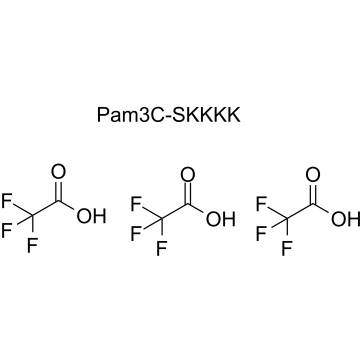
Pam3CSK4 TFA is a novel and potent toll-like receptor 1/2 (TLR1/2) agonist with an EC50 of 0.47 ng/mL for human TLR1/2.
Physicochemical Properties
| Molecular Formula | C87H159F9N10O19S |
| Molecular Weight | 1852.29961705208 |
| Exact Mass | 1623.15 |
| CAS # | 112208-01-2 |
| Related CAS # | Pam3CSK4;112208-00-1;Pam3CSK4 trihydrochloride;112208-04-5 |
| PubChem CID | 137700171 |
| Sequence | Pal-Cys-Ser-Lys-Lys-Lys-Lys |
| SequenceShortening | XSKKKK; Pal-CSKKKK |
| Appearance | White to off-white solid powder |
| Hydrogen Bond Donor Count | 13 |
| Hydrogen Bond Acceptor Count | 23 |
| Rotatable Bond Count | 80 |
| Heavy Atom Count | 112 |
| Complexity | 2260 |
| Defined Atom Stereocenter Count | 6 |
| SMILES | S(CC(COC(CCCCCCCCCCCCCCC)=O)OC(CCCCCCCCCCCCCCC)=O)C[C@@H](C(N[C@@H](CO)C(N[C@H](C(N[C@H](C(N[C@H](C(N[C@H](C(=O)O)CCCCN)=O)CCCCN)=O)CCCCN)=O)CCCCN)=O)=O)NC(CCCCCCCCCCCCCCC)=O.FC(C(=O)O)(F)F.FC(C(=O)O)(F)F.FC(C(=O)O)(F)F |
| InChi Key | VUABEPVGXYOKOG-UDFJXRDYSA-N |
| InChi Code | InChI=1S/C81H156N10O13S.C2HF3O2/c1-4-7-10-13-16-19-22-25-28-31-34-37-40-55-73(93)86-72(65-105-64-66(104-75(95)57-42-39-36-33-30-27-24-21-18-15-12-9-6-3)63-103-74(94)56-41-38-35-32-29-26-23-20-17-14-11-8-5-2)80(100)91-71(62-92)79(99)89-68(52-44-48-59-83)77(97)87-67(51-43-47-58-82)76(96)88-69(53-45-49-60-84)78(98)90-70(81(101)102)54-46-50-61-85;3-2(4,5)1(6)7/h66-72,92H,4-65,82-85H2,1-3H3,(H,86,93)(H,87,97)(H,88,96)(H,89,99)(H,90,98)(H,91,100)(H,101,102);(H,6,7)/t66?,67-,68-,69-,70-,71-,72-;/m0./s1 |
| Chemical Name | (2S)-6-amino-2-[[(2S)-6-amino-2-[[(2S)-6-amino-2-[[(2S)-6-amino-2-[[(2S)-2-[[(2R)-3-[2,3-di(hexadecanoyloxy)propylsulfanyl]-2-(hexadecanoylamino)propanoyl]amino]-3-hydroxypropanoyl]amino]hexanoyl]amino]hexanoyl]amino]hexanoyl]amino]hexanoic acid;2,2,2-trifluoroacetic acid |
| Synonyms | Pam3CSK4 TFA; 112208-01-2; Pam3CSK4 (TFA); Pam3Cys-Ser-(Lys)4 TFA; Pam3CSK4 trifluoroacetate; orb1296767; |
| HS Tariff Code | 2934.99.9001 |
| Storage |
Powder-20°C 3 years 4°C 2 years In solvent -80°C 6 months -20°C 1 month Note: Please store this product in a sealed and protected environment, avoid exposure to moisture. |
| Shipping Condition | Room temperature (This product is stable at ambient temperature for a few days during ordinary shipping and time spent in Customs) |
Biological Activity
| Targets |
- Toll-like receptor 2 (TLR2)-TLR1 heterodimer
- Pam3CSK4 is a specific agonist of the TLR2-TLR1 complex. For equine TLR2-TLR1, it induced NF-κB activation with an EC50 of 43.2 ± 5.6 nM in HEK293T cells transfected with equine TLR2 and TLR1; no significant activation of TLR2-TLR6 heterodimer was observed (EC50 >1000 nM) [1] |
| ln Vitro |
Pam3CSK4 is a TLR1/2 heterodimer that recognizes triacylated lipopeptides [1]. Pam3CSK4 (1 μg/mL) improves the antibacterial activity of GM-CSF-induced neutrophils against Methicillin-resistant Staphylococcus aureus (MRSA) [2].
- TLR2-TLR1 signaling activation (equine TLRs): 1. NF-κB reporter gene activation: HEK293T cells co-transfected with equine TLR2, TLR1, and an NF-κB-luciferase reporter plasmid were treated with Pam3CSK4 (0.1–1000 nM) for 24 hours. At 100 nM, Pam3CSK4 increased luciferase activity by 8.5 ± 1.2-fold compared to vehicle control; this effect was abolished by TLR2 siRNA transfection [1] 2. Cytokine induction: Equine peripheral blood mononuclear cells (PBMCs) treated with Pam3CSK4 (100 nM) for 16 hours showed 3.2-fold higher TNF-α and 2.8-fold higher IL-6 mRNA expression (qPCR) compared to untreated cells [1] - Antibacterial function enhancement (neutrophils): 1. Phagocytosis promotion: GM-CSF-induced human neutrophils were treated with Pam3CSK4 (100 nM, 1 μM) for 2 hours, then infected with methicillin-resistant Staphylococcus aureus (MRSA, MOI=10). At 1 μM, Pam3CSK4 increased MRSA phagocytosis rate from 32.5% (vehicle) to 68.3% (flow cytometry, FITC-labeled MRSA) [2] 2. Bactericidal activity increase: Pam3CSK4 (1 μM) enhanced MRSA killing by 2.3-fold in GM-CSF-induced neutrophils (colony-forming unit, CFU assay: 1.2×10⁴ CFU/mL vs. 2.8×10⁴ CFU/mL in vehicle) [2] 3. Inflammatory mediator secretion: Pam3CSK4 (100 nM) increased TNF-α and IL-8 secretion by 4.1-fold and 3.5-fold, respectively, in MRSA-infected neutrophils (ELISA) [2] |
| ln Vivo |
In neonatal mice, Pam3CSK4 (5 mg/kg; ip; once daily for 9 days) modifies the weights of the liver, spleen, and brain[3].
- Neonatal mouse brain development impairment: 1. Brain weight reduction: C57BL/6 mice (postnatal day 1, P1) received Pam3CSK4 (1 mg/kg or 5 mg/kg, ip) daily for 3 days (P1-P3). At P7, the 5 mg/kg group showed a 12.5% reduction in brain weight compared to vehicle control (145 ± 8 mg vs. 165 ± 10 mg) [3] 2. Neurogenesis inhibition: Pam3CSK4 (5 mg/kg) decreased the number of BrdU-positive (proliferating) cells in the subventricular zone (SVZ) by 38% and NeuN-positive (mature neuron) cells in the cortex by 27% (immunohistochemistry) [3] 3. Brain inflammation induction: Pam3CSK4 (5 mg/kg) increased mRNA levels of IL-1β (3.8-fold) and TNF-α (2.6-fold) in the neonatal mouse brain (qPCR) [3] |
| Enzyme Assay |
- Equine TLR2-TLR1 activation assay (NF-κB reporter gene) [1]: 1. Cell transfection: HEK293T cells were seeded in 24-well plates (2×10⁵ cells/well) and transfected with 0.5 μg equine TLR2 plasmid, 0.5 μg equine TLR1 plasmid, and 0.2 μg NF-κB-luciferase reporter plasmid using transfection reagent. 2. Drug treatment: After 24 hours of transfection, Pam3CSK4 (0.1–1000 nM, vehicle: DMSO) was added to the culture medium, and cells were incubated for another 24 hours. 3. Activity detection: Cells were lysed with reporter lysis buffer, and luciferase activity was measured using a luminometer. Relative luciferase activity (RLA) was calculated by normalizing to vehicle control; EC50 was determined via nonlinear regression. |
| Cell Assay |
- Equine PBMC cytokine induction assay [1]: 1. PBMC isolation: Equine peripheral blood was collected, and PBMCs were isolated via density gradient centrifugation (Ficoll-Paque). Cells were resuspended in RPMI 1640 medium with 10% FBS at 1×10⁶ cells/mL. 2. Drug treatment: Pam3CSK4 (10–1000 nM) was added to PBMC cultures, which were incubated at 37°C, 5% CO2 for 16 hours. 3. Cytokine detection: Total RNA was extracted from PBMCs, reverse-transcribed to cDNA, and qPCR was performed to quantify TNF-α and IL-6 mRNA levels (using GAPDH as internal control). - GM-CSF-induced neutrophil antibacterial assay [2]: 1. Neutrophil isolation: Human peripheral blood neutrophils were isolated via dextran sedimentation and density gradient centrifugation. Cells were resuspended in HBSS at 2×10⁶ cells/mL. 2. GM-CSF and drug treatment: Neutrophils were pre-treated with GM-CSF (10 ng/mL) for 16 hours, then with Pam3CSK4 (100 nM, 1 μM) for 2 hours. 3. MRSA infection and detection: Neutrophils were infected with FITC-labeled MRSA (MOI=10) for 1 hour. Phagocytosis was analyzed by flow cytometry (FITC-positive cells); bactericidal activity was determined by plating cell lysates on agar plates and counting CFUs. |
| Animal Protocol |
Animal/Disease Models: Time-mated pregnant C57BL/6 wild-type mice; B6.129-Tlr2tm1Kir /J (TLR2 -deficient) mice[3] Doses: 5 mg/kg Route of Administration: Intraperitoneally (ip); one time/day for 9 days Experimental Results: After repeated administration from postnatal day (PND3) to PND11, brain weight was diminished compared with endotoxin-free saline-treated animals at PND12. diminished volume of cerebral gray matter, white matter in the forebrain and cerebellar molecular layer that was accompanied by an increase in spleen and liver weight at PND12. - Neonatal mouse brain development study [3]: 1. Animal selection: C57BL/6 neonatal mice (P1, male and female) were used, housed with dams under standard conditions. 2. Drug formulation: Pam3CSK4 was dissolved in sterile PBS to concentrations of 0.1 mg/mL (1 mg/kg dose) and 0.5 mg/mL (5 mg/kg dose). 3. Administration: Mice received intraperitoneal (ip) injections of Pam3CSK4 (10 μL/g body weight) daily from P1 to P3. Control mice received ip PBS of the same volume. 4. Endpoint measurements: At P7, mice were euthanized. Brains were excised, weighed, and fixed in 4% paraformaldehyde for immunohistochemistry (BrdU, NeuN staining). For cytokine analysis, fresh brain tissue was homogenized, and RNA was extracted for qPCR. |
| Toxicity/Toxicokinetics |
- In vivo developmental toxicity (neonatal mice) [3]: 1. Lethality: No mortality was observed in neonatal mice treated with Pam3CSK4 up to 5 mg/kg (ip, P1-P3). 2. Brain-specific toxicity: Pam3CSK4 (5 mg/kg) caused no significant changes in body weight but reduced brain weight and inhibited neurogenesis. No histological damage (e.g., necrosis, edema) was observed in the liver, kidney, or lung. 3. Inflammatory toxicity: Pam3CSK4 (5 mg/kg) increased pro-inflammatory cytokine (IL-1β, TNF-α) levels in the brain but not in the peripheral blood. - In vitro toxicity: Pam3CSK4 (≤10 μM) showed no cytotoxicity in HEK293T cells, equine PBMCs, or human neutrophils (MTT assay, cell viability >90% vs. control) [1,2] |
| References |
[1]. The molecular basis for recognition of bacterial ligands at equine TLR2, TLR1 and TLR6. Vet Res. 2013 Jul 4;44:50. [2]. TLR2 agonist Pam3CSK4 enhances the antibacterial functions of GM-CSF induced neutrophils to methicillin-resistant Staphylococcus aureus. Microb Pathog. 2019 May;130:204-212. [3]. Systemic stimulation of TLR2 impairs neonatal mouse brain development. PLoS One. 2011 May 6;6(5):e19583. |
| Additional Infomation |
- Background: Pam3CSK4 is a synthetic triacylated lipopeptide mimicking bacterial lipoprotein, designed as a specific agonist of the TLR2-TLR1 heterodimer. It activates the innate immune system by triggering TLR2-TLR1-mediated signaling pathways [1,2] - Therapeutic potential: Pam3CSK4 has been investigated for enhancing antibacterial immunity (e.g., against MRSA) by boosting neutrophil function [2]. However, its use in neonates is cautioned due to potential impairment of brain development [3] - Species specificity: Pam3CSK4 effectively activates equine TLR2-TLR1 (EC50 ~43 nM) [1], with similar activity in human and mouse TLR2-TLR1, indicating cross-species reactivity for TLR2-TLR1 activation [2,3] - Regulatory status: Pam3CSK4 is a research-grade reagent and has not been approved by the FDA for clinical use [1,2,3] |
Solubility Data
| Solubility (In Vitro) |
DMSO : ~50 mg/mL (~26.99 mM) H2O : ~16.67 mg/mL (~9.00 mM) |
| Solubility (In Vivo) |
Note: Listed below are some common formulations that may be used to formulate products with low water solubility (e.g. < 1 mg/mL), you may test these formulations using a minute amount of products to avoid loss of samples. Injection Formulations (e.g. IP/IV/IM/SC) Injection Formulation 1: DMSO : Tween 80: Saline = 10 : 5 : 85 (i.e. 100 μL DMSO stock solution → 50 μL Tween 80 → 850 μL Saline) *Preparation of saline: Dissolve 0.9 g of sodium chloride in 100 mL ddH ₂ O to obtain a clear solution. Injection Formulation 2: DMSO : PEG300 :Tween 80 : Saline = 10 : 40 : 5 : 45 (i.e. 100 μL DMSO → 400 μLPEG300 → 50 μL Tween 80 → 450 μL Saline) Injection Formulation 3: DMSO : Corn oil = 10 : 90 (i.e. 100 μL DMSO → 900 μL Corn oil) Example: Take the Injection Formulation 3 (DMSO : Corn oil = 10 : 90) as an example, if 1 mL of 2.5 mg/mL working solution is to be prepared, you can take 100 μL 25 mg/mL DMSO stock solution and add to 900 μL corn oil, mix well to obtain a clear or suspension solution (2.5 mg/mL, ready for use in animals). Injection Formulation 4: DMSO : 20% SBE-β-CD in saline = 10 : 90 [i.e. 100 μL DMSO → 900 μL (20% SBE-β-CD in saline)] *Preparation of 20% SBE-β-CD in Saline (4°C,1 week): Dissolve 2 g SBE-β-CD in 10 mL saline to obtain a clear solution. Injection Formulation 5: 2-Hydroxypropyl-β-cyclodextrin : Saline = 50 : 50 (i.e. 500 μL 2-Hydroxypropyl-β-cyclodextrin → 500 μL Saline) Injection Formulation 6: DMSO : PEG300 : castor oil : Saline = 5 : 10 : 20 : 65 (i.e. 50 μL DMSO → 100 μLPEG300 → 200 μL castor oil → 650 μL Saline) Injection Formulation 7: Ethanol : Cremophor : Saline = 10: 10 : 80 (i.e. 100 μL Ethanol → 100 μL Cremophor → 800 μL Saline) Injection Formulation 8: Dissolve in Cremophor/Ethanol (50 : 50), then diluted by Saline Injection Formulation 9: EtOH : Corn oil = 10 : 90 (i.e. 100 μL EtOH → 900 μL Corn oil) Injection Formulation 10: EtOH : PEG300:Tween 80 : Saline = 10 : 40 : 5 : 45 (i.e. 100 μL EtOH → 400 μLPEG300 → 50 μL Tween 80 → 450 μL Saline) Oral Formulations Oral Formulation 1: Suspend in 0.5% CMC Na (carboxymethylcellulose sodium) Oral Formulation 2: Suspend in 0.5% Carboxymethyl cellulose Example: Take the Oral Formulation 1 (Suspend in 0.5% CMC Na) as an example, if 100 mL of 2.5 mg/mL working solution is to be prepared, you can first prepare 0.5% CMC Na solution by measuring 0.5 g CMC Na and dissolve it in 100 mL ddH2O to obtain a clear solution; then add 250 mg of the product to 100 mL 0.5% CMC Na solution, to make the suspension solution (2.5 mg/mL, ready for use in animals). Oral Formulation 3: Dissolved in PEG400 Oral Formulation 4: Suspend in 0.2% Carboxymethyl cellulose Oral Formulation 5: Dissolve in 0.25% Tween 80 and 0.5% Carboxymethyl cellulose Oral Formulation 6: Mixing with food powders Note: Please be aware that the above formulations are for reference only. InvivoChem strongly recommends customers to read literature methods/protocols carefully before determining which formulation you should use for in vivo studies, as different compounds have different solubility properties and have to be formulated differently. (Please use freshly prepared in vivo formulations for optimal results.) |
| Preparing Stock Solutions | 1 mg | 5 mg | 10 mg | |
| 1 mM | 0.5399 mL | 2.6993 mL | 5.3987 mL | |
| 5 mM | 0.1080 mL | 0.5399 mL | 1.0797 mL | |
| 10 mM | 0.0540 mL | 0.2699 mL | 0.5399 mL |