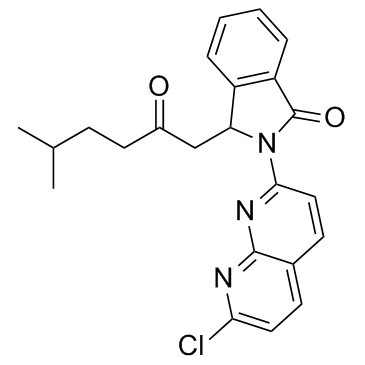
Physicochemical Properties
| Molecular Formula | C23H22CLN3O2 |
| Molecular Weight | 407.898 |
| Exact Mass | 407.14 |
| CAS # | 133737-32-3 |
| PubChem CID | 131664 |
| Appearance | White to off-white solid powder |
| Density | 1.273g/cm3 |
| Boiling Point | 582.1ºC at 760mmHg |
| Flash Point | 305.9ºC |
| Vapour Pressure | 1.53E-13mmHg at 25°C |
| Index of Refraction | 1.625 |
| LogP | 5.445 |
| Hydrogen Bond Donor Count | 0 |
| Hydrogen Bond Acceptor Count | 4 |
| Rotatable Bond Count | 6 |
| Heavy Atom Count | 29 |
| Complexity | 613 |
| Defined Atom Stereocenter Count | 0 |
| InChi Key | HIUPRQPBWVEQJJ-UHFFFAOYSA-N |
| InChi Code | InChI=1S/C23H22ClN3O2/c1-14(2)7-10-16(28)13-19-17-5-3-4-6-18(17)23(29)27(19)21-12-9-15-8-11-20(24)25-22(15)26-21/h3-6,8-9,11-12,14,19H,7,10,13H2,1-2H3 |
| Chemical Name | 2-(7-chloro-1,8-naphthyridin-2-yl)-3-(5-methyl-2-oxohexyl)-3H-isoindol-1-one |
| Synonyms | IP-456; CI-1043; Pagoclone |
| HS Tariff Code | 2934.99.9001 |
| Storage |
Powder-20°C 3 years 4°C 2 years In solvent -80°C 6 months -20°C 1 month |
| Shipping Condition | Room temperature (This product is stable at ambient temperature for a few days during ordinary shipping and time spent in Customs) |
Biological Activity
| ln Vitro | The affinity of goclone for recombinant human GABAA receptors with α1, α2, α3, or α5 subunits is high and about similar (Ki = 0.7-9.1 nM). With an EC50 of 3.1-6.6 nM, pagoclone has strong agonist action at all four diazepam-sensitive GABAA receptor subtypes [1]. |
| ln Vivo | At all three tested doses (0.3, 1, and 3 mg/kg, po), goclone dramatically decreased total distance walked, although it also demonstrated considerable anxiolytic-like effects. Arm open time increased dose-dependently when compared to controls when using pagoclone (3 mg/kg, po). In response sensitivity tests, the cumulative chain pull reaction is decreased by pagoclone (1, 3, or 10 mg/kg). The concentrations of paragolone in plasma were shown to be dose-dependent and non-linear, with values of 0.4±0.1, 1.1±0.2, and 2.2±0.2 ng/mL, respectively. In rats, dosage-dependent reductions in locomotor activity are observed with goclone (0.3, 1 or 3 mg/kg) [1]. |
| References |
[1]. The in vivo properties of pagoclone in rat are most likely mediated by 5'-hydroxy pagoclone. Neuropharmacology. 2006 May;50(6):677-89. |
| Additional Infomation |
Pagoclone is an anxiolytic drug from the cyclopyrrolone family, which is related to other more well known drugs such as the sleeping medication zopiclone. It is one of a relatively recently developed class of medicines known as the nonbenzodiazepines, which have similar effects to the older benzodiazepine group, but with quite different chemical structures. Drug Indication For the potential treatment of panic and anxiety disorders. Mechanism of Action Pagoclone is a subtype-selective drug which binds primarily to the alpha2/alpha3 subtypes of the GABAA receptor which are responsible for the anti-anxiety effects of these kind of drugs, but has relatively little efficacy at the alpha1 subtype which produces the sedative and memory loss effects. Pharmacodynamics Pagoclone was originally developed as an anti-anxiety drug, but never commercialised. It is a partial agonist acting at GABAA receptors in the brain. In contrast to zopiclone, pagoclone produces anxiolytic effects with little or no sedative or amnestic actions at low doses. |
Solubility Data
| Solubility (In Vitro) | DMSO : ~10 mg/mL (~24.52 mM) |
| Solubility (In Vivo) |
Solubility in Formulation 1: 1 mg/mL (2.45 mM) in 10% DMSO + 40% PEG300 + 5% Tween80 + 45% Saline (add these co-solvents sequentially from left to right, and one by one), suspension solution; with sonication. For example, if 1 mL of working solution is to be prepared, you can add 100 μL of 10.0 mg/mL clear DMSO stock solution to 400 μL of PEG300 and mix evenly; then add 50 μL of Tween-80 to the above solution and mix evenly; then add 450 μL of normal saline to adjust the volume to 1 mL. Preparation of saline: Dissolve 0.9 g of sodium chloride in 100 mL ddH₂ O to obtain a clear solution. Solubility in Formulation 2: ≥ 1 mg/mL (2.45 mM) (saturation unknown) in 10% DMSO + 90% Corn Oil (add these co-solvents sequentially from left to right, and one by one), clear solution. For example, if 1 mL of working solution is to be prepared, you can add 100 μL of 10.0 mg/mL clear DMSO stock solution to 900 μL of corn oil and mix evenly. (Please use freshly prepared in vivo formulations for optimal results.) |
| Preparing Stock Solutions | 1 mg | 5 mg | 10 mg | |
| 1 mM | 2.4516 mL | 12.2579 mL | 24.5158 mL | |
| 5 mM | 0.4903 mL | 2.4516 mL | 4.9032 mL | |
| 10 mM | 0.2452 mL | 1.2258 mL | 2.4516 mL |