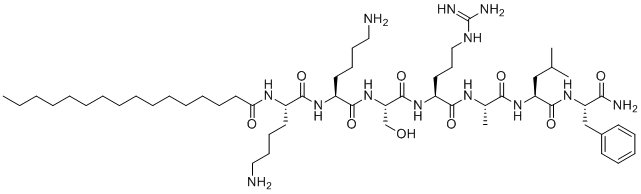
PZ-128 (PZ128; P1pal-7) is a novel and potent PAR1 (protease-activated receptor-1) antagonist with antiplatelet, anti-metastatic, anti-angiogenic and anticancer activity and has the potential for the treatment of thrombosis. As a cell-penetrating lipopeptide pepducin, PZ-128 targets the cytoplasmic surface of PAR1 and interrupts signaling to internally-located G (PAR1-G) proteins.
Physicochemical Properties
| Molecular Formula | C55H99N13O9 |
| Molecular Weight | 1086.47 |
| Exact Mass | 1085.768 |
| CAS # | 371131-16-7 |
| PubChem CID | 72187679 |
| Appearance | White to off-white solid powder |
| Density | 1.2±0.1 g/cm3 |
| Index of Refraction | 1.585 |
| LogP | 4.95 |
| Hydrogen Bond Donor Count | 13 |
| Hydrogen Bond Acceptor Count | 12 |
| Rotatable Bond Count | 45 |
| Heavy Atom Count | 77 |
| Complexity | 1750 |
| Defined Atom Stereocenter Count | 7 |
| SMILES | CCCCCCCCCCCCCCCC(=O)N[C@@H](CCCCN)C(=O)N[C@@H](CCCCN)C(=O)N[C@@H](CO)C(=O)N[C@@H](CCCN=C(N)N)C(=O)N[C@@H](C)C(=O)N[C@@H](CC(C)C)C(=O)N[C@@H](CC1=CC=CC=C1)C(=O)N |
| InChi Key | VZRIKWNVDCTBTF-BKGFHLQYSA-N |
| InChi Code | InChI=1S/C55H99N13O9/c1-5-6-7-8-9-10-11-12-13-14-15-16-20-31-47(70)63-41(28-21-23-32-56)51(74)64-42(29-22-24-33-57)52(75)68-46(37-69)54(77)65-43(30-25-34-61-55(59)60)50(73)62-39(4)49(72)67-45(35-38(2)3)53(76)66-44(48(58)71)36-40-26-18-17-19-27-40/h17-19,26-27,38-39,41-46,69H,5-16,20-25,28-37,56-57H2,1-4H3,(H2,58,71)(H,62,73)(H,63,70)(H,64,74)(H,65,77)(H,66,76)(H,67,72)(H,68,75)(H4,59,60,61)/t39-,41-,42-,43-,44-,45-,46-/m0/s1 |
| Chemical Name | N-[(2S)-6-amino-1-[[(2S)-6-amino-1-[[(2S)-1-[[(2S)-1-[[(2S)-1-[[(2S)-1-[[(2S)-1-amino-1-oxo-3-phenylpropan-2-yl]amino]-4-methyl-1-oxopentan-2-yl]amino]-1-oxopropan-2-yl]amino]-5-(diaminomethylideneamino)-1-oxopentan-2-yl]amino]-3-hydroxy-1-oxopropan-2-yl]amino]-1-oxohexan-2-yl]amino]-1-oxohexan-2-yl]hexadecanamide |
| Synonyms | PZ 128 PZ128 PZ-128 |
| HS Tariff Code | 2934.99.9001 |
| Storage |
Powder-20°C 3 years 4°C 2 years In solvent -80°C 6 months -20°C 1 month Note: Please store this product in a sealed and protected environment, avoid exposure to moisture. |
| Shipping Condition | Room temperature (This product is stable at ambient temperature for a few days during ordinary shipping and time spent in Customs) |
Biological Activity
| ln Vitro | Ninety-nine percent of OVCAR-4 migration into human ovarian ascites and fibroblast-conditioned media is blocked by PZ-128 (P1pal-7; 3 μM). PZ-128 nearly entirely reduced the 2.2-fold increase in endothelial barrier permeability seen in conditioned media of peritoneal fibroblasts treated with OVCAR4 [1]. Targeting the cytoplasmic surface of PAR1, PZ-128 is a lipidated "pepducin" that obstructs internal G protein signaling. PZ-128's structure was discovered to replicate the closed state of PAR1's equivalent intracellular region, which is essential for coupling to G proteins [3]. |
| ln Vivo | PZ-128 (P1pal-7; 10 mg/kg; intraperitoneal injection; every other day; for 6 weeks) treatment significantly reduced mean ascites volume by 60%. PZ-128 treatment also resulted in a significant 84-96% reduction in vessel density in the center and edges of OVCAR-4 tumors [1]. |
| Animal Protocol |
Animal/Disease Models: Female NCR Nu/nu (nude) mice (5-7 weeks) injected with OVCAR-4 or SKOV-3 cells [1] Doses: 10 mg/kg Route of Administration: intraperitoneal (ip) injection; every other day; for 6 weeks Experimental Results: The average ascites volume was Dramatically diminished by 60%. |
| References |
[1]. Targeting a metalloprotease-PAR1 signaling system with cell-penetrating pepducins inhibits angiogenesis, ascites, and progression of ovarian cancer. Mol Cancer Ther. 2008 Sep;7(9):2746-57. [2]. Protease-Activated Receptor 1 as Therapeutic Target in Breast, Lung, and Ovarian Cancer: Pepducin Approach. Int J Mol Sci. 2018 Jul 31;19(8):2237. [3]. Suppression of arterial thrombosis without affecting hemostatic parameters with a cell-penetrating PAR1 pepducin. Circulation. 2012 Jul 3;126(1):83-91. [4]. Cell-Penetrating Pepducin Therapy Targeting PAR1 in Subjects With Coronary Artery Disease. Arterioscler Thromb Vasc Biol. 2016 Jan;36(1):189-97. |
| Additional Infomation | PZ-128 has been used in trials studying the prevention and treatment of Heart Diseases, Coronary Disease, Arteriosclerosis, Vascular Diseases, and Myocardial Ischemia, among others. |
Solubility Data
| Solubility (In Vitro) | DMSO : ~100 mg/mL (~92.04 mM) |
| Solubility (In Vivo) |
Solubility in Formulation 1: ≥ 2.5 mg/mL (2.30 mM) (saturation unknown) in 10% DMSO + 40% PEG300 + 5% Tween80 + 45% Saline (add these co-solvents sequentially from left to right, and one by one), clear solution. For example, if 1 mL of working solution is to be prepared, you can add 100 μL of 25.0 mg/mL clear DMSO stock solution to 400 μL PEG300 and mix evenly; then add 50 μL Tween-80 to the above solution and mix evenly; then add 450 μL normal saline to adjust the volume to 1 mL. Preparation of saline: Dissolve 0.9 g of sodium chloride in 100 mL ddH₂ O to obtain a clear solution. Solubility in Formulation 2: ≥ 2.5 mg/mL (2.30 mM) (saturation unknown) in 10% DMSO + 90% (20% SBE-β-CD in Saline) (add these co-solvents sequentially from left to right, and one by one), clear solution. For example, if 1 mL of working solution is to be prepared, you can add 100 μL of 25.0 mg/mL clear DMSO stock solution to 900 μL of 20% SBE-β-CD physiological saline solution and mix evenly. Preparation of 20% SBE-β-CD in Saline (4°C,1 week): Dissolve 2 g SBE-β-CD in 10 mL saline to obtain a clear solution. Solubility in Formulation 3: ≥ 2.5 mg/mL (2.30 mM) (saturation unknown) in 10% DMSO + 90% Corn Oil (add these co-solvents sequentially from left to right, and one by one), clear solution. For example, if 1 mL of working solution is to be prepared, you can add 100 μL of 25.0 mg/mL clear DMSO stock solution to 900 μL of corn oil and mix evenly. (Please use freshly prepared in vivo formulations for optimal results.) |
| Preparing Stock Solutions | 1 mg | 5 mg | 10 mg | |
| 1 mM | 0.9204 mL | 4.6021 mL | 9.2041 mL | |
| 5 mM | 0.1841 mL | 0.9204 mL | 1.8408 mL | |
| 10 mM | 0.0920 mL | 0.4602 mL | 0.9204 mL |