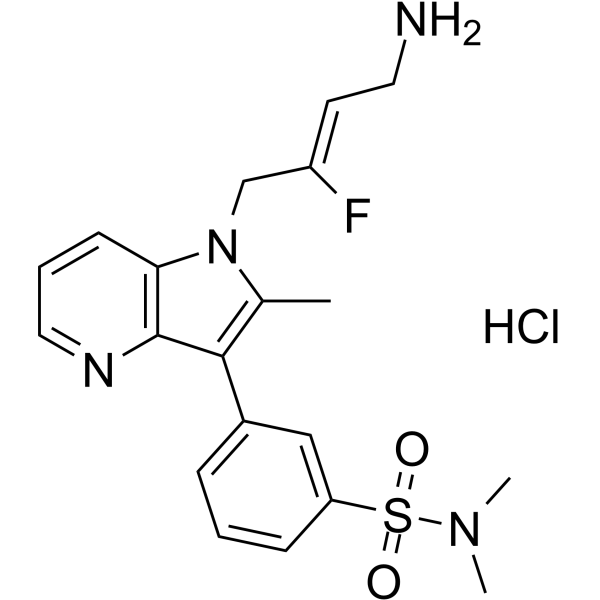
Physicochemical Properties
| Molecular Formula | C20H24CLFN4O2S |
| Molecular Weight | 438.95 |
| Related CAS # | PXS-5153A;2125956-82-1 |
| Appearance | Off-white to yellow solid powder |
| HS Tariff Code | 2934.99.9001 |
| Storage |
Powder-20°C 3 years 4°C 2 years In solvent -80°C 6 months -20°C 1 month Note: Please store this product in a sealed and protected environment, avoid exposure to moisture. |
| Shipping Condition | Room temperature (This product is stable at ambient temperature for a few days during ordinary shipping and time spent in Customs) |
Biological Activity
| ln Vitro | For LOXL2, PXS-5153A monohydrochloride exhibits an IC50 of less than 40 nM in all tested mammalian species. With an IC50 of 63 nM, PXS-5153A monohydrochloride also inhibits human LOXL3. More than 700 times more selective than other comparable amine oxidases, PXS-5153A monohydrochloride is more than 40 times more selective for LOXL2 than LOX and LOXL1. The fast-acting inhibitor PXS-5153A monohydrochloride blocks enzyme activity almost entirely in 15 minutes [1]. |
| ln Vivo | PXS-5153A monohydrochloride dose-dependently inhibited collagen oxidation, whereas rhLOXL2 dose-dependently promoted it. When compared to animals treated with CCl4, treatment with PXS-5153A monohydrochloride dramatically decreased the production of immature cross-links. The treatment with PXS-5153A monohydrochloride also decreased the amount of mature cross-links that formed. When comparing the DHLNL formation of all groups receiving PXS-5153A monohydrochloride to the animals treated with CCl4, a substantial reduction was observed. When HYP was treated with PXS-5153A monohydrochloride, it was much lower than in the CCl4 group. Additionally, a 2.2-fold increase in the proportion of Sirius red stained area covered indicates that the disease considerably increases the amount of fibrillar collagen, whereas PXS-5153A decreases the area covered [1]. |
| References |
[1]. The lysyl oxidase like 2/3 enzymatic inhibitor, PXS-5153A, reduces crosslinks and ameliorates fibrosis. J Cell Mol Med. 2018 Dec 9. |
Solubility Data
| Solubility (In Vitro) | DMSO :~125 mg/mL (~284.77 mM) |
| Solubility (In Vivo) |
Solubility in Formulation 1: ≥ 2.08 mg/mL (4.74 mM) (saturation unknown) in 10% DMSO + 40% PEG300 + 5% Tween80 + 45% Saline (add these co-solvents sequentially from left to right, and one by one), clear solution. For example, if 1 mL of working solution is to be prepared, you can add 100 μL of 20.8 mg/mL clear DMSO stock solution to 400 μL PEG300 and mix evenly; then add 50 μL Tween-80 to the above solution and mix evenly; then add 450 μL normal saline to adjust the volume to 1 mL. Preparation of saline: Dissolve 0.9 g of sodium chloride in 100 mL ddH₂ O to obtain a clear solution. Solubility in Formulation 2: ≥ 2.08 mg/mL (4.74 mM) (saturation unknown) in 10% DMSO + 90% (20% SBE-β-CD in Saline) (add these co-solvents sequentially from left to right, and one by one), clear solution. For example, if 1 mL of working solution is to be prepared, you can add 100 μL of 20.8 mg/mL clear DMSO stock solution to 900 μL of 20% SBE-β-CD physiological saline solution and mix evenly. Preparation of 20% SBE-β-CD in Saline (4°C,1 week): Dissolve 2 g SBE-β-CD in 10 mL saline to obtain a clear solution. Solubility in Formulation 3: ≥ 2.08 mg/mL (4.74 mM) (saturation unknown) in 10% DMSO + 90% Corn Oil (add these co-solvents sequentially from left to right, and one by one), clear solution. For example, if 1 mL of working solution is to be prepared, you can add 100 μL of 20.8 mg/mL clear DMSO stock solution to 900 μL of corn oil and mix evenly. (Please use freshly prepared in vivo formulations for optimal results.) |
| Preparing Stock Solutions | 1 mg | 5 mg | 10 mg | |
| 1 mM | 2.2782 mL | 11.3908 mL | 22.7816 mL | |
| 5 mM | 0.4556 mL | 2.2782 mL | 4.5563 mL | |
| 10 mM | 0.2278 mL | 1.1391 mL | 2.2782 mL |