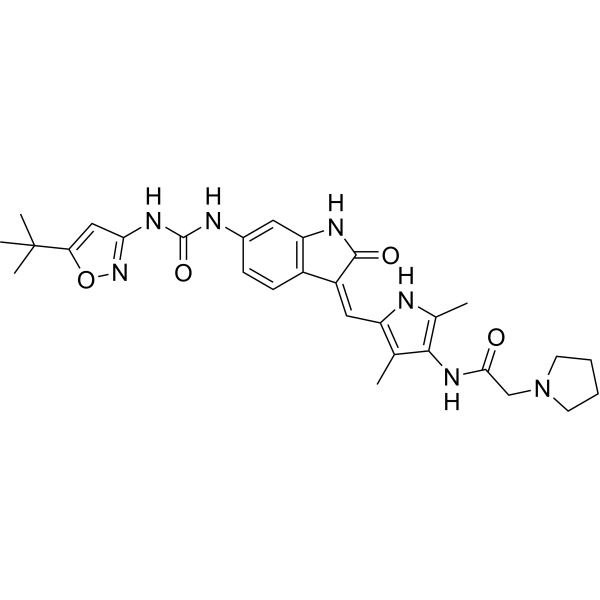
Physicochemical Properties
| Molecular Formula | C29H35N7O4 |
| Molecular Weight | 545.63 |
| Appearance | Typically exists as solid at room temperature |
| HS Tariff Code | 2934.99.9001 |
| Storage |
Powder-20°C 3 years 4°C 2 years In solvent -80°C 6 months -20°C 1 month |
| Shipping Condition | Room temperature (This product is stable at ambient temperature for a few days during ordinary shipping and time spent in Customs) |
Biological Activity
| ln Vitro | PXB17 (30 - 3000 nM; 4 h) increased the stability of CSF1R in a dose-dependent manner[1]. PXB17 (30, 100 nM; 24 h) inhibited cholesterol biosynthesis and promoted the conversion of M2 phenotype to M1 phenotype by blocking PI3K-AKT-mTORC1 signaling, thereby preventing the development of CRC[1]. PXB17 (10, 30, 100nM; 72 h) increased the expression of CD69 in CD8+T cells. It prevented the growth of CRC cells by enhancing anti-tumor immunity[1]. Real Time qPCR[1] Cell Line: BMDMs Concentration: 10, 30, 100nM Incubation Time: 24 h Result: PXB17 shifted macrophages from an M2-like to an M1-like phenotype, indicated by changes in marker gene expression. The ability of PXB17 to reprogram macrophages suggests a role in enhancing anti-tumor immunity by converting immunosuppressive M2 macrophages into pro-inflammatory M1 macrophages , which are more capable of attacking tumor cells. |
| ln Vivo | PXB17 (10, 20 mg/kg; po; daily) effectively inhibited tumor growth in C57BL/6 mice inoculated with MC-38 cells[1]. PXB17 (10, 20 mg/kg; po; daily) was found to affect the survival and proliferation of tumor cells by directly inhibiting CSF1R and regulating the cholesterol biosynthesis pathway in C57BL/6 and BALB/c mice inoculated with MC-38 cells, and remodeled the tumor microenvironment by changing the phenotype of macrophages[1]. The simultaneous use of PXB17 (20 mg/kg; po; daily) and PD-1 mAb improved the anti-tumor effect and reduced recurrence in CT-26(MSS) and MC-38(MSI-H) mice[1]. |
| Cell Assay |
Immunofluorescence[1] Cell Types: BMDMs Concentration: 10, 30,100 nM Incubation Duration: 4 h Experimental Results: PXB17 significantly inhibited CSF1R phosphorylation across all tested concentrations. |
| Animal Protocol |
Animal/Disease Models:mice were inoculated with MC-38 cell [1] Doses: 10,20 mg/kg; daily Route of Administration: p.o. Experimental Results: PXB17 significantly inhibited tumor growth and showed stronger anti-tumor effects at a dose of 20 mg/kg compared with PLX3397 (HY-16749). Meanwhile, tumor cell apoptosis was significantly increased in the PXB17-treated group, reprogramming of M2-type to M1-type macrophages, and enhanced activation and infiltration of CD8+ T cells. |
| References |
[1]. Qi L et al. CSF1R inhibition reprograms tumor-associated macrophages to potentiate anti-PD-1 therapy efficacy against colorectal cancer Pharmacological Research 202 (2024) 107126. |
Solubility Data
| Solubility (In Vitro) | May dissolve in DMSO (in most cases), if not, try other solvents such as H2O, Ethanol, or DMF with a minute amount of products to avoid loss of samples |
| Solubility (In Vivo) |
Note: Listed below are some common formulations that may be used to formulate products with low water solubility (e.g. < 1 mg/mL), you may test these formulations using a minute amount of products to avoid loss of samples. Injection Formulations (e.g. IP/IV/IM/SC) Injection Formulation 1: DMSO : Tween 80: Saline = 10 : 5 : 85 (i.e. 100 μL DMSO stock solution → 50 μL Tween 80 → 850 μL Saline) *Preparation of saline: Dissolve 0.9 g of sodium chloride in 100 mL ddH ₂ O to obtain a clear solution. Injection Formulation 2: DMSO : PEG300 :Tween 80 : Saline = 10 : 40 : 5 : 45 (i.e. 100 μL DMSO → 400 μLPEG300 → 50 μL Tween 80 → 450 μL Saline) Injection Formulation 3: DMSO : Corn oil = 10 : 90 (i.e. 100 μL DMSO → 900 μL Corn oil) Example: Take the Injection Formulation 3 (DMSO : Corn oil = 10 : 90) as an example, if 1 mL of 2.5 mg/mL working solution is to be prepared, you can take 100 μL 25 mg/mL DMSO stock solution and add to 900 μL corn oil, mix well to obtain a clear or suspension solution (2.5 mg/mL, ready for use in animals). Injection Formulation 4: DMSO : 20% SBE-β-CD in saline = 10 : 90 [i.e. 100 μL DMSO → 900 μL (20% SBE-β-CD in saline)] *Preparation of 20% SBE-β-CD in Saline (4°C,1 week): Dissolve 2 g SBE-β-CD in 10 mL saline to obtain a clear solution. Injection Formulation 5: 2-Hydroxypropyl-β-cyclodextrin : Saline = 50 : 50 (i.e. 500 μL 2-Hydroxypropyl-β-cyclodextrin → 500 μL Saline) Injection Formulation 6: DMSO : PEG300 : castor oil : Saline = 5 : 10 : 20 : 65 (i.e. 50 μL DMSO → 100 μLPEG300 → 200 μL castor oil → 650 μL Saline) Injection Formulation 7: Ethanol : Cremophor : Saline = 10: 10 : 80 (i.e. 100 μL Ethanol → 100 μL Cremophor → 800 μL Saline) Injection Formulation 8: Dissolve in Cremophor/Ethanol (50 : 50), then diluted by Saline Injection Formulation 9: EtOH : Corn oil = 10 : 90 (i.e. 100 μL EtOH → 900 μL Corn oil) Injection Formulation 10: EtOH : PEG300:Tween 80 : Saline = 10 : 40 : 5 : 45 (i.e. 100 μL EtOH → 400 μLPEG300 → 50 μL Tween 80 → 450 μL Saline) Oral Formulations Oral Formulation 1: Suspend in 0.5% CMC Na (carboxymethylcellulose sodium) Oral Formulation 2: Suspend in 0.5% Carboxymethyl cellulose Example: Take the Oral Formulation 1 (Suspend in 0.5% CMC Na) as an example, if 100 mL of 2.5 mg/mL working solution is to be prepared, you can first prepare 0.5% CMC Na solution by measuring 0.5 g CMC Na and dissolve it in 100 mL ddH2O to obtain a clear solution; then add 250 mg of the product to 100 mL 0.5% CMC Na solution, to make the suspension solution (2.5 mg/mL, ready for use in animals). Oral Formulation 3: Dissolved in PEG400 Oral Formulation 4: Suspend in 0.2% Carboxymethyl cellulose Oral Formulation 5: Dissolve in 0.25% Tween 80 and 0.5% Carboxymethyl cellulose Oral Formulation 6: Mixing with food powders Note: Please be aware that the above formulations are for reference only. InvivoChem strongly recommends customers to read literature methods/protocols carefully before determining which formulation you should use for in vivo studies, as different compounds have different solubility properties and have to be formulated differently. (Please use freshly prepared in vivo formulations for optimal results.) |
| Preparing Stock Solutions | 1 mg | 5 mg | 10 mg | |
| 1 mM | 1.8327 mL | 9.1637 mL | 18.3274 mL | |
| 5 mM | 0.3665 mL | 1.8327 mL | 3.6655 mL | |
| 10 mM | 0.1833 mL | 0.9164 mL | 1.8327 mL |