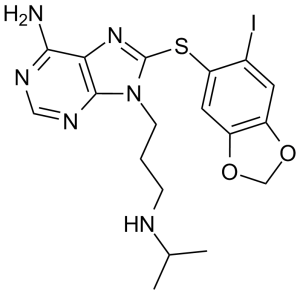
This product has been discontinued from InvivoChem. PU-H71 (also known as NSC-750424; PU-H-71) is a novel, highly potent and selective inhibitor of HSP90 with anticancer activity. It inhibits HSP90 with IC50 of 51 nM. PU-H71 showed anti-tumor effects in TNBC xenografts, including complete response and tumor regression, without toxicity to the host are achieved with this agent. PU-H71 induces efficient and sustained downregulation and inactivation, both in vitro and in vivo, of these proteins.
Physicochemical Properties
| Molecular Formula | C18H21IN6O2S | |
| Molecular Weight | 512.37 | |
| Exact Mass | 512.049 | |
| CAS # | 873436-91-0 | |
| Related CAS # | Zelavespib hydrochloride | |
| PubChem CID | 9549213 | |
| Appearance | White to off-white solid powder | |
| Density | 1.8±0.1 g/cm3 | |
| Boiling Point | 650.6±65.0 °C at 760 mmHg | |
| Flash Point | 347.3±34.3 °C | |
| Vapour Pressure | 0.0±1.9 mmHg at 25°C | |
| Index of Refraction | 1.777 | |
| LogP | 4.11 | |
| Hydrogen Bond Donor Count | 2 | |
| Hydrogen Bond Acceptor Count | 8 | |
| Rotatable Bond Count | 7 | |
| Heavy Atom Count | 28 | |
| Complexity | 521 | |
| Defined Atom Stereocenter Count | 0 | |
| InChi Key | SUPVGFZUWFMATN-UHFFFAOYSA-N | |
| InChi Code | InChI=1S/C18H21IN6O2S/c1-10(2)21-4-3-5-25-17-15(16(20)22-8-23-17)24-18(25)28-14-7-13-12(6-11(14)19)26-9-27-13/h6-8,10,21H,3-5,9H2,1-2H3,(H2,20,22,23) | |
| Chemical Name | 8-[(6-iodo-1,3-benzodioxol-5-yl)sulfanyl]-9-[3-(propan-2-ylamino)propyl]purin-6-amine | |
| Synonyms |
|
|
| HS Tariff Code | 2934.99.9001 | |
| Storage |
Powder-20°C 3 years 4°C 2 years In solvent -80°C 6 months -20°C 1 month |
|
| Shipping Condition | Room temperature (This product is stable at ambient temperature for a few days during ordinary shipping and time spent in Customs) |
Biological Activity
| ln Vitro | Zelavespib is a strong Hsp90 product with an IC50 of 51 nM in MDA-MB-468 cells. Zelavespib inhibits the growth of multiple tumor cells, such as MDA-MB-468, MDA-MB-231, and HCC-1806 cells, with IC50s of 65 ± 8 nM, 140 ± 5 nM, and 87 ± 3 nM, respectively. This inhibition is consistent with G2-M blockade associated. Zelavespib (10-1000 nM) can significantly induce triple-negative breast cancer (TNBC). Zelavespib (0.5, 1 μM) can also induce potential cancer proteins in TNBC [1]. Zelavespib (0.5 μM) reduces and senescence BCR signaling disruption. Zelavespib (0.25-10 μM) is cytotoxic to CLL cells. Additionally, Zelavespib (0-1μM) reduces CLL viability by inducing mitochondria and antagonizes survival signals from the CLL microenvironment at 0.5 μM [2]. Zelavespib (0.05 μM) induces MDA-MB-231, BT-474, and MCF7 cells, and TNF-α enhances this induction. Zelavespib (0.05 μM) promotes IKKβ and activates NF-κB activity induced by TNF-α processing [3]. | ||
| ln Vivo | In MDA-MB-468 tumor-bearing mice, zelavespib (75 mg/kg, i.p.) resulted in intratumoral accumulation, extended downregulation of antitumor driving molecules, and completed and retained responses at nontoxic levels. Zelavespib (75 mg/kg, intraperitoneally, for 3 weeks) slows the growth of tumors; this action is linked to the downregulation of several malignant kinesins regulated by Hsp90 [1]. | ||
| Animal Protocol |
|
||
| References |
[1]. Hsp90 inhibitor PU-H71, a multimodal inhibitor of malignancy, induces complete responses in triple-negative breast cancer models. Proc Natl Acad Sci U S A. 2009 May 19;106(20):8368-73. [2]. HSP90 stabilizes B-cell receptor kinases in a multi-client interactome: PU-H71 induces CLL apoptosis in a cytoprotective microenvironment. Oncogene. 2017 Jun 15;36(24):3441-3449. [3]. PU-H71 effectively induces degradation of IκB kinase β in the presence of TNF-α. Mol Cell Biochem. 2014 Jan;386(1-2):135-42. |
||
| Additional Infomation |
Zelavespib (PU-H71) has been used in trials studying the treatment of LYMPHOMA, Solid Tumors, Metastatic Solid Tumor, and Myeloproliferative Neoplasms (MPN). Zelavespib is a purine-based heat shock protein 90 (Hsp90) inhibitor with potential antineoplastic activity. Zelavespib specifically inhibits active Hsp90, thereby inhibiting its chaperone function and promoting the proteasomal degradation of oncogenic signaling proteins involved in tumor cell proliferation and survival. This may result in the inhibition of cellular proliferation in susceptible tumor cell populations. Hsp90, a molecular chaperone protein, is upregulated in a variety of tumor cell types. |
Solubility Data
| Solubility (In Vitro) |
|
|||
| Solubility (In Vivo) |
Solubility in Formulation 1: ≥ 2.5 mg/mL (4.88 mM) (saturation unknown) in 10% DMSO + 40% PEG300 + 5% Tween80 + 45% Saline (add these co-solvents sequentially from left to right, and one by one), clear solution. For example, if 1 mL of working solution is to be prepared, you can add 100 μL of 25.0 mg/mL clear DMSO stock solution to 400 μL PEG300 and mix evenly; then add 50 μL Tween-80 to the above solution and mix evenly; then add 450 μL normal saline to adjust the volume to 1 mL. Preparation of saline: Dissolve 0.9 g of sodium chloride in 100 mL ddH₂ O to obtain a clear solution. Solubility in Formulation 2: ≥ 2.5 mg/mL (4.88 mM) (saturation unknown) in 10% DMSO + 90% (20% SBE-β-CD in Saline) (add these co-solvents sequentially from left to right, and one by one), clear solution. For example, if 1 mL of working solution is to be prepared, you can add 100 μL of 25.0 mg/mL clear DMSO stock solution to 900 μL of 20% SBE-β-CD physiological saline solution and mix evenly. Preparation of 20% SBE-β-CD in Saline (4°C,1 week): Dissolve 2 g SBE-β-CD in 10 mL saline to obtain a clear solution. Solubility in Formulation 3: ≥ 2.5 mg/mL (4.88 mM) (saturation unknown) in 10% DMSO + 90% Corn Oil (add these co-solvents sequentially from left to right, and one by one), clear solution. For example, if 1 mL of working solution is to be prepared, you can add 100 μL of 25.0 mg/mL clear DMSO stock solution to 900 μL of corn oil and mix evenly. (Please use freshly prepared in vivo formulations for optimal results.) |
| Preparing Stock Solutions | 1 mg | 5 mg | 10 mg | |
| 1 mM | 1.9517 mL | 9.7586 mL | 19.5171 mL | |
| 5 mM | 0.3903 mL | 1.9517 mL | 3.9034 mL | |
| 10 mM | 0.1952 mL | 0.9759 mL | 1.9517 mL |