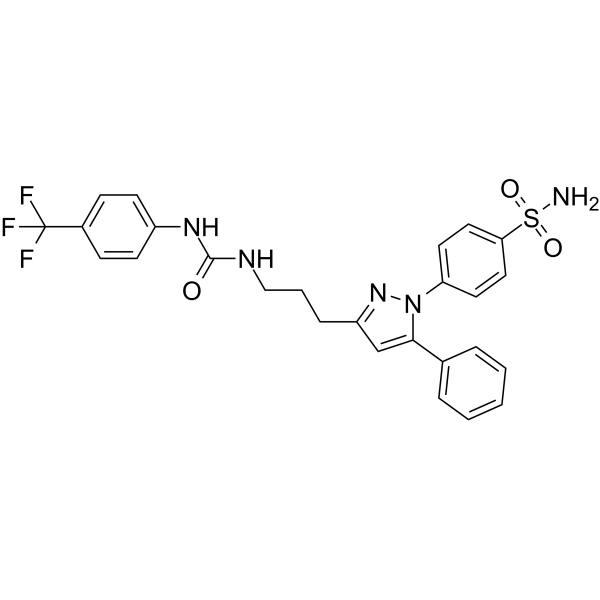
PTUPB is a novel and potent dual inhibitor of sEH and COX-2 enzymes which can decrease inflammatory and oxidative stress markers in ZDF rats. It inhibits dual targets with IC50 of 1.26 uM/0.9 nM, and does not inhibit COX-1 (IC50>100 uM).
Physicochemical Properties
| Molecular Formula | C26H24F3N5O3S |
| Molecular Weight | 543.560674667358 |
| Exact Mass | 543.155 |
| CAS # | 1287761-01-6 |
| PubChem CID | 52951990 |
| Appearance | White to off-white solid powder |
| Density | 1.4±0.1 g/cm3 |
| Index of Refraction | 1.626 |
| LogP | 4.91 |
| Hydrogen Bond Donor Count | 3 |
| Hydrogen Bond Acceptor Count | 8 |
| Rotatable Bond Count | 8 |
| Heavy Atom Count | 38 |
| Complexity | 862 |
| Defined Atom Stereocenter Count | 0 |
| InChi Key | CSEPEVFNTFMBAE-UHFFFAOYSA-N |
| InChi Code | InChI=1S/C26H24F3N5O3S/c27-26(28,29)19-8-10-20(11-9-19)32-25(35)31-16-4-7-21-17-24(18-5-2-1-3-6-18)34(33-21)22-12-14-23(15-13-22)38(30,36)37/h1-3,5-6,8-15,17H,4,7,16H2,(H2,30,36,37)(H2,31,32,35) |
| Chemical Name | 1-[3-[5-phenyl-1-(4-sulfamoylphenyl)pyrazol-3-yl]propyl]-3-[4-(trifluoromethyl)phenyl]urea |
| HS Tariff Code | 2934.99.9001 |
| Storage |
Powder-20°C 3 years 4°C 2 years In solvent -80°C 6 months -20°C 1 month |
| Shipping Condition | Room temperature (This product is stable at ambient temperature for a few days during ordinary shipping and time spent in Customs) |
Biological Activity
| ln Vitro | PTUPB (1–10 μM; 24 hours) shows inhibitory efficacy against human 5-LOX, showing 83% and 44% inhibitory activity at 1 μM and 10 μM, respectively [1]. PTUPB (10-20) efficiently reduces the proliferation of HUVECs after 3 days of treatment, although it has negligible inhibitory effects on the proliferation of several blue lineages, including human melanoma cells and transformed endothelial cells [1]. Under varying conditions, μM; 72 hours) causes cell cycle induction in the G0/1 phase. PTUPB cell number percentages were 65.15%, 66.87%, and 65.91% at 10 μM, 15 μM, and 20 μM, respectively[1]. |
| ln Vivo | In comparison to heart rate, PTUPB (subcutaneous injection; 30 mg/kg; 4 weeks) reduced LLC tumor growth by 70–83% and showed no overt effects, such as weight loss. Following a course of treatment, peak plasma concentrations of PTUPB (subcutaneous injection; once daily; 5 mg/kg) improved non-alcoholic fatty liver disease caused by a high-fat diet by blocking the activation of the NLRP3 inflammasome. It can lower myocardial weight, body weight, and the expression of genes linked to nutrition. It can also break down fat or lipogenesis [2]. |
| Cell Assay |
Cell Viability Assay[1] Cell Types: Multiple cancer Cell Types: PC-3 cells, Met-1, H-1, A375, and transformed endothelial cell line (bEnd.3) Tested Concentrations: 10 μM, 15 μM and 20 μM Incubation Duration: 72 hour Experimental Results: Inhibited HUVEC proliferation after 3 days. Cell cycle analysis[1] Cell Types: HUVEC Tested Concentrations: 10 μM, 15 μM and 20 μM Incubation Duration: 72 hrs (hours) Experimental Results: Induced cell cycle arrest in G0/1 phase. |
| Animal Protocol |
Animal/Disease Models: C57BL/6 mice with LLC cells [1] Doses: 30 mg/kg; triglyceride and cholesterol content. 4-week dosing: subcutaneous injection via Alzet mini-osmotic pump; one time/day; 4-week Experimental Results: Inhibition of LLC tumor growth and metastasis. Animal/Disease Models: High-fat diet (HFD)-induced obese male C57BL/6 mice [2] Doses: 5 mg/kg; 12-week Route of Administration: subcutaneous injection; one time/day; 12-week Experimental Results: fibrosis progression was inhibited, high Fatty diet-induced non-alcoholic fatty liver disease is improved. |
| References |
[1]. PTUPB ameliorates high-fat diet-induced non-alcoholic fatty liver disease via inhibiting NLRP3 inflammasome activation in mice. Biochem Biophys Res Commun. 2020 Mar 19;523(4):1020-1026. [2]. Dual inhibition of cyclooxygenase-2 and soluble epoxide hydrolase synergistically suppresses primary tumor growth and metastasis. Proc Natl Acad Sci U S A. 2014 Jul 29;111(30):11127-32. [3]. Synthesis and structure-activity relationship studies of urea-containing pyrazoles as dual inhibitors of cyclooxygenase-2 and soluble epoxide hydrolase.J Med Chem. 2011 Apr 28;54(8):3037-50. |
Solubility Data
| Solubility (In Vitro) | DMSO : ~100 mg/mL (~183.97 mM) |
| Solubility (In Vivo) |
Solubility in Formulation 1: ≥ 2.08 mg/mL (3.83 mM) (saturation unknown) in 10% DMSO + 40% PEG300 + 5% Tween80 + 45% Saline (add these co-solvents sequentially from left to right, and one by one), clear solution. For example, if 1 mL of working solution is to be prepared, you can add 100 μL of 20.8 mg/mL clear DMSO stock solution to 400 μL PEG300 and mix evenly; then add 50 μL Tween-80 to the above solution and mix evenly; then add 450 μL normal saline to adjust the volume to 1 mL. Preparation of saline: Dissolve 0.9 g of sodium chloride in 100 mL ddH₂ O to obtain a clear solution. Solubility in Formulation 2: ≥ 2.08 mg/mL (3.83 mM) (saturation unknown) in 10% DMSO + 90% (20% SBE-β-CD in Saline) (add these co-solvents sequentially from left to right, and one by one), clear solution. For example, if 1 mL of working solution is to be prepared, you can add 100 μL of 20.8 mg/mL clear DMSO stock solution to 900 μL of 20% SBE-β-CD physiological saline solution and mix evenly. Preparation of 20% SBE-β-CD in Saline (4°C,1 week): Dissolve 2 g SBE-β-CD in 10 mL saline to obtain a clear solution. Solubility in Formulation 3: ≥ 2.08 mg/mL (3.83 mM) (saturation unknown) in 10% DMSO + 90% Corn Oil (add these co-solvents sequentially from left to right, and one by one), clear solution. For example, if 1 mL of working solution is to be prepared, you can add 100 μL of 20.8 mg/mL clear DMSO stock solution to 900 μL of corn oil and mix evenly. (Please use freshly prepared in vivo formulations for optimal results.) |
| Preparing Stock Solutions | 1 mg | 5 mg | 10 mg | |
| 1 mM | 1.8397 mL | 9.1986 mL | 18.3972 mL | |
| 5 mM | 0.3679 mL | 1.8397 mL | 3.6794 mL | |
| 10 mM | 0.1840 mL | 0.9199 mL | 1.8397 mL |