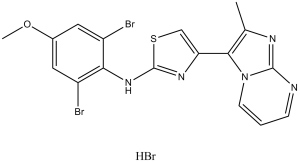
PTC-209 HBr (PTC209) is the hydrobromide salt of PTC-209. PTC-209 is an innovative, strong, and focused BMI-1 inhibitor, possessing an IC50 of 0.5 μM and possible anticancer properties. It may result in an irreversible decrease in CICs, or cancer-initiating cells. In HCT116 (human colorectal cell) and HT1080 (human fibrosarcoma tumor cell), PTC-209 inhibited both endogenous BMI-1 expression and UTR-mediated reporter expression in a dose-dependent manner. Furthermore, PTC-209's inhibitory action did not result from cytotoxicity. Additionally, PTC-209 specifically decreased PRC1 activity.
Physicochemical Properties
| Molecular Formula | C17H13BR2N5OS | |
| Molecular Weight | 576.10 | |
| Exact Mass | 572.847 | |
| Elemental Analysis | C, 35.44; H, 2.45; Br, 41.61; N, 12.16; O, 2.78; S, 5.56 | |
| CAS # | 1217022-63-3 | |
| Related CAS # | PTC-209;315704-66-6 | |
| PubChem CID | 76458124 | |
| Appearance | Light yellow to yellow solid powder | |
| LogP | 6.469 | |
| Hydrogen Bond Donor Count | 2 | |
| Hydrogen Bond Acceptor Count | 6 | |
| Rotatable Bond Count | 4 | |
| Heavy Atom Count | 27 | |
| Complexity | 480 | |
| Defined Atom Stereocenter Count | 0 | |
| SMILES | CC1=C(C2=CSC(NC3=C(Br)C=C(OC)C=C3Br)=N2)N4C=CC=NC4=N1.Br |
|
| InChi Key | UOPFJYYKFDZXSY-UHFFFAOYSA-N | |
| InChi Code | InChI=1S/C17H13Br2N5OS.BrH/c1-9-15(24-5-3-4-20-16(24)21-9)13-8-26-17(22-13)23-14-11(18)6-10(25-2)7-12(14)19;/h3-8H,1-2H3,(H,22,23);1H | |
| Chemical Name | N-(2,6-dibromo-4-methoxyphenyl)-4-(2-methylimidazo[1,2-a]pyrimidin-3-yl)-1,3-thiazol-2-amine;hydrobromide | |
| Synonyms |
|
|
| HS Tariff Code | 2934.99.9001 | |
| Storage |
Powder-20°C 3 years 4°C 2 years In solvent -80°C 6 months -20°C 1 month Note: Please store this product in a sealed and protected environment, avoid exposure to moisture. |
|
| Shipping Condition | Room temperature (This product is stable at ambient temperature for a few days during ordinary shipping and time spent in Customs) |
Biological Activity
| Targets | BMI-1 (IC50 = 0.5 μM) | |
| ln Vitro |
|
|
| ln Vivo |
|
|
| Enzyme Assay | The luciferase open-reading frame is surrounded by the BMI-1 5′ and 3′ UTRs and is post-transcriptionally controlled when HEK293 cells are transfected with a GEMS reporter vector. Luciferase reporter activity is measured using Bright-Glo assays after the resultant stable cells (F8) are treated with PTC-209 or vehicle control for an overnight period. To calculate the percentage of inhibition against the vehicle control, the assays are performed three times for every point. | |
| Cell Assay | Cells are plated with the inhibitor for 4 days in vitro and plated in limiting doses in vitro without adding additional inhibitor to ascertain whether pretreatment with the inhibitor affects tumor cell growth. Viable cell counts are performed using trypan blue exclusion. The number of wells containing spheres is used to calculate the in vitro sphere-initiating cell frequency following inhibitor treatment. One E6 cell per well in 6-well plates was seeded and incubated overnight for the experiments where LDAs are set up after recovery of PTC-209 treated cells. After that, cells are treated in triplicate for 4 days with either PTC-209 (0.01, 0.1, 1 and 10 μM) or DMSO vehicle. After washing off the drug treatments, 4 mL of brand-new suspension medium are added to each well. Cells are trypsinized and counted at 0, 24, 72, and 120 hours after the drug is removed in order to evaluate the viability of the cells after the 4-day treatment window. By plating LDAs (50,000, 10,000, 1,000, 100, 10 and 1 cell per well) using the cells obtained 120 hours after the 4-d drug treatment, the long-lasting effects of the drug treatment on sphere-forming ability are evaluated. | |
| Animal Protocol |
Primary human colon cancer xenograft, human colon cancer cell lines LIM1215 and HCT116 xenografts in nude mice. ~60 mg/kg/day s.c. |
|
| References |
[1]. Self-renewal as a therapeutic target in human colorectal cancer. Nat Med. 2014 Jan;20(1):29-36. [2]. The BMI1 inhibitor PTC-209 is a potential compound to halt cellular growth in biliary tract cancer cells. Oncotarget. 2016 Jan 5; 7(1): 745-758. [3]. BMI1 is expressed in canine osteosarcoma and contributes to cell growth and chemotherapy resistance. PLoS One. 2015 Jun 25;10(6):e0131006. |
Solubility Data
| Solubility (In Vitro) |
|
|||
| Solubility (In Vivo) | 2% DMSO+35% PEG 300+2% Tween 80+ddH2O: 2% DMSO+35% PEG 300+2% Tween 80+ddH2O (Please use freshly prepared in vivo formulations for optimal results.) |
| Preparing Stock Solutions | 1 mg | 5 mg | 10 mg | |
| 1 mM | 1.7358 mL | 8.6790 mL | 17.3581 mL | |
| 5 mM | 0.3472 mL | 1.7358 mL | 3.4716 mL | |
| 10 mM | 0.1736 mL | 0.8679 mL | 1.7358 mL |