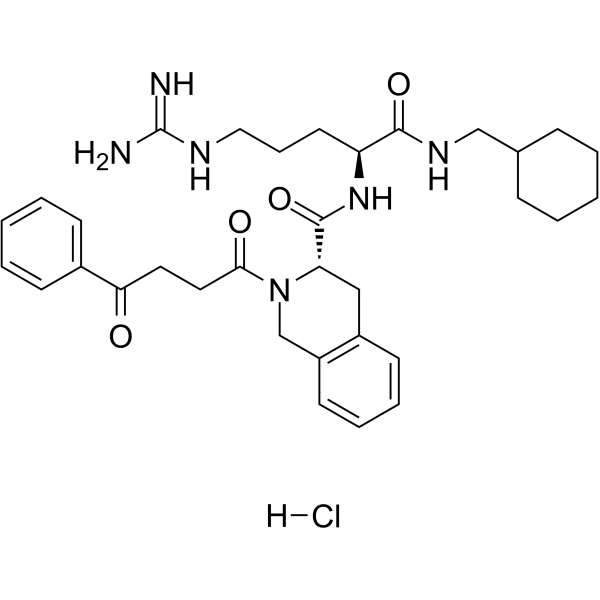
Physicochemical Properties
| Molecular Formula | C33H45CLN6O4 |
| Molecular Weight | 625.201206922531 |
| Exact Mass | 624.319 |
| CAS # | 1596362-29-6 |
| Related CAS # | PS372424;914291-61-5 |
| PubChem CID | 117064650 |
| Appearance | White to off-white solid powder |
| Hydrogen Bond Donor Count | 5 |
| Hydrogen Bond Acceptor Count | 5 |
| Rotatable Bond Count | 13 |
| Heavy Atom Count | 44 |
| Complexity | 970 |
| Defined Atom Stereocenter Count | 2 |
| SMILES | Cl.O=C([C@H](CCC/N=C(\N)/N)NC([C@@H]1CC2C=CC=CC=2CN1C(CCC(C1C=CC=CC=1)=O)=O)=O)NCC1CCCCC1 |
| InChi Key | XHGSJQNAEULTAR-DHBRAOIWSA-N |
| InChi Code | InChI=1S/C33H44N6O4.ClH/c34-33(35)36-19-9-16-27(31(42)37-21-23-10-3-1-4-11-23)38-32(43)28-20-25-14-7-8-15-26(25)22-39(28)30(41)18-17-29(40)24-12-5-2-6-13-24;/h2,5-8,12-15,23,27-28H,1,3-4,9-11,16-22H2,(H,37,42)(H,38,43)(H4,34,35,36);1H/t27-,28-;/m0./s1 |
| Chemical Name | (3S)-N-[(2S)-1-(cyclohexylmethylamino)-5-(diaminomethylideneamino)-1-oxopentan-2-yl]-2-(4-oxo-4-phenylbutanoyl)-3,4-dihydro-1H-isoquinoline-3-carboxamide;hydrochloride |
| HS Tariff Code | 2934.99.9001 |
| Storage |
Powder-20°C 3 years 4°C 2 years In solvent -80°C 6 months -20°C 1 month Note: Please store this product in a sealed and protected environment, avoid exposure to moisture. |
| Shipping Condition | Room temperature (This product is stable at ambient temperature for a few days during ordinary shipping and time spent in Customs) |
Biological Activity
| Targets | Human CXCR3 |
| ln Vitro | In U87-CXCR3-A cells, PS372424 (100 ng/mL) raises p-Erk1 and p-Erk2 after 5 minutes of stimulation[1]. CCR5 on CXCR3+ T cells, but not on CXCR3- T cells, is phosphorylated in response to concentration when exposed to PS372424 (10-200 nM; 30 min)[2]. At an IC50 of 42±21 nM, PS372424 competes with radiolabeled CXCL10 for binding to membranes made from HEK293/CXCR3 Gqi5 cells[3]. |
| Cell Assay |
Western Blot Analysis[2] Cell Types: CXCR3+ T cells and CXCR3- T cells Tested Concentrations: 10, 50, 100, or 200 nM Incubation Duration: 30 minutes Experimental Results: Caused a concentration-dependent phosphorylation of CCR5 on CXCR3+ T cells. Did not result in phosphorylation of CCR5 on CXCR3- T cells. |
| References |
[1]. The role of CXCR3/LRP1 cross-talk in the invasion of primary brain tumors. Nat Commun. 2017 Nov 17;8(1):1571. [2]. Chemokine receptor CXCR3 agonist prevents human T-cell migration in a humanized model of arthritic inflammation. Proc Natl Acad Sci U S A. 2012 Mar 20;109(12):4598-603. [3]. Identification of CXCR3 receptor agonists in combinatorial small-molecule libraries. Biochem Biophys Res Commun. 2006 Oct 13;349(1):221-8. |
Solubility Data
| Solubility (In Vitro) | DMSO: 250 mg/mL (399.87 mM) |
| Solubility (In Vivo) |
Solubility in Formulation 1: ≥ 2.08 mg/mL (3.33 mM) (saturation unknown) in 10% DMSO + 40% PEG300 + 5% Tween80 + 45% Saline (add these co-solvents sequentially from left to right, and one by one), clear solution. For example, if 1 mL of working solution is to be prepared, you can add 100 μL of 20.8 mg/mL clear DMSO stock solution to 400 μL PEG300 and mix evenly; then add 50 μL Tween-80 to the above solution and mix evenly; then add 450 μL normal saline to adjust the volume to 1 mL. Preparation of saline: Dissolve 0.9 g of sodium chloride in 100 mL ddH₂ O to obtain a clear solution. Solubility in Formulation 2: ≥ 2.08 mg/mL (3.33 mM) (saturation unknown) in 10% DMSO + 90% (20% SBE-β-CD in Saline) (add these co-solvents sequentially from left to right, and one by one), clear solution. For example, if 1 mL of working solution is to be prepared, you can add 100 μL of 20.8 mg/mL clear DMSO stock solution to 900 μL of 20% SBE-β-CD physiological saline solution and mix evenly. Preparation of 20% SBE-β-CD in Saline (4°C,1 week): Dissolve 2 g SBE-β-CD in 10 mL saline to obtain a clear solution. Solubility in Formulation 3: ≥ 2.08 mg/mL (3.33 mM) (saturation unknown) in 10% DMSO + 90% Corn Oil (add these co-solvents sequentially from left to right, and one by one), clear solution. For example, if 1 mL of working solution is to be prepared, you can add 100 μL of 20.8 mg/mL clear DMSO stock solution to 900 μL of corn oil and mix evenly. (Please use freshly prepared in vivo formulations for optimal results.) |
| Preparing Stock Solutions | 1 mg | 5 mg | 10 mg | |
| 1 mM | 1.5995 mL | 7.9974 mL | 15.9949 mL | |
| 5 mM | 0.3199 mL | 1.5995 mL | 3.1990 mL | |
| 10 mM | 0.1599 mL | 0.7997 mL | 1.5995 mL |