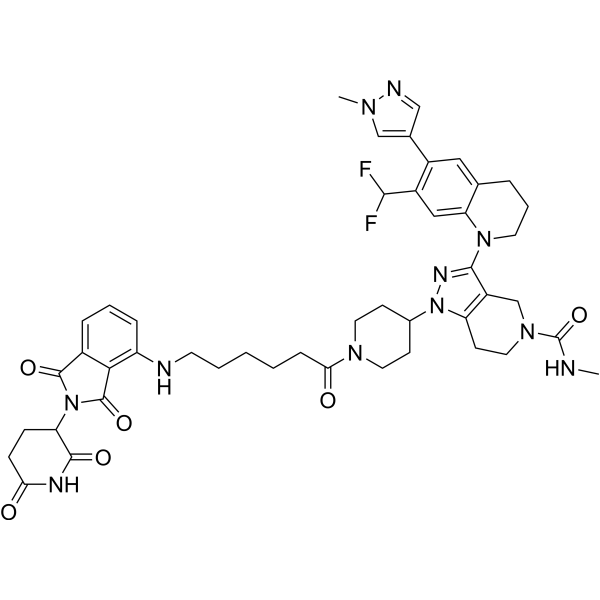
Physicochemical Properties
| Molecular Formula | C46H53F2N11O6 |
| Molecular Weight | 893.98 |
| Exact Mass | 893.414 |
| CAS # | 2484739-48-0 |
| PubChem CID | 162642580 |
| Appearance | Light yellow to green yellow solid powder |
| LogP | 3.8 |
| Hydrogen Bond Donor Count | 3 |
| Hydrogen Bond Acceptor Count | 12 |
| Rotatable Bond Count | 12 |
| Heavy Atom Count | 65 |
| Complexity | 1790 |
| Defined Atom Stereocenter Count | 0 |
| SMILES | C1N(C(NC)=O)CCC2N(C3CCN(C(=O)CCCCCNC4=CC=CC5=C4C(=O)N(C4CCC(=O)NC4=O)C5=O)CC3)N=C(N3C4=C(C=C(C5=CN(C)N=C5)C(C(F)F)=C4)CCC3)C1=2 |
| InChi Key | KOXRGDZBEAJAKE-UHFFFAOYSA-N |
| InChi Code | InChI=1S/C46H53F2N11O6/c1-49-46(65)56-21-16-35-33(26-56)42(57-18-7-8-27-22-31(28-24-51-54(2)25-28)32(41(47)48)23-37(27)57)53-59(35)29-14-19-55(20-15-29)39(61)11-4-3-5-17-50-34-10-6-9-30-40(34)45(64)58(44(30)63)36-12-13-38(60)52-43(36)62/h6,9-10,22-25,29,36,41,50H,3-5,7-8,11-21,26H2,1-2H3,(H,49,65)(H,52,60,62) |
| Chemical Name | 3-[7-(difluoromethyl)-6-(1-methylpyrazol-4-yl)-3,4-dihydro-2H-quinolin-1-yl]-1-[1-[6-[[2-(2,6-dioxopiperidin-3-yl)-1,3-dioxoisoindol-4-yl]amino]hexanoyl]piperidin-4-yl]-N-methyl-6,7-dihydro-4H-pyrazolo[4,3-c]pyridine-5-carboxamide |
| HS Tariff Code | 2934.99.9001 |
| Storage |
Powder-20°C 3 years 4°C 2 years In solvent -80°C 6 months -20°C 1 month Note: Please store this product in a sealed and protected environment (e.g. under nitrogen), avoid exposure to moisture and light. |
| Shipping Condition | Room temperature (This product is stable at ambient temperature for a few days during ordinary shipping and time spent in Customs) |
Biological Activity
| Targets | Cereblon |
| ln Vitro | LNCaP prostate cancer cell viability was inhibited by PROTAC CBP/P300 Degrader-1 (IC50=0.4 nM). P300 degradation (≥ 80%) is induced by PROTAC CBP/P300 Degrader-1 (10 nM) [1]. HHEL, NOMO-1, MOLM-13, HL-60, MEG-01, MM.IS, MM.1R, NCL-H929, RPM-8226, AMO -1, WSU-DLCL2, Karpas-422, Pfeiffer, SU-DHL-1, LNCap clone FGC, VCap; 22RV1, NCI-H520, NCI-H703, LK-2, MCE-7, and SK-BR-3 cells. The IC50 range is 0.1-141.4 nM. |
| References |
[1]. Cyclic-amp response element binding protein (cbp) and/or adenoviral e1a binding protein of 300 kda (p300) degradation compounds and methods of use. WO2020173440A1. |
Solubility Data
| Solubility (In Vitro) | DMSO : 173.33 mg/mL (193.89 mM) |
| Solubility (In Vivo) |
Solubility in Formulation 1: 6.5 mg/mL (7.27 mM) in 10% DMSO + 40% PEG300 +5% Tween-80 + 45% Saline (add these co-solvents sequentially from left to right, and one by one), suspension solution; with sonication. For example, if 1 mL of working solution is to be prepared, you can add 100 μL of 65.0 mg/mL clear DMSO stock solution to 400 μL PEG300 and mix evenly; then add 50 μL Tween-80 + to the above solution and mix evenly; then add 450 μL normal saline to adjust the volume to 1 mL. Preparation of saline: Dissolve 0.9 g of sodium chloride in 100 mL ddH₂ O to obtain a clear solution. (Please use freshly prepared in vivo formulations for optimal results.) |
| Preparing Stock Solutions | 1 mg | 5 mg | 10 mg | |
| 1 mM | 1.1186 mL | 5.5930 mL | 11.1859 mL | |
| 5 mM | 0.2237 mL | 1.1186 mL | 2.2372 mL | |
| 10 mM | 0.1119 mL | 0.5593 mL | 1.1186 mL |