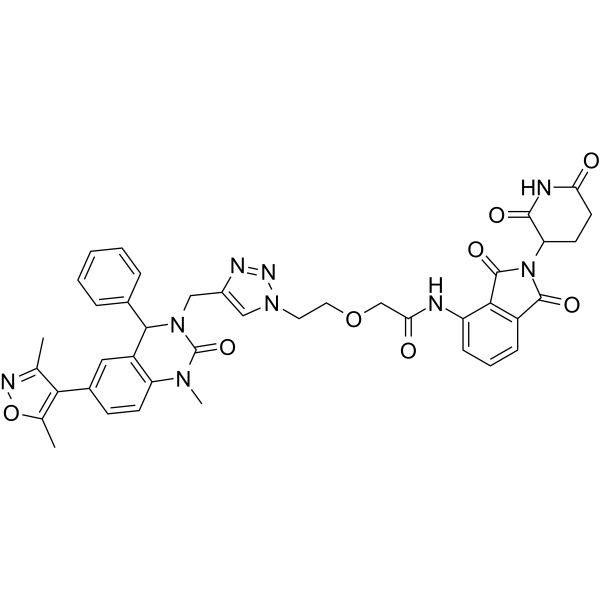
Physicochemical Properties
| Molecular Formula | C40H37N9O8 |
| Molecular Weight | 771.7773 |
| Exact Mass | 771.276 |
| CAS # | 2133360-00-4 |
| PubChem CID | 141488039 |
| Appearance | White to off-white solid powder |
| LogP | 2.2 |
| Hydrogen Bond Donor Count | 2 |
| Hydrogen Bond Acceptor Count | 11 |
| Rotatable Bond Count | 11 |
| Heavy Atom Count | 57 |
| Complexity | 1560 |
| Defined Atom Stereocenter Count | 0 |
| SMILES | O=C1N(C([H])([H])[H])C2C([H])=C([H])C(C3C(C([H])([H])[H])=NOC=3C([H])([H])[H])=C([H])C=2C([H])(C2C([H])=C([H])C([H])=C([H])C=2[H])N1C([H])([H])C1=C([H])N(C([H])([H])C([H])([H])OC([H])([H])C(N([H])C2=C([H])C([H])=C([H])C3C(N(C(C=32)=O)C2([H])C(N([H])C(C([H])([H])C2([H])[H])=O)=O)=O)=O)N=N1 |
| InChi Key | FXNACIMQXOPNJG-UHFFFAOYSA-N |
| InChi Code | InChI=1S/C40H37N9O8/c1-22-34(23(2)57-44-22)25-12-13-30-28(18-25)36(24-8-5-4-6-9-24)48(40(55)46(30)3)20-26-19-47(45-43-26)16-17-56-21-33(51)41-29-11-7-10-27-35(29)39(54)49(38(27)53)31-14-15-32(50)42-37(31)52/h4-13,18-19,31,36H,14-17,20-21H2,1-3H3,(H,41,51)(H,42,50,52) |
| Chemical Name | 2-[2-[4-[[6-(3,5-dimethyl-1,2-oxazol-4-yl)-1-methyl-2-oxo-4-phenyl-4H-quinazolin-3-yl]methyl]triazol-1-yl]ethoxy]-N-[2-(2,6-dioxopiperidin-3-yl)-1,3-dioxoisoindol-4-yl]acetamide |
| HS Tariff Code | 2934.99.9001 |
| Storage |
Powder-20°C 3 years 4°C 2 years In solvent -80°C 6 months -20°C 1 month |
| Shipping Condition | Room temperature (This product is stable at ambient temperature for a few days during ordinary shipping and time spent in Customs) |
Biological Activity
| ln Vitro | PROTAC BRD4 Degrader-1 (Compound 21) (2.5 μM; 24 hours), exhibits modest action against Raji and HL-60 cell lines and strong inhibitory activity against the development of the human monocytic lymphoma cell line THP-1, with an IC50 value of 0.81 μM[1]. Pomalidomide cannot degrade BRD4 at low concentrations, whereas PROTAC BRD4 Degrader-1 (1 μM; 24 hours) can efficiently promote BRD4 protein degradation and inhibit c-Myc [1]. |
| Cell Assay |
Cell proliferation assay [1] Cell Types: HL-60, Raji and THP-1 Cell Tested Concentrations: 2.5 μM Incubation Duration: 24 hrs (hours) Experimental Results: Inhibition of HL-60, Raji and THP-1 cell growth. Western Blot Analysis[1] Cell Types: THP-1 Cell Tested Concentrations: 1 μM Incubation Duration: 3 hrs (hours) Experimental Results: BRD4 protein degrades and inhibits c-Myc expression. |
| References |
[1]. Discovery of a new class of PROTAC BRD4 degraders based on a dihydroquinazolinone derivative and lenalidomide/pomalidomide.Bioorg Med Chem. 2020 Jan 1;28(1):115228. |
Solubility Data
| Solubility (In Vitro) | DMSO : ~100 mg/mL (~129.57 mM) |
| Solubility (In Vivo) |
Solubility in Formulation 1: ≥ 5 mg/mL (6.48 mM) (saturation unknown) in 10% DMSO + 90% Corn Oil (add these co-solvents sequentially from left to right, and one by one), clear solution. For example, if 1 mL of working solution is to be prepared, you can add 100 μL of 50.0 mg/mL clear DMSO stock solution to 900 μL of corn oil and mix evenly. (Please use freshly prepared in vivo formulations for optimal results.) |
| Preparing Stock Solutions | 1 mg | 5 mg | 10 mg | |
| 1 mM | 1.2957 mL | 6.4785 mL | 12.9571 mL | |
| 5 mM | 0.2591 mL | 1.2957 mL | 2.5914 mL | |
| 10 mM | 0.1296 mL | 0.6479 mL | 1.2957 mL |