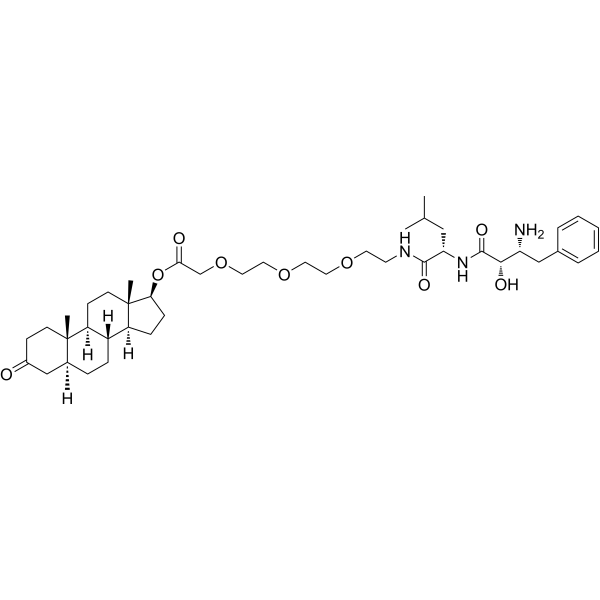
Physicochemical Properties
| Exact Mass | 769.487 |
| CAS # | 1351169-31-7 |
| Related CAS # | PROTAC AR Degrader-4 TFA |
| PubChem CID | 54764407 |
| Appearance | Typically exists as solid at room temperature |
| LogP | 4.8 |
| Hydrogen Bond Donor Count | 4 |
| Hydrogen Bond Acceptor Count | 10 |
| Rotatable Bond Count | 21 |
| Heavy Atom Count | 55 |
| Complexity | 1280 |
| Defined Atom Stereocenter Count | 10 |
| SMILES | CC(C)C[C@@H](C(=O)NCCOCCOCCOCC(=O)O[C@H]1CC[C@@H]2[C@@]1(CC[C@H]3[C@H]2CC[C@@H]4[C@@]3(CCC(=O)C4)C)C)NC(=O)[C@H]([C@@H](CC5=CC=CC=C5)N)O |
| InChi Key | YNDJPWSVYYRNTJ-MEXKHVBFSA-N |
| InChi Code | InChI=1S/C43H67N3O9/c1-28(2)24-36(46-41(51)39(49)35(44)25-29-8-6-5-7-9-29)40(50)45-18-19-52-20-21-53-22-23-54-27-38(48)55-37-13-12-33-32-11-10-30-26-31(47)14-16-42(30,3)34(32)15-17-43(33,37)4/h5-9,28,30,32-37,39,49H,10-27,44H2,1-4H3,(H,45,50)(H,46,51)/t30-,32-,33-,34-,35+,36-,37-,39-,42-,43-/m0/s1 |
| Chemical Name | [(5S,8R,9S,10S,13S,14S,17S)-10,13-dimethyl-3-oxo-1,2,4,5,6,7,8,9,11,12,14,15,16,17-tetradecahydrocyclopenta[a]phenanthren-17-yl] 2-[2-[2-[2-[[(2S)-2-[[(2S,3R)-3-amino-2-hydroxy-4-phenylbutanoyl]amino]-4-methylpentanoyl]amino]ethoxy]ethoxy]ethoxy]acetate |
| HS Tariff Code | 2934.99.9001 |
| Storage |
Powder-20°C 3 years 4°C 2 years In solvent -80°C 6 months -20°C 1 month |
| Shipping Condition | Room temperature (This product is stable at ambient temperature for a few days during ordinary shipping and time spent in Customs) |
Biological Activity
| ln Vitro | IAP recognition structure and target protein recognition structure are combined to create the bifunctional compounds known as specific and non-genetic IAP-dependent protein erasers (SNIPERs). Three steps are involved in targeted protein degradation. SNIPER is able to form an IAP connection complex with E3 ligase activity with the target protein thanks to its two recognition structures, as demonstrated in Figure 1. 2. IAPs polyubiquitinate the target protein. 3. The proteasome breaks down proteins that have been polyubiquitinated. |
| References |
[1]. Design, synthesis and biological evaluation of nuclear receptor-degradation inducers. Bioorg Med Chem. 2011 Nov 15;19(22):6768-78. |
Solubility Data
| Solubility (In Vitro) | DMSO : ~200 mg/mL (~259.74 mM) |
| Solubility (In Vivo) |
Solubility in Formulation 1: ≥ 5 mg/mL (6.49 mM) (saturation unknown) in 10% DMSO + 40% PEG300 + 5% Tween80 + 45% Saline (add these co-solvents sequentially from left to right, and one by one), clear solution. For example, if 1 mL of working solution is to be prepared, you can add 100 μL of 50.0 mg/mL clear DMSO stock solution to 400 μL PEG300 and mix evenly; then add 50 μL Tween-80 to the above solution and mix evenly; then add 450 μL normal saline to adjust the volume to 1 mL. Preparation of saline: Dissolve 0.9 g of sodium chloride in 100 mL ddH₂ O to obtain a clear solution. Solubility in Formulation 2: 5 mg/mL (6.49 mM) in 10% DMSO + 90% (20% SBE-β-CD in Saline) (add these co-solvents sequentially from left to right, and one by one), suspension solution; with ultrasonication. For example, if 1 mL of working solution is to be prepared, you can add 100 μL of 50.0 mg/mL clear DMSO stock solution to 900 μL of 20% SBE-β-CD physiological saline solution and mix evenly. Preparation of 20% SBE-β-CD in Saline (4°C,1 week): Dissolve 2 g SBE-β-CD in 10 mL saline to obtain a clear solution. (Please use freshly prepared in vivo formulations for optimal results.) |