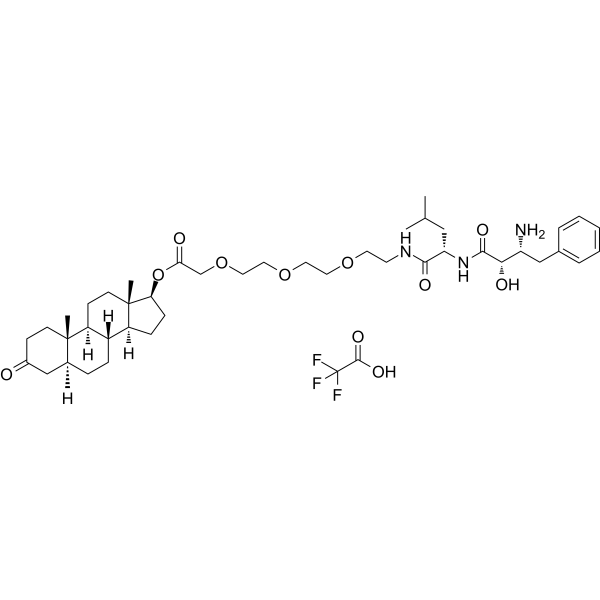
Physicochemical Properties
| Molecular Formula | C45H68F3N3O11 |
| Molecular Weight | 884.03 |
| Related CAS # | PROTAC AR Degrader-4;1351169-31-7 |
| Appearance | White to off-white solid powder |
| HS Tariff Code | 2934.99.9001 |
| Storage |
Powder-20°C 3 years 4°C 2 years In solvent -80°C 6 months -20°C 1 month Note: Please store this product in a sealed and protected environment (e.g. under nitrogen), avoid exposure to moisture. |
| Shipping Condition | Room temperature (This product is stable at ambient temperature for a few days during ordinary shipping and time spent in Customs) |
Biological Activity
| Targets | cIAP1 |
| ln Vitro | IAPs-dependent Protein Erasers that are Specific and Nongenetic (SNIPERs) are two-component compounds that are created by combining an IAPs recognition structure with a target protein recognition structure. Three processes are involved in directing protein breakdown. 1. SNIPER's two recognition structures enable the formation of a complex that binds the target protein to IAPs, which contain E3 ligase activity. IAPs cause the target protein to become polyubiquitinated. 3. Proteases breakdown the polyubiquitinated protein. |
| References |
[1]. Design, synthesis and biological evaluation of nuclear receptor-degradation inducers. Bioorg Med Chem. 2011 Nov 15;19(22):6768-78. |
Solubility Data
| Solubility (In Vitro) | DMSO :~200 mg/mL (~226.24 mM) |
| Solubility (In Vivo) |
Solubility in Formulation 1: ≥ 5 mg/mL (5.66 mM) (saturation unknown) in 10% DMSO + 40% PEG300 + 5% Tween80 + 45% Saline (add these co-solvents sequentially from left to right, and one by one), clear solution. For example, if 1 mL of working solution is to be prepared, you can add 100 μL of 50.0 mg/mL clear DMSO stock solution to 400 μL PEG300 and mix evenly; then add 50 μL Tween-80 to the above solution and mix evenly; then add 450 μL normal saline to adjust the volume to 1 mL. Preparation of saline: Dissolve 0.9 g of sodium chloride in 100 mL ddH₂ O to obtain a clear solution. Solubility in Formulation 2: 5 mg/mL (5.66 mM) in 10% DMSO + 90% (20% SBE-β-CD in Saline) (add these co-solvents sequentially from left to right, and one by one), suspension solution; with ultrasonication. For example, if 1 mL of working solution is to be prepared, you can add 100 μL of 50.0 mg/mL clear DMSO stock solution to 900 μL of 20% SBE-β-CD physiological saline solution and mix evenly. Preparation of 20% SBE-β-CD in Saline (4°C,1 week): Dissolve 2 g SBE-β-CD in 10 mL saline to obtain a clear solution. (Please use freshly prepared in vivo formulations for optimal results.) |
| Preparing Stock Solutions | 1 mg | 5 mg | 10 mg | |
| 1 mM | 1.1312 mL | 5.6559 mL | 11.3118 mL | |
| 5 mM | 0.2262 mL | 1.1312 mL | 2.2624 mL | |
| 10 mM | 0.1131 mL | 0.5656 mL | 1.1312 mL |