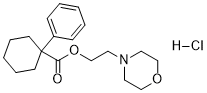
PRE084 (PRE-084) HCl is a novel, potent, high affinity and selective sigma 1 agonist with Ki values of 2.2 and 13091 nM for σ1 and σ2 receptors respectively.
Physicochemical Properties
| Molecular Formula | C19H28CLNO3 |
| Molecular Weight | 353.88352 |
| Exact Mass | 353.175 |
| CAS # | 138847-85-5 |
| Related CAS # | PRE-084 hydrochloride;75136-54-8 |
| PubChem CID | 126402 |
| Appearance | White to off-white solid powder |
| Density | 1.103g/cm3 |
| Boiling Point | 446.6ºC at 760mmHg |
| Flash Point | 223.9ºC |
| Vapour Pressure | 3.61E-08mmHg at 25°C |
| Index of Refraction | 1.532 |
| LogP | 3.503 |
| Hydrogen Bond Donor Count | 0 |
| Hydrogen Bond Acceptor Count | 4 |
| Rotatable Bond Count | 6 |
| Heavy Atom Count | 23 |
| Complexity | 367 |
| Defined Atom Stereocenter Count | 0 |
| InChi Key | QUJWFJNHTBKCLU-UHFFFAOYSA-N |
| InChi Code | InChI=1S/C19H27NO3.ClH/c21-18(23-16-13-20-11-14-22-15-12-20)19(9-5-2-6-10-19)17-7-3-1-4-8-17/h1,3-4,7-8H,2,5-6,9-16H21H |
| Chemical Name | Cyclohexanecarboxylic acid, 1-phenyl-, 2-(4-morpholinyl)ethyl ester hydrochloride |
| Synonyms | PRE 084 PRE-084 HClPRE-084 PRE084. PRE-084 hydrochloride |
| HS Tariff Code | 2934.99.9001 |
| Storage |
Powder-20°C 3 years 4°C 2 years In solvent -80°C 6 months -20°C 1 month |
| Shipping Condition | Room temperature (This product is stable at ambient temperature for a few days during ordinary shipping and time spent in Customs) |
Biological Activity
| ln Vitro | PRE-084 (0.1-100 µM; 24 hours) lowers the levels of the pro-apoptotic protein Bax at 10 µM and shields cultured cortical neurons from beta-amyloid damage (maximum neuroprotection at 10 µM) [1]. |
| ln Vivo | PRE-084 (0.25 mg/kg; i.p.; 3 times per week for 8 weeks) exhibited favorable effects on locomotor performance (increased motor neuron survival, decreased paw abnormalities, and grip strength performance) in wobbler mice, and Shows neuroprotective properties (increased BDNF levels in gray matter) [2]. PRE-084 (1 mg/kg; i.p.; single dosage) protects the heart via activating the Akt-eNOS pathway in a myocardial infarction model [3]. |
| Cell Assay |
Cell Viability Assay[1] Cell Types: Cortical cells (βAP(25-35) induced neurotoxicity model) Tested Concentrations: 0.1-100 µM Incubation Duration: 24 hrs (hours) Experimental Results: diminished neuronal toxicity in a bell-shaped manner and at 10 µM . Western Blot Analysis[1] Cell Types: Cortical cells (βAP(25-35)-induced neurotoxicity model) Tested Concentrations: 10 µM Incubation Duration: 24 h Experimental Results: βAP(25--induced pro-apoptotic protein Bax in cortical neurons Level diminished by 35). |
| Animal Protocol |
Animal/Disease Models: Wobbler mouse (4 weeks old) [2]. Doses: 0.25 mg/kg Route of Administration: intraperitoneal (ip) injection; 3 times a week for 8 weeks. Experimental Results: Paw abnormalities were Dramatically improved from week 4 onwards, and paw grip strength was Dramatically improved by week 5. The number of reactive astrocytes diminished, while the number of panmacrophage markers CD68-positive cells and CD206+ cells involved in tissue repair increased. The average number of large-sized NISSL-positive motor neurons increased by 26.5%. Animal/Disease Models: Adult male SD (SD (Sprague-Dawley)) rat (220-250 g; myocardial infarction model) [3]. Doses: 1 mg/kg Route of Administration: intraperitoneal (ip) injection; single. Experimental Results: The degree of cardiomyocyte apoptosis was Dramatically diminished. Resulting in a significant increase in p-Akt and p-eNOS expression. |
| References |
[1]. Neuroprotective effects of sigma-1 receptor agonists against beta-amyloid-induced toxicity. Neuroreport. 2005 Aug 1;16(11):1223-6. [2]. Neuroprotective effects of the Sigma-1 receptor (S1R) agonist PRE-084, in a mouse model of motor neuron disease not linked to SOD1 mutation. Neurobiol Dis. 2014 Feb;62:218-32. [3]. Sigma-1 Receptor Stimulation with PRE-084 Ameliorates Myocardial Ischemia-Reperfusion Injury in Rats. Chin Med J (Engl). 2018 Mar 5;131(5):539-543. [4]. Sigma compounds derived from phencyclidine: identification of PRE-084, a new, selective sigma ligand. J Pharmacol Exp Ther. 1991 Nov;259(2):543-50. |
| Additional Infomation | 1-phenyl-1-cyclohexanecarboxylic acid 2-(4-morpholinyl)ethyl ester is a member of morpholines. |
Solubility Data
| Solubility (In Vitro) | May dissolve in DMSO (in most cases), if not, try other solvents such as H2O, Ethanol, or DMF with a minute amount of products to avoid loss of samples |
| Solubility (In Vivo) |
Note: Listed below are some common formulations that may be used to formulate products with low water solubility (e.g. < 1 mg/mL), you may test these formulations using a minute amount of products to avoid loss of samples. Injection Formulations (e.g. IP/IV/IM/SC) Injection Formulation 1: DMSO : Tween 80: Saline = 10 : 5 : 85 (i.e. 100 μL DMSO stock solution → 50 μL Tween 80 → 850 μL Saline) *Preparation of saline: Dissolve 0.9 g of sodium chloride in 100 mL ddH ₂ O to obtain a clear solution. Injection Formulation 2: DMSO : PEG300 :Tween 80 : Saline = 10 : 40 : 5 : 45 (i.e. 100 μL DMSO → 400 μLPEG300 → 50 μL Tween 80 → 450 μL Saline) Injection Formulation 3: DMSO : Corn oil = 10 : 90 (i.e. 100 μL DMSO → 900 μL Corn oil) Example: Take the Injection Formulation 3 (DMSO : Corn oil = 10 : 90) as an example, if 1 mL of 2.5 mg/mL working solution is to be prepared, you can take 100 μL 25 mg/mL DMSO stock solution and add to 900 μL corn oil, mix well to obtain a clear or suspension solution (2.5 mg/mL, ready for use in animals). Injection Formulation 4: DMSO : 20% SBE-β-CD in saline = 10 : 90 [i.e. 100 μL DMSO → 900 μL (20% SBE-β-CD in saline)] *Preparation of 20% SBE-β-CD in Saline (4°C,1 week): Dissolve 2 g SBE-β-CD in 10 mL saline to obtain a clear solution. Injection Formulation 5: 2-Hydroxypropyl-β-cyclodextrin : Saline = 50 : 50 (i.e. 500 μL 2-Hydroxypropyl-β-cyclodextrin → 500 μL Saline) Injection Formulation 6: DMSO : PEG300 : castor oil : Saline = 5 : 10 : 20 : 65 (i.e. 50 μL DMSO → 100 μLPEG300 → 200 μL castor oil → 650 μL Saline) Injection Formulation 7: Ethanol : Cremophor : Saline = 10: 10 : 80 (i.e. 100 μL Ethanol → 100 μL Cremophor → 800 μL Saline) Injection Formulation 8: Dissolve in Cremophor/Ethanol (50 : 50), then diluted by Saline Injection Formulation 9: EtOH : Corn oil = 10 : 90 (i.e. 100 μL EtOH → 900 μL Corn oil) Injection Formulation 10: EtOH : PEG300:Tween 80 : Saline = 10 : 40 : 5 : 45 (i.e. 100 μL EtOH → 400 μLPEG300 → 50 μL Tween 80 → 450 μL Saline) Oral Formulations Oral Formulation 1: Suspend in 0.5% CMC Na (carboxymethylcellulose sodium) Oral Formulation 2: Suspend in 0.5% Carboxymethyl cellulose Example: Take the Oral Formulation 1 (Suspend in 0.5% CMC Na) as an example, if 100 mL of 2.5 mg/mL working solution is to be prepared, you can first prepare 0.5% CMC Na solution by measuring 0.5 g CMC Na and dissolve it in 100 mL ddH2O to obtain a clear solution; then add 250 mg of the product to 100 mL 0.5% CMC Na solution, to make the suspension solution (2.5 mg/mL, ready for use in animals). Oral Formulation 3: Dissolved in PEG400 Oral Formulation 4: Suspend in 0.2% Carboxymethyl cellulose Oral Formulation 5: Dissolve in 0.25% Tween 80 and 0.5% Carboxymethyl cellulose Oral Formulation 6: Mixing with food powders Note: Please be aware that the above formulations are for reference only. InvivoChem strongly recommends customers to read literature methods/protocols carefully before determining which formulation you should use for in vivo studies, as different compounds have different solubility properties and have to be formulated differently. (Please use freshly prepared in vivo formulations for optimal results.) |
| Preparing Stock Solutions | 1 mg | 5 mg | 10 mg | |
| 1 mM | 2.8258 mL | 14.1291 mL | 28.2582 mL | |
| 5 mM | 0.5652 mL | 2.8258 mL | 5.6516 mL | |
| 10 mM | 0.2826 mL | 1.4129 mL | 2.8258 mL |