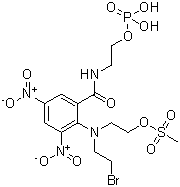
PR-104, a novel, potent, non-toxic, small-molecule, hypoxia-activated, 3,5-dinitrobenzamide nitrogen mustard, is a drug from the class of hypoxia-activated prodrugs (HAPs), which is being researched as a potential anti-cancer therapeutic agent. It is a phosphate ester “pre-prodrug” that is rapidly converted to the HAP PR-104A in the body. PR-104A is in turn metabolised to reactive nitrogen mustard DNA crosslinking agents in hypoxic tissues such as found in solid tumours. Following initial clinical studies, it was discovered that PR-104A is also activated by the enzyme AKR1C3, independently of hypoxia. Hypoxia in the bone marrow of patients with leukaemia, and high activity of AKR1C3 in some leukaemia subtypes has led to interest in clinical trials of PR-104 in relapsed refractory acute leukaemias
Physicochemical Properties
| Molecular Formula | C14H20N4O12PSBR |
| Molecular Weight | 579.271 |
| Exact Mass | 577.972 |
| CAS # | 851627-62-8 |
| Related CAS # | PR-104 sodium;851627-80-0 |
| PubChem CID | 11455973 |
| Appearance | White to yellow solid powder |
| LogP | 3.221 |
| Hydrogen Bond Donor Count | 3 |
| Hydrogen Bond Acceptor Count | 13 |
| Rotatable Bond Count | 12 |
| Heavy Atom Count | 33 |
| Complexity | 839 |
| Defined Atom Stereocenter Count | 0 |
| InChi Key | GZSOKPMDWVRVMG-UHFFFAOYSA-N |
| InChi Code | InChI=1S/C14H20BrN4O12PS/c1-33(28,29)31-7-5-17(4-2-15)13-11(14(20)16-3-6-30-32(25,26)27)8-10(18(21)22)9-12(13)19(23)24/h8-9H,2-7H2,1H3,(H,16,20)(H2,25,26,27) |
| Chemical Name | 2-((2-bromoethyl)(2,4-dinitro-6-((2-(phosphonooxy)ethyl)carbamoyl)phenyl)amino)ethyl methanesulfonate |
| Synonyms | PR 104; PR-104; PR104. |
| HS Tariff Code | 2934.99.9001 |
| Storage |
Powder-20°C 3 years 4°C 2 years In solvent -80°C 6 months -20°C 1 month Note: (1). This product requires protection from light (avoid light exposure) during transportation and storage.(2). Please store this product in a sealed and protected environment (e.g. under nitrogen), avoid exposure to moisture. |
| Shipping Condition | Room temperature (This product is stable at ambient temperature for a few days during ordinary shipping and time spent in Customs) |
Biological Activity
| ln Vitro | In anoxic rather than aerobic settings, PR-104 (80 μM; 1 h; SiHa cells) exhibits a higher inhibitory impact on radiation-induced DNA single-strand breaks. Ser139 on histone H2AX (gH2AX) is phosphorylated by PR-104 (100 μM; 1 hour; SiHa cells). Following radiation, PR-104 (0.266 mmol/kg; 18 h; SiHa cells) shown efficacy against hypoxic cells. Different cell lines have different potencies of PR-104; H460 cells have the lowest IC50 (0.51 μmol/L) while PC3 prostate cells have the highest (7.3 μmol/L) [1]. |
| ln Vivo | The plasma area under the curve is increased by PR-104 (0.56 mmol/kg; iv or ip; 0~2 hours). PR-104 exhibits antitumor activity (0.23 mmol/kg; intraperitoneal; 100 days) [1]. |
| Animal Protocol |
Animal/Disease Models: CD-1nu/nu mouse Doses: 0.56 mmol/kg (pharmacokinetic/PK/PK analysis) Route of Administration: intravenous (iv) (iv)injection or intraperitoneal (ip) injection Experimental Results: plasma area under the curve. Animal/Disease Models: CD1-Foxn1nu mouse Doses: 0.23 mmol/kg Route of Administration: intraperitoneal (ip) injection Experimental Results:demonstrated anti-tumor activity. |
| References |
[1]. Mechanism of action and preclinical antitumor activity of the novel hypoxia-activated DNA cross-linking agent PR-104. Clin Cancer Res. 2007;13(13):3922-3932. |
| Additional Infomation |
Nitrogen Mustard Prodrug PR-104 is a non-toxic, small-molecule, hypoxia-activated, 3,5-dinitrobenzamide nitrogen mustard pre-prodrug with potential antitumor activity. Upon intravenous administration, PR-104 is converted by systemic phosphatases to the alcohol intermediate PR-104A, which is reduced to form the active DNA-crosslinking mustard species hydroxylamine PR-104H intracellularly under hypoxic conditions. PR-104H specifically crosslinks hypoxic tumor cell DNA, resulting in the inhibition of DNA repair and synthesis, cell-cycle arrest, and apoptosis in susceptible hypoxic tumor cell populations while sparing normoxic tissues. Drug Indication Investigated for use/treatment in cancer/tumors (unspecified) and solid tumors. Mechanism of Action PR-104 is a novel hypoxia-activated DNA cross-linking agent with marked activity against human tumor xenografts, both as monotherapy and combined with radiotherapy and chemotherapy. Upon intravenous administration, PR-104 is converted by systemic phosphatases to the alcohol intermediate PR-104A, which is reduced to form the active DNA-crosslinking mustard species hydroxylamine PR-104H intracellularly under hypoxic conditions. PR-104H specifically crosslinks hypoxic tumor cell DNA, resulting in the inhibition of DNA repair and synthesis, cell-cycle arrest, and apoptosis in susceptible hypoxic tumor cell populations while sparing normoxic tissues. |
Solubility Data
| Solubility (In Vitro) |
DMSO : ~100 mg/mL (~172.63 mM) H2O : ~31.25 mg/mL (~53.95 mM) |
| Solubility (In Vivo) |
Solubility in Formulation 1: ≥ 5 mg/mL (8.63 mM) (saturation unknown) in 10% DMSO + 40% PEG300 + 5% Tween80 + 45% Saline (add these co-solvents sequentially from left to right, and one by one), clear solution. For example, if 1 mL of working solution is to be prepared, you can add 100 μL of 50.0 mg/mL clear DMSO stock solution to 400 μL PEG300 and mix evenly; then add 50 μL Tween-80 to the above solution and mix evenly; then add 450 μL normal saline to adjust the volume to 1 mL. Preparation of saline: Dissolve 0.9 g of sodium chloride in 100 mL ddH₂ O to obtain a clear solution. Solubility in Formulation 2: ≥ 5 mg/mL (8.63 mM) (saturation unknown) in 10% DMSO + 90% (20% SBE-β-CD in Saline) (add these co-solvents sequentially from left to right, and one by one), clear solution. For example, if 1 mL of working solution is to be prepared, you can add 100 μL of 50.0 mg/mL clear DMSO stock solution to 900 μL of 20% SBE-β-CD physiological saline solution and mix evenly. Preparation of 20% SBE-β-CD in Saline (4°C,1 week): Dissolve 2 g SBE-β-CD in 10 mL saline to obtain a clear solution. (Please use freshly prepared in vivo formulations for optimal results.) |
| Preparing Stock Solutions | 1 mg | 5 mg | 10 mg | |
| 1 mM | 1.7263 mL | 8.6316 mL | 17.2631 mL | |
| 5 mM | 0.3453 mL | 1.7263 mL | 3.4526 mL | |
| 10 mM | 0.1726 mL | 0.8632 mL | 1.7263 mL |