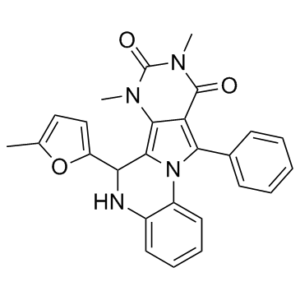
PPQ-102 (also known as CFTR Inhibitor) is a potent inhibitor of CFTR (cystic fibrosis transmembrane conductance regulator) discovered from screening of approximately 110000 small synthetic and natural compounds for inhibition of halide influx in CFTR-expressing epithelial cells. PPQ-102 can slow cyst enlargement in polycystic kidney disease and reduce intestinal fluid loss in secretory diarrheas. PPQ-102 completely inhibited CFTR chloride current with an IC50 of approximately 90 nM. Unlike prior CFTR inhibitors, PPQ-102 is uncharged at physiological pH, and therefore not subject to membrane potential-dependent cellular partitioning or block efficiency. Patch-clamp analysis confirmed voltage-independent CFTR inhibition by PPQ-102 and showed stabilization of the channel closed state. PPQ-102 prevented cyst expansion and reduced the size of preformed cysts in a neonatal kidney organ culture model of polycystic kidney disease. PPQ-102 is the most potent CFTR inhibitor identified to date.
Physicochemical Properties
| Molecular Formula | C26H22N4O3 | |
| Molecular Weight | 438.48 | |
| Exact Mass | 438.169 | |
| CAS # | 931706-15-9 | |
| Related CAS # |
|
|
| PubChem CID | 16016583 | |
| Appearance | Light yellow to yellow solid powder | |
| Density | 1.4±0.1 g/cm3 | |
| Boiling Point | 648.7±65.0 °C at 760 mmHg | |
| Flash Point | 346.1±34.3 °C | |
| Vapour Pressure | 0.0±1.9 mmHg at 25°C | |
| Index of Refraction | 1.720 | |
| LogP | 3.48 | |
| Hydrogen Bond Donor Count | 1 | |
| Hydrogen Bond Acceptor Count | 4 | |
| Rotatable Bond Count | 2 | |
| Heavy Atom Count | 33 | |
| Complexity | 786 | |
| Defined Atom Stereocenter Count | 0 | |
| InChi Key | MNOOVRNGPIWJDI-UHFFFAOYSA-N | |
| InChi Code | InChI=1S/C26H22N4O3/c1-15-13-14-19(33-15)21-24-23-20(25(31)29(3)26(32)28(23)2)22(16-9-5-4-6-10-16)30(24)18-12-8-7-11-17(18)27-21/h4-14,21,27H,1-3H3 | |
| Chemical Name | 12,14-dimethyl-9-(5-methylfuran-2-yl)-17-phenyl-1,8,12,14-tetrazatetracyclo[8.7.0.02,7.011,16]heptadeca-2,4,6,10,16-pentaene-13,15-dione | |
| Synonyms |
|
|
| HS Tariff Code | 2934.99.9001 | |
| Storage |
Powder-20°C 3 years 4°C 2 years In solvent -80°C 6 months -20°C 1 month |
|
| Shipping Condition | Room temperature (This product is stable at ambient temperature for a few days during ordinary shipping and time spent in Customs) |
Biological Activity
| Targets |
PPQ-102 targets human cystic fibrosis transmembrane conductance regulator (CFTR) channel (IC50 = 3.2 nM in T84 cell chloride secretion assay; IC50 = 4.7 nM in CFTR-expressing oocyte patch clamp assay) [1] |
| ln Vitro |
In an embryonic kidney organ culture model of Parkinson's disease, PPQ-102 (0, 0.5, 5 μM, 4 days) both prevents and reverses the expansion of renal cysts [1]. Preformed cysts have demonstrated reduced fluid accumulation when exposed to PPQ-102 (0, 0.5, 5 μM, 3 days) [1]. In T84 human colonic epithelial cells, PPQ-102 dose-dependently inhibited forskolin-induced CFTR-mediated chloride secretion, with an IC50 of 3.2 nM; maximal inhibition (≥90%) was achieved at 30 nM, and the effect was reversible after drug washout [1] - In Xenopus laevis oocytes heterologously expressing human CFTR, whole-cell patch clamp recordings showed that PPQ-102 (0.1-100 nM) suppressed CFTR-dependent chloride currents in a concentration-dependent manner (IC50 = 4.7 nM), without affecting voltage-gated sodium or potassium currents [1] - PPQ-102 (up to 1 μM) exhibited no significant inhibition of calcium-activated chloride channels (CaCC), epithelial sodium channels (ENaC), or potassium channels in T84 cells, demonstrating high selectivity for CFTR [1] - In primary renal epithelial cells isolated from Pkd1 knockout mice (PKD model), PPQ-102 (1-30 nM) dose-dependently reduced cyst formation in 3D Matrigel culture: 30 nM treatment decreased cyst number by ~65% and cyst volume by ~72% compared to vehicle control [1] - MTT assay showed that PPQ-102 (up to 1 μM) did not affect the viability of T84 cells or primary renal epithelial cells after 72-hour treatment [1] |
| ln Vivo |
PPQ-102 prevented cyst expansion and reduced the size of preformed cysts in a neonatal kidney organ culture model of polycystic kidney disease. PPQ-102 is the most potent CFTR inhibitor identified to date In Pkd1 conditional knockout mice (a genetic model of autosomal dominant polycystic kidney disease, ADPKD), oral administration of PPQ-102 (10 mg/kg/day or 30 mg/kg/day for 21 days) dose-dependently reduced renal cyst burden: high-dose treatment decreased total cyst volume by ~68% and cyst number by ~59% compared to vehicle control [1] - PPQ-102 (30 mg/kg/day for 21 days) improved renal function in Pkd1 knockout mice: serum creatinine levels decreased from 0.87 ± 0.12 mg/dL (vehicle) to 0.52 ± 0.08 mg/dL, and blood urea nitrogen (BUN) levels reduced from 32.5 ± 4.2 mg/dL to 21.3 ± 3.1 mg/dL [1] - Histopathological analysis of kidney tissues from treated mice showed that PPQ-102 (30 mg/kg/day) reduced cyst epithelial cell proliferation (Ki-67 positivity decreased by ~55%) and attenuated interstitial inflammation (CD45+ cell infiltration reduced by ~48%) [1] - No significant effect on body weight, liver function (ALT, AST), or cardiac function was observed in treated mice [1] |
| Enzyme Assay |
CFTR-mediated chloride secretion assay (Ussing chamber): T84 cells were cultured on permeable filters until forming a confluent monolayer. The filters were mounted in Ussing chambers, with apical and basolateral sides perfused with physiological solutions. PPQ-102 (0.1-100 nM) was added to the apical side 30 minutes before stimulation with forskolin (10 μM) to activate CFTR. Short-circuit current (Isc) was recorded continuously, and chloride secretion was calculated as the difference in Isc before and after forskolin stimulation. IC50 values were determined by nonlinear regression of dose-response curves [1] - CFTR channel current assay (oocyte patch clamp): Xenopus laevis oocytes were injected with human CFTR cRNA and incubated at 18°C for 48-72 hours to allow protein expression. Whole-cell patch clamp recordings were performed with intracellular and extracellular solutions optimized for chloride currents. PPQ-102 (0.1-100 nM) was added to the bath solution, and CFTR currents were activated by intracellular cAMP elevation. Current amplitude was measured at steady state, and inhibition rates were calculated relative to vehicle control [1] |
| Cell Assay |
Cell Viability Assay[1] Cell Types: E13.5 embryonic kidneys (embryonic kidney organ culture model of PKD) Tested Concentrations: 0, 0.5, 5 μM Incubation Duration: 3 or 4 days Experimental Results: Remarkably decreased the number and size of renal cysts formed in the 8-Br-cAMP-containing medium (demonstrated ∼60% inhibition of cyst formation at 0.5 μM, near complete absence of cysts at 2.5 and 5 μM). Remarkable decreased cyst size over 1 and 2 days in the 8-Br-cAMP -containing medium. 3D cyst formation assay: Primary renal epithelial cells isolated from Pkd1 knockout mice were suspended in Matrigel and seeded in 24-well plates. PPQ-102 (1-30 nM) was added to the culture medium, and cells were incubated at 37°C with 5% CO2 for 14 days. Cysts were imaged under a phase-contrast microscope, and cyst number and volume were quantified using image analysis software [1] - Cell viability assay: T84 cells and primary renal epithelial cells were seeded in 96-well plates at 5×10³ cells/well. After 24 hours, PPQ-102 (0.1 nM-1 μM) was added, and cells were cultured for another 72 hours. MTT reagent was added, and absorbance was measured at 570 nm to assess cell viability [1] - Ion channel selectivity assay: T84 cells were treated with PPQ-102 (1 μM) and respective channel activators (e.g., carbachol for CaCC, aldosterone for ENaC). Chloride or sodium currents were measured by Ussing chamber or patch clamp to evaluate selectivity for CFTR [1] |
| Animal Protocol |
Pkd1 conditional knockout mouse model (ADPKD): Male and female Pkd1flox/flox; Ksp-Cre mice (4-6 weeks old) were randomly divided into vehicle control, PPQ-102 10 mg/kg, and 30 mg/kg groups (n=8 per group). The drug was dissolved in 0.5% methylcellulose + 0.1% Tween 80 and administered by oral gavage once daily for 21 days. Body weight was measured weekly. At the end of treatment, mice were euthanized; kidneys were harvested, weighed, and fixed in formalin for histopathological analysis. Blood samples were collected to measure serum creatinine and BUN levels [1] |
| ADME/Pharmacokinetics |
Oral bioavailability: In mice, oral administration of PPQ-102 (10 mg/kg) resulted in an oral bioavailability of ~45% [1] - Plasma half-life (t1/2): In mice, the terminal plasma half-life of PPQ-102 was 3.8 ± 0.5 hours after oral administration (10 mg/kg) [1] - Peak plasma concentration (Cmax): In mice, oral administration of PPQ-102 (10 mg/kg) achieved a Cmax of 287 ± 42 ng/mL at 1.2 ± 0.3 hours post-dosing [1] - Volume of distribution (Vd): The apparent volume of distribution of PPQ-102 in mice was 15.6 ± 2.3 L/kg after intravenous administration (2 mg/kg) [1] - Clearance (CL): Total plasma clearance in mice was 2.7 ± 0.4 L/kg/h following intravenous administration (2 mg/kg) [1] |
| Toxicity/Toxicokinetics |
Plasma protein binding: PPQ-102 exhibited plasma protein binding of 89-92% in mouse plasma and 91-93% in human plasma, as determined by equilibrium dialysis [1] - Acute toxicity in mice: Single oral administration of PPQ-102 at doses up to 200 mg/kg did not cause mortality or significant clinical signs of toxicity (e.g., weight loss, lethargy, abnormal behavior) [1] - Chronic toxicity in mice: Repeated oral administration of PPQ-102 (30 mg/kg/day for 21 days) was well-tolerated; no significant changes in body weight, hematological parameters (red blood cells, white blood cells, platelets), or serum biochemical markers (ALT, AST, creatinine, BUN) were observed compared to vehicle control [1] |
| References |
[1]. Nanomolar potency pyrimido-pyrrolo-quinoxalinedione CFTR inhibitor reduces cyst size in a polycystic kidney disease model. J Med Chem. 2009 Oct 22;52(20):6447-55. |
| Additional Infomation |
PPQ-102 is a potent, selective small-molecule inhibitor of the cystic fibrosis transmembrane conductance regulator (CFTR) channel, belonging to the pyrimido-pyrrolo-quinoxalinedione chemical class [1] - The therapeutic mechanism of PPQ-102 in polycystic kidney disease (PKD) involves selective inhibition of CFTR-mediated chloride and fluid secretion in cyst epithelial cells, thereby reducing cyst expansion and alleviating renal damage [1] - PPQ-102 shows high selectivity for CFTR over other ion channels (CaCC, ENaC, potassium channels), minimizing off-target effects [1] - Preclinical data demonstrate that PPQ-102 effectively reduces cyst burden and improves renal function in a genetic PKD mouse model, supporting its potential as a therapeutic agent for ADPKD [1] |
Solubility Data
| Solubility (In Vitro) |
|
|||
| Solubility (In Vivo) |
Solubility in Formulation 1: 2.5 mg/mL (5.70 mM) in 10% DMSO + 40% PEG300 + 5% Tween80 + 45% Saline (add these co-solvents sequentially from left to right, and one by one), clear solution; with sonication. For example, if 1 mL of working solution is to be prepared, you can add 100 μL of 25.0 mg/mL clear DMSO stock solution to 400 μL PEG300 and mix evenly; then add 50 μL Tween-80 to the above solution and mix evenly; then add 450 μL normal saline to adjust the volume to 1 mL. Preparation of saline: Dissolve 0.9 g of sodium chloride in 100 mL ddH₂ O to obtain a clear solution. Solubility in Formulation 2: ≥ 2.5 mg/mL (5.70 mM) (saturation unknown) in 10% DMSO + 90% Corn Oil (add these co-solvents sequentially from left to right, and one by one), clear solution. For example, if 1 mL of working solution is to be prepared, you can add 100 μL of 25.0 mg/mL clear DMSO stock solution to 900 μL of corn oil and mix evenly. (Please use freshly prepared in vivo formulations for optimal results.) |
| Preparing Stock Solutions | 1 mg | 5 mg | 10 mg | |
| 1 mM | 2.2806 mL | 11.4030 mL | 22.8061 mL | |
| 5 mM | 0.4561 mL | 2.2806 mL | 4.5612 mL | |
| 10 mM | 0.2281 mL | 1.1403 mL | 2.2806 mL |