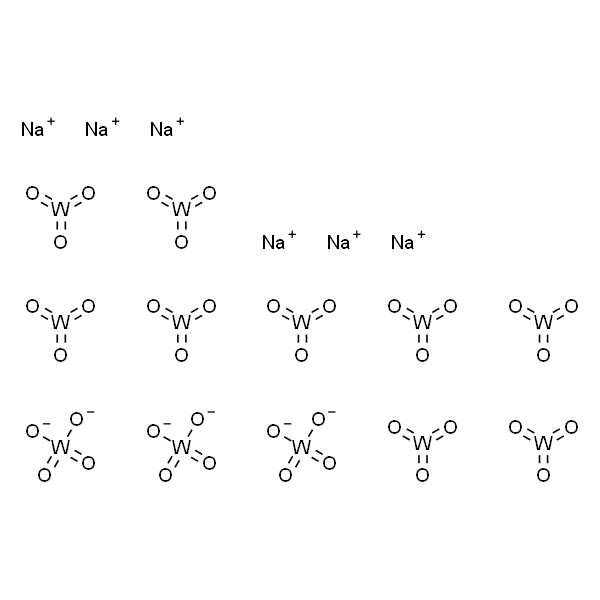
Physicochemical Properties
| Molecular Formula | 3[O4W-2].9[O3W].6[NA+] |
| Molecular Weight | 2967.9954 |
| Exact Mass | 2969.15 |
| CAS # | 12141-67-2 |
| PubChem CID | 3084108 |
| Appearance | White to off-white solid powder |
| Density | 3.1 g/cm3 |
| Index of Refraction | n20/D 1.5555 |
| Hydrogen Bond Acceptor Count | 39 |
| Heavy Atom Count | 57 |
| Complexity | 124 |
| Defined Atom Stereocenter Count | 0 |
| HS Tariff Code | 2934.99.9001 |
| Storage |
Powder-20°C 3 years 4°C 2 years In solvent -80°C 6 months -20°C 1 month Note: Please store this product in a sealed and protected environment, avoid exposure to moisture. |
| Shipping Condition | Room temperature (This product is stable at ambient temperature for a few days during ordinary shipping and time spent in Customs) |
Biological Activity
| Targets | POM-1 is an inhibitor of ecto-nucleoside triphosphate diphosphohydrolases (NTPDases). Reported Ki values are: 2.58 μM for NTPDase1, 28.8 μM for NTPDase2, and 3.26 μM for NTPDase3. [1] |
| ln Vitro |
In cerebellar slices, POM-1 (100 μM) significantly inhibits the breakdown of extracellular ATP (100 μM) by ~57.4%, which is more effective than the standard inhibitor ARL 67156 (13.9% inhibition). At a lower ATP concentration (25 μM), the inhibition by POM-1 is ~68%. HPLC analysis confirms that POM-1 acts at the first step of the ATP breakdown cascade (ATP to ADP), reducing the accumulation of downstream metabolites (ADP, AMP, and adenosine). [1] Application of POM-1 (100 μM) also inhibits glutamatergic synaptic transmission at parallel fibre-Purkinje cell synapses, climbing fibre-Purkinje cell synapses in the cerebellum, and Schaffer collateral-CA1 synapses in the hippocampus. This inhibitory effect is independent of NTPDase inhibition and P2 receptor activation, and is characterized by a reduction in excitatory postsynaptic potential (EPSP) amplitude, an increase in paired-pulse ratio, and a decrease in presynaptic fiber volley amplitude. [1] |
| ln Vivo | In animal models of ischemia, POM-1 has been found to increase cardiac infarct size following ischemia and abolish the protective effects of cardiac and renal ischemic preconditioning. These effects are attributed to reduced breakdown of ATP to cytoprotective adenosine. [1] |
| Enzyme Assay |
The inhibitory efficacy of POM-1 on extracellular ATP breakdown was assessed using a malachite green phosphate assay. Cerebellar slices were incubated in phosphate-free artificial cerebrospinal fluid (aCSF) containing ATP (25 or 100 μM) with or without POM-1. Aliquots of the solution were taken at timed intervals over 30 minutes, and the accumulation of inorganic phosphate was measured colorimetrically to determine the rate of ATP hydrolysis. [1] To investigate the site of action in the ATP breakdown pathway, HPLC analysis was employed. Cerebellar slices were incubated with etheno-ATP (50 μM), and the breakdown products (etheno-ADP, etheno-AMP, etheno-adenosine) were separated and quantified using a C18 column with a potassium phosphate/methanol gradient. [1] |
| Animal Protocol |
For electrophysiology and biochemical assays, cerebellar slices (400 μm thick) were prepared from 21-28 day old male Wistar rats. Rats were killed by cervical dislocation and decapitated. Slices were cut in cold, high-Mg²⁺, low-Ca²⁺ aCSF and then stored in normal aCSF at room temperature before use. [1] Hippocampal slices (400 μm thick) were prepared from 16-22 day old Sprague-Dawley rats of either sex using a similar method, with slicing performed in ice-cold, high-Mg²⁺ aCSF. [1] |
| References |
[1]. The novel NTPDase inhibitor sodium polyoxotungstate (POM-1) inhibits ATP breakdown but also blocks central synaptic transmission, an action independent of NTPDase inhibition . Neuropharmacology, 2008, 55(7): 1251-1258. [2]. POM-1 inhibits P2 receptors and exhibits anti-inflammatory effects in macrophages . Purinergic Signalling, 2017, 13: 611-627. [3]. CD39 improves survival in microbial sepsis by attenuating systemic inflammation . The FASEB Journal, 2015, 29(1): 25. [4]. Conversion of ATP to adenosine by CD39 and CD73 in multiple myeloma can be successfully targeted together with adenosine receptor A2A blockade . Journal for immunotherapy of cancer, 2020, 8(1). |
| Additional Infomation |
POM-1 (sodium polyoxotungstate) is a polyoxometalate and represents a new class of NTPDase inhibitors. It is more potent than the previously standard inhibitor ARL 67156. [1] Its mechanism of inhibition appears non-competitive or of much higher affinity compared to ATP, as its efficacy is less dependent on substrate concentration. [1] While POM-1 is an effective tool for inhibiting extracellular ATP metabolism in reduced systems like brain slices, its utility in intact preparations is limited by a significant off-target effect: the direct inhibition of glutamatergic synaptic transmission, which is independent of its action on purinergic signalling pathways. [1] |
Solubility Data
| Solubility (In Vitro) |
H2O : ~50 mg/mL (~16.74 mM) DMSO : ~50 mg/mL (~16.74 mM) |
| Solubility (In Vivo) |
Solubility in Formulation 1: ≥ 2.5 mg/mL (0.84 mM) (saturation unknown) in 10% DMSO + 40% PEG300 + 5% Tween80 + 45% Saline (add these co-solvents sequentially from left to right, and one by one), clear solution. For example, if 1 mL of working solution is to be prepared, you can add 100 μL of 25.0 mg/mL clear DMSO stock solution to 400 μL PEG300 and mix evenly; then add 50 μL Tween-80 to the above solution and mix evenly; then add 450 μL normal saline to adjust the volume to 1 mL. Preparation of saline: Dissolve 0.9 g of sodium chloride in 100 mL ddH₂ O to obtain a clear solution. Solubility in Formulation 2: ≥ 2.5 mg/mL (0.84 mM) (saturation unknown) in 10% DMSO + 90% (20% SBE-β-CD in Saline) (add these co-solvents sequentially from left to right, and one by one), clear solution. For example, if 1 mL of working solution is to be prepared, you can add 100 μL of 25.0 mg/mL clear DMSO stock solution to 900 μL of 20% SBE-β-CD physiological saline solution and mix evenly. Preparation of 20% SBE-β-CD in Saline (4°C,1 week): Dissolve 2 g SBE-β-CD in 10 mL saline to obtain a clear solution. Solubility in Formulation 3: ≥ 2.5 mg/mL (0.84 mM) (saturation unknown) in 10% DMSO + 90% Corn Oil (add these co-solvents sequentially from left to right, and one by one), clear solution. For example, if 1 mL of working solution is to be prepared, you can add 100 μL of 25.0 mg/mL clear DMSO stock solution to 900 μL of corn oil and mix evenly. Solubility in Formulation 4: 100 mg/mL (33.49 mM) in PBS (add these co-solvents sequentially from left to right, and one by one), clear solution; with ultrasonication. (Please use freshly prepared in vivo formulations for optimal results.) |
| Preparing Stock Solutions | 1 mg | 5 mg | 10 mg | |
| 1 mM | 0.3369 mL | 1.6846 mL | 3.3693 mL | |
| 5 mM | 0.0674 mL | 0.3369 mL | 0.6739 mL | |
| 10 mM | 0.0337 mL | 0.1685 mL | 0.3369 mL |