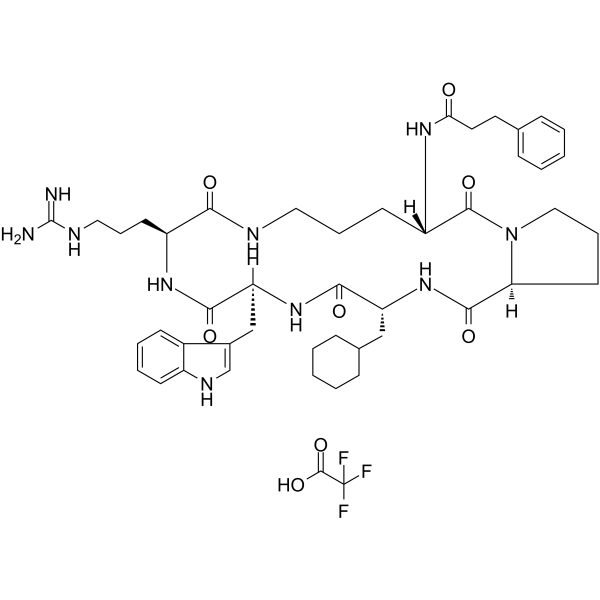
Physicochemical Properties
| Molecular Formula | C47H63F3N10O8 |
| Molecular Weight | 953.06 |
| Related CAS # | PMX 205;514814-49-4 |
| Appearance | White to off-white solid powder |
| HS Tariff Code | 2934.99.9001 |
| Storage |
Powder-20°C 3 years 4°C 2 years In solvent -80°C 6 months -20°C 1 month Note: Please store this product in a sealed and protected environment, avoid exposure to moisture. |
| Shipping Condition | Room temperature (This product is stable at ambient temperature for a few days during ordinary shipping and time spent in Customs) |
Biological Activity
| Targets | C5aR[1] |
| ln Vitro | G protein-coupled cell-surface C5aR is activated by complement activation product C5a, which is known to attract and activate microglia and astrocytes in vitro. By comparing each group to the negative control group in the 24-hour plate MTT assay, it is evident that each is significant. The values for the EP54 group, Tamoxifen group, and PMX 205 (PMX205) group range from 0.09893 to 0.2464, 0.02724 to 0.1748, and 0.09880 to 0.2464, respectively. During the 48-hour incubation period, PMX 205 and Tamoxifen are the only two groups exhibiting noteworthy outcomes. Between 0.04987 and 0.3273 and 0.5777 and 0.8551, respectively, are the recorded values. Only PMX 205 (antagonist group), with a value reported between 0.02136 and 0.5322, exhibits a significant result for the 72-hour plate[1]. |
| ln Vivo | PMX 205, sometimes known as PMX205, is a selective and active oral C5aR antagonist. When compared to rats treated with a vehicle, animals treated with PMX 205 (1 mg/kg/day, oral) show a significant extension of survival time and a reduction in end-stage motor scores. In the lumbar spinal cord, animals treated with PMX 205 also show decreased levels of astroglial growth. PMX 205 (1 mg/kg/day) is administered orally to SOD1G93A rats starting two days (days 28 and 70) prior to the onset of significant clinical signs. The life times of both treatment groups are significantly longer than those of the untreated rats (p=0.022, day 28; p=0.015, day 70), and there are no appreciable changes in the results of the two treatment plans[2]. When Tg2576 mice are 12 to 15 months old—when amyloid deposits in these animals rapidly accumulate—they are given 20 μg/mL of PMX 205 (PMX205) in their drinking water (n=17). Eleven untreated Tg2576 animals serve as the controls. Compared to untreated animals, PMX 205-treated animals have a markedly lower fibrillar plaque load (thioflavine reactivity) after three months. Additionally, PMX 205 dramatically lowers hyperphosphorylated tau (69%) in 3×Tg mice[3]. |
| References |
[1]. Expression of complement C5a receptor and the viability of 4T1 tumor cells following agonist-antagonist treatment. J Cancer Res Ther. 2016 Apr-Jun;12(2):590-6. [2]. The complement factor C5a contributes to pathology in a rat model of amyotrophic lateral sclerosis. J Immunol. 2008 Dec 15;181(12):8727-34. [3]. Treatment with a C5aR antagonist decreases pathology and enhances behavioral performance in murine models of Alzheimer's disease. J Immunol. 2009 Jul 15;183(2):1375-83. |
Solubility Data
| Solubility (In Vitro) |
DMSO :≥ 100 mg/mL (~104.93 mM) H2O :< 0.1 mg/mL |
| Solubility (In Vivo) |
Solubility in Formulation 1: ≥ 2.5 mg/mL (2.62 mM) (saturation unknown) in 10% DMSO + 40% PEG300 + 5% Tween80 + 45% Saline (add these co-solvents sequentially from left to right, and one by one), clear solution. For example, if 1 mL of working solution is to be prepared, you can add 100 μL of 25.0 mg/mL clear DMSO stock solution to 400 μL PEG300 and mix evenly; then add 50 μL Tween-80 to the above solution and mix evenly; then add 450 μL normal saline to adjust the volume to 1 mL. Preparation of saline: Dissolve 0.9 g of sodium chloride in 100 mL ddH₂ O to obtain a clear solution. Solubility in Formulation 2: ≥ 2.5 mg/mL (2.62 mM) (saturation unknown) in 10% DMSO + 90% (20% SBE-β-CD in Saline) (add these co-solvents sequentially from left to right, and one by one), clear solution. For example, if 1 mL of working solution is to be prepared, you can add 100 μL of 25.0 mg/mL clear DMSO stock solution to 900 μL of 20% SBE-β-CD physiological saline solution and mix evenly. Preparation of 20% SBE-β-CD in Saline (4°C,1 week): Dissolve 2 g SBE-β-CD in 10 mL saline to obtain a clear solution. Solubility in Formulation 3: ≥ 2.5 mg/mL (2.62 mM) (saturation unknown) in 10% DMSO + 90% Corn Oil (add these co-solvents sequentially from left to right, and one by one), clear solution. For example, if 1 mL of working solution is to be prepared, you can add 100 μL of 25.0 mg/mL clear DMSO stock solution to 900 μL of corn oil and mix evenly. (Please use freshly prepared in vivo formulations for optimal results.) |
| Preparing Stock Solutions | 1 mg | 5 mg | 10 mg | |
| 1 mM | 1.0493 mL | 5.2463 mL | 10.4925 mL | |
| 5 mM | 0.2099 mL | 1.0493 mL | 2.0985 mL | |
| 10 mM | 0.1049 mL | 0.5246 mL | 1.0493 mL |