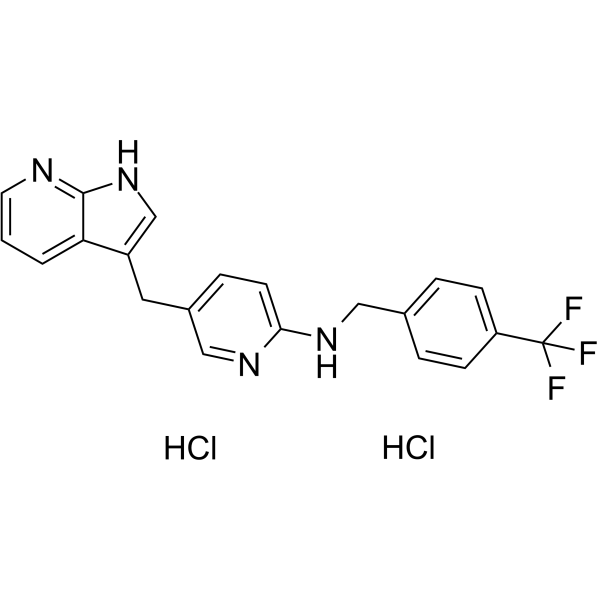
Physicochemical Properties
| Molecular Formula | C21H19CL2F3N4 |
| Molecular Weight | 455.30 |
| Exact Mass | 454.093 |
| CAS # | 1779796-38-1 |
| Related CAS # | PLX647;873786-09-5 |
| PubChem CID | 78243730 |
| Appearance | Typically exists as solid at room temperature |
| Hydrogen Bond Donor Count | 4 |
| Hydrogen Bond Acceptor Count | 6 |
| Rotatable Bond Count | 5 |
| Heavy Atom Count | 30 |
| Complexity | 493 |
| Defined Atom Stereocenter Count | 0 |
| SMILES | C(C1=CN=C(NCC2C=CC(C(F)(F)F)=CC=2)C=C1)C1=CNC2=NC=CC=C12.Cl |
| InChi Key | MVMKWLRKACAUTB-UHFFFAOYSA-N |
| InChi Code | InChI=1S/C21H17F3N4.2ClH/c22-21(23,24)17-6-3-14(4-7-17)11-26-19-8-5-15(12-27-19)10-16-13-28-20-18(16)2-1-9-25-20;;/h1-9,12-13H,10-11H2,(H,25,28)(H,26,27);2*1H |
| Chemical Name | 5-(1H-pyrrolo[2,3-b]pyridin-3-ylmethyl)-N-[[4-(trifluoromethyl)phenyl]methyl]pyridin-2-amine;dihydrochloride |
| HS Tariff Code | 2934.99.9001 |
| Storage |
Powder-20°C 3 years 4°C 2 years In solvent -80°C 6 months -20°C 1 month |
| Shipping Condition | Room temperature (This product is stable at ambient temperature for a few days during ordinary shipping and time spent in Customs) |
Biological Activity
| ln Vitro | PLX647 dihydrochloride has an IC50 of 92 nM and potently suppresses BCR-FMS cell growth in vitro. An IC50 of 180 nM for PLX647 dihydrochloride similarly indicates that a related Ba/F3 cell line expressing BCR-KIT is very susceptible to the drug. Moreover, ligand-dependent cell lines that express FMS and KIT, respectively, such as M-NFS-60 (IC50=380 nM) and M-07e (IC50=230 nM), show that PLX647 dihydrochloride suppresses endogenous FMS and KIT[1]. FLT3-ITD-expressing MV4-11 cells are potently inhibited from growing by PLX647 dihydrochloride (IC50=110 nM). The growth of Ba/F3 cells expressing BCR-KDR is only slightly inhibited by PLX647 dihydrochloride (IC50=5 μM). The osteoclast differentiation is inhibited by PLX647 dihydrochloride, with an IC50 of 0.17 μM[1]. |
| ln Vivo | In UUO kidney and blood monocytes, PLX647 dihydrochloride (40 mg/kg; po; twice daily for 7 days) decreases macrophage accumulation[1]. Male Swiss Webster mice exposed to 40 mg/kg of PLX647 dihydrochloride po decrease the release of IL-6 and TNF-α after exposure to LPS[1]. On collagen-induced arthritis, PLX647 dihydrochloride (20–80 mg/kg; po; once or twice daily from 27–41 days) exhibits effects[1]. Bone osteolysis and TRAP5b immunostaining are significantly inhibited by PLX647 dihydrochloride (30 mg/kg). The ability of PLX647 dihydrochloride (30 mg/kg BID) to stop tumor cells from damaging bone[1]. |
| Animal Protocol |
Animal/Disease Models: Male C57BL/6 mice (mouse unilateral ureter obstruction model)[1] Doses: 40 mg/kg Route of Administration: Po; twice (two times) daily for 7 days Experimental Results: Resulted in reduction in the levels of F4/80+ macrophages by 77%. Animal/Disease Models: 7-9 wk old Male DBA/1J mice ( Mouse collagen-induced arthritis model)[1] Doses: 20 mg/kg, 80 mg/kg Route of Administration: Po; daily (20 mg/kg) from 27-41 days, twice (two times) daily (80 mg/kg) from 27-41 days Experimental Results: 20 mg/kg PLX647 had no initial effect on the development of severe arthritis. However, starting on day 33, no further development of disease severity was recorded, and a 30% inhibition of the macroscopic signs of arthritis was evident in clinical score on day 41. Mice treated with 80 mg/kg BID PLX647 initially shows delayed development of severe arthritic signs. Starting on day 33, the signs of arthritis began to decrease in this treatment group, reaching a maximum reversal of 76% on day 41. |
| References |
[1]. Design and pharmacology of a highly specific dual FMS and KIT kinase inhibitor. Proc Natl Acad Sci U S A. 2013 Apr 2;110(14):5689-94. |
Solubility Data
| Solubility (In Vitro) | May dissolve in DMSO (in most cases), if not, try other solvents such as H2O, Ethanol, or DMF with a minute amount of products to avoid loss of samples |
| Solubility (In Vivo) |
Note: Listed below are some common formulations that may be used to formulate products with low water solubility (e.g. < 1 mg/mL), you may test these formulations using a minute amount of products to avoid loss of samples. Injection Formulations (e.g. IP/IV/IM/SC) Injection Formulation 1: DMSO : Tween 80: Saline = 10 : 5 : 85 (i.e. 100 μL DMSO stock solution → 50 μL Tween 80 → 850 μL Saline) *Preparation of saline: Dissolve 0.9 g of sodium chloride in 100 mL ddH ₂ O to obtain a clear solution. Injection Formulation 2: DMSO : PEG300 :Tween 80 : Saline = 10 : 40 : 5 : 45 (i.e. 100 μL DMSO → 400 μLPEG300 → 50 μL Tween 80 → 450 μL Saline) Injection Formulation 3: DMSO : Corn oil = 10 : 90 (i.e. 100 μL DMSO → 900 μL Corn oil) Example: Take the Injection Formulation 3 (DMSO : Corn oil = 10 : 90) as an example, if 1 mL of 2.5 mg/mL working solution is to be prepared, you can take 100 μL 25 mg/mL DMSO stock solution and add to 900 μL corn oil, mix well to obtain a clear or suspension solution (2.5 mg/mL, ready for use in animals). Injection Formulation 4: DMSO : 20% SBE-β-CD in saline = 10 : 90 [i.e. 100 μL DMSO → 900 μL (20% SBE-β-CD in saline)] *Preparation of 20% SBE-β-CD in Saline (4°C,1 week): Dissolve 2 g SBE-β-CD in 10 mL saline to obtain a clear solution. Injection Formulation 5: 2-Hydroxypropyl-β-cyclodextrin : Saline = 50 : 50 (i.e. 500 μL 2-Hydroxypropyl-β-cyclodextrin → 500 μL Saline) Injection Formulation 6: DMSO : PEG300 : castor oil : Saline = 5 : 10 : 20 : 65 (i.e. 50 μL DMSO → 100 μLPEG300 → 200 μL castor oil → 650 μL Saline) Injection Formulation 7: Ethanol : Cremophor : Saline = 10: 10 : 80 (i.e. 100 μL Ethanol → 100 μL Cremophor → 800 μL Saline) Injection Formulation 8: Dissolve in Cremophor/Ethanol (50 : 50), then diluted by Saline Injection Formulation 9: EtOH : Corn oil = 10 : 90 (i.e. 100 μL EtOH → 900 μL Corn oil) Injection Formulation 10: EtOH : PEG300:Tween 80 : Saline = 10 : 40 : 5 : 45 (i.e. 100 μL EtOH → 400 μLPEG300 → 50 μL Tween 80 → 450 μL Saline) Oral Formulations Oral Formulation 1: Suspend in 0.5% CMC Na (carboxymethylcellulose sodium) Oral Formulation 2: Suspend in 0.5% Carboxymethyl cellulose Example: Take the Oral Formulation 1 (Suspend in 0.5% CMC Na) as an example, if 100 mL of 2.5 mg/mL working solution is to be prepared, you can first prepare 0.5% CMC Na solution by measuring 0.5 g CMC Na and dissolve it in 100 mL ddH2O to obtain a clear solution; then add 250 mg of the product to 100 mL 0.5% CMC Na solution, to make the suspension solution (2.5 mg/mL, ready for use in animals). Oral Formulation 3: Dissolved in PEG400 Oral Formulation 4: Suspend in 0.2% Carboxymethyl cellulose Oral Formulation 5: Dissolve in 0.25% Tween 80 and 0.5% Carboxymethyl cellulose Oral Formulation 6: Mixing with food powders Note: Please be aware that the above formulations are for reference only. InvivoChem strongly recommends customers to read literature methods/protocols carefully before determining which formulation you should use for in vivo studies, as different compounds have different solubility properties and have to be formulated differently. (Please use freshly prepared in vivo formulations for optimal results.) |
| Preparing Stock Solutions | 1 mg | 5 mg | 10 mg | |
| 1 mM | 2.1964 mL | 10.9818 mL | 21.9635 mL | |
| 5 mM | 0.4393 mL | 2.1964 mL | 4.3927 mL | |
| 10 mM | 0.2196 mL | 1.0982 mL | 2.1964 mL |