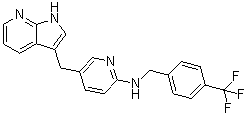
PLX-647 (PLX647) is a novel, potent and highly specific dual FMS/KIT kinase inhibitor with anticancer activity. With IC50 values of 28/16 nM, it inhibits both FMS and KIt. When compared to other kinases, PLX647 exhibits high selectivity. With distinct dual FMS and KIT specificity, PLX647 belongs to a special class of kinase inhibitors.
Physicochemical Properties
| Molecular Formula | C21H17F3N4 |
| Molecular Weight | 382.381694555283 |
| Exact Mass | 382.14 |
| Elemental Analysis | C, 65.96; H, 4.48; F, 14.91; N, 14.65 |
| CAS # | 873786-09-5 |
| Related CAS # | PLX647 dihydrochloride;1779796-38-1 |
| PubChem CID | 11545419 |
| Appearance | white solid powder |
| Density | 1.4±0.1 g/cm3 |
| Boiling Point | 552.8±50.0 °C at 760 mmHg |
| Flash Point | 288.1±30.1 °C |
| Vapour Pressure | 0.0±1.5 mmHg at 25°C |
| Index of Refraction | 1.654 |
| LogP | 4.77 |
| Hydrogen Bond Donor Count | 2 |
| Hydrogen Bond Acceptor Count | 6 |
| Rotatable Bond Count | 5 |
| Heavy Atom Count | 28 |
| Complexity | 493 |
| Defined Atom Stereocenter Count | 0 |
| SMILES | FC(C1C=CC(CNC2C=CC(CC3C4C(=NC=CC=4)NC=3)=CN=2)=CC=1)(F)F |
| InChi Key | NODCQQSEMCESEC-UHFFFAOYSA-N |
| InChi Code | InChI=1S/C21H17F3N4/c22-21(23,24)17-6-3-14(4-7-17)11-26-19-8-5-15(12-27-19)10-16-13-28-20-18(16)2-1-9-25-20/h1-9,12-13H,10-11H2,(H,25,28)(H,26,27) |
| Chemical Name | 5-(1H-pyrrolo[2,3-b]pyridin-3-ylmethyl)-N-[[4-(trifluoromethyl)phenyl]methyl]pyridin-2-amine |
| Synonyms | PLX-647; PLX 647; PLX647 |
| HS Tariff Code | 2934.99.9001 |
| Storage |
Powder-20°C 3 years 4°C 2 years In solvent -80°C 6 months -20°C 1 month |
| Shipping Condition | Room temperature (This product is stable at ambient temperature for a few days during ordinary shipping and time spent in Customs) |
Biological Activity
| ln Vitro |
PLX647 has an IC50 of 92 nM and strongly suppresses BCR-FMS cell proliferation in vitro. Similarly, a corresponding Ba/F3 cell line that expresses BCR-KIT has an IC50 of 180 nM, making it highly sensitive to PLX647. Moreover, ligand-dependent cell lines that express FMS and KIT, respectively, such as M-NFS-60 (IC50=380 nM) and M-07e (IC50=230 nM), show that PLX647 inhibits endogenous FMS and KIT[1]. PLX647 inhibits FLT3-ITD-expressing MV4-11 cell growth potently (IC50=110 nM). The proliferation of Ba/F3 cells expressing BCR-KDR was minimally inhibited by PLX647 (IC50=5 μM). With an IC50 of 0.17 μM, PLX647 inhibits the differentiation of osteoclasts[1]. |
| ln Vivo |
PLX647 (40 mg/kg; p.o.; twice daily for 7 days) decreases the accumulation of macrophages in UUO kidney and blood monocytes[1]. PLX647 (40 mg/kg; p.o.; male Swiss Webster mice) inhibits the release of TNF-α and IL-6 triggered by LPS[1]. PLX647 (20–80 mg/kg; p.o.; once or twice daily for 27–41 days) exhibits effects on arthritis caused by collagen[1]. PLX647 (30 mg/kg) causes TRAP5b immunostaining and bone osteolysis to be significantly inhibited. Tumor cell-induced bone damage can be avoided with PLX647 (30 mg/kg BID)[1]. |
| Animal Protocol |
Male C57BL/6 mice (mouse unilateral ureter obstruction model)[1] 40 mg/kg P.o.; twice daily for 7 days |
| References |
[1]. Design and pharmacology of a highly specific dual FMS and KIT kinase inhibitor. Proc Natl Acad Sci U S A. 2013 Apr 2;110(14):5689-94. [2]. Tyrosine kinase inhibitors reverse type 1 diabetes in nonobese diabetic mice. Proc Natl Acad Sci U S A. 2008 Dec 2;105(48):18895-900. |
Solubility Data
| Solubility (In Vitro) | DMSO: ~25 mg/mL (~65.4 mM) |
| Solubility (In Vivo) |
Solubility in Formulation 1: ≥ 2.5 mg/mL (6.54 mM) (saturation unknown) in 10% DMSO + 40% PEG300 + 5% Tween80 + 45% Saline (add these co-solvents sequentially from left to right, and one by one), clear solution. For example, if 1 mL of working solution is to be prepared, you can add 100 μL of 25.0 mg/mL clear DMSO stock solution to 400 μL PEG300 and mix evenly; then add 50 μL Tween-80 to the above solution and mix evenly; then add 450 μL normal saline to adjust the volume to 1 mL. Preparation of saline: Dissolve 0.9 g of sodium chloride in 100 mL ddH₂ O to obtain a clear solution. Solubility in Formulation 2: ≥ 2.5 mg/mL (6.54 mM) (saturation unknown) in 10% DMSO + 90% Corn Oil (add these co-solvents sequentially from left to right, and one by one), clear solution. For example, if 1 mL of working solution is to be prepared, you can add 100 μL of 25.0 mg/mL clear DMSO stock solution to 900 μL of corn oil and mix evenly. (Please use freshly prepared in vivo formulations for optimal results.) |
| Preparing Stock Solutions | 1 mg | 5 mg | 10 mg | |
| 1 mM | 2.6152 mL | 13.0760 mL | 26.1520 mL | |
| 5 mM | 0.5230 mL | 2.6152 mL | 5.2304 mL | |
| 10 mM | 0.2615 mL | 1.3076 mL | 2.6152 mL |