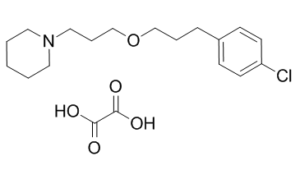
Pitolisant oxalate (formerly BF2649; BF2.649; Ciproxidine; Tiprolisant; Wakix), the oxalate salt of pitolisant, is a novel nonimidazole analog and an inverse agonist of the recombinant human histamine H3 receptor with Ki of 0.16 nM. It has gained FDA approval in 2019 for the treatment of excessive daytime sleepiness in adults with narcolepsy.
Physicochemical Properties
| Molecular Formula | C19H28CLNO5 |
| Molecular Weight | 385.8823 |
| Exact Mass | 385.165 |
| CAS # | 362665-57-4 |
| Related CAS # | Pitolisant;362665-56-3;Pitolisant hydrochloride;903576-44-3 |
| PubChem CID | 23137286 |
| Appearance | Off-white to light yellow solid powder |
| Hydrogen Bond Donor Count | 2 |
| Hydrogen Bond Acceptor Count | 6 |
| Rotatable Bond Count | 9 |
| Heavy Atom Count | 26 |
| Complexity | 307 |
| Defined Atom Stereocenter Count | 0 |
| SMILES | ClC1C([H])=C([H])C(=C([H])C=1[H])C([H])([H])C([H])([H])C([H])([H])OC([H])([H])C([H])([H])C([H])([H])N1C([H])([H])C([H])([H])C([H])([H])C([H])([H])C1([H])[H].O([H])C(C(=O)O[H])=O |
| InChi Key | OZTKSXOIWBLDBB-UHFFFAOYSA-N |
| InChi Code | InChI=1S/C17H26ClNO.C2H2O4/c18-17-9-7-16(8-10-17)6-4-14-20-15-5-13-19-11-2-1-3-12-19;3-1(4)2(5)6/h7-10H,1-6,11-15H2;(H,3,4)(H,5,6) |
| Chemical Name | 1-(3-(3-(4-Chlorophenyl)propoxy)propyl)piperidine oxalate |
| Synonyms | FUB-649 oxalate, FUB649, BF-2649; FUB 649; BF2.649; BF2649 oxalate; B F2649; Pitolisant, Tiprolisant; Pitolisant oxalate; Pitolisant oxalate |
| HS Tariff Code | 2934.99.9001 |
| Storage |
Powder-20°C 3 years 4°C 2 years In solvent -80°C 6 months -20°C 1 month |
| Shipping Condition | Room temperature (This product is stable at ambient temperature for a few days during ordinary shipping and time spent in Customs) |
Biological Activity
| ln Vitro | Pitolisant (BF2.649) exhibits competitive antagonistic behavior, with a Ki value of 0.16 nM and an inverse EC50, when it comes to stimulating the binding of guanosine 5'-O-(3-[35S]thio)triphosphate to this receptor. The agonist value is 1.5 nM, and the intrinsic activity is roughly 50% higher than that of ciproxifene. Pitolisant has an IC50 value of 26.4±4.5 nM, which is sufficient to displace [125I]iodoproxyfan binding on mouse brain cortical membranes. Pitolisant's derived Ki value is 14±1 nM, based on the radioligand's Kd value of 161±9 pM. Pitolisant, with an IC50 value of 4.2±0.2 nM, displaces [125I]iodoproxyfan binding on the membrane of rat glioma C6 cells that are stably expressing human H3 receptors. Pitolisant's derived Ki value is 2.7±0.5 nM, based on the radioligand's Kd value of 50±4 pM. With a Hill coefficient close to 1 and an IC50 value of 330±68 nM, pitolisant progressively reverses this process, yielding a Ki value of 17±4 nM. With an EC50 value of 1.5±0.1 nM, pitolisant reduces basal specific [35S]GTPγS binding to membranes in a dose-dependent manner, with a maximum impact equal to 75±1% of basal specific binding [1]. |
| ln Vivo | The immobility period in the FST was also considerably impacted by a single dosage of olanzapine (2 mg/kg bw) given 30 minutes before to a single dose of pitolisantat (10 mg/kg). When the above medication sequence was subsequently given to mice, the length of immobility was statistically substantially longer than when the time for controls was measured in the footsie test. Moreover, it lessens motor activity. On the other hand, after 15 subchronic administrations of both medications (Pitolisant 10 mg/kg bw, olanzapine 2 mg/kg bw after 30 min, and olanzapine 2 mg/kg bw after 4 h), the locomotor activity of the mice was balanced when Pitolisant was dosed first, followed by Olanzapine, as opposed to when Pitolisant was administered alone. More notably, in the mouse forced swim test, this medication combination dramatically shortened immobility time to levels attained by the control group [one-way ANOVA; F(3,20)=4.226, P=0.0181][2]. Rats administered 10 mg/kg of pitolisant during the conditioning phase spent 502±94 seconds on the paired texture; this number did not differ statistically from the control group, suggesting that pitolisant does not support location preference [3]. |
| References |
[1]. Ligneau X, et al. BF2.649 [1-{3-[3-(4-Chlorophenyl)propoxy]propyl}piperidine, hydrochloride], a nonimidazole inverse agonist/antagonist at the human histamine H3 receptor: Preclinical pharmacology. J Pharmacol Exp Ther. 2007 Jan;320(1):365-75. [2]. Dudek M, et al. H3 histamine receptor antagonist pitolisant reverses some subchronic disturbances induced by olanzapine in mice. Metab Brain Dis. 2016 Oct;31(5):1023-9. [3]. Uguen M, et al. Preclinical evaluation of the abuse potential of Pitolisant, a histamine H? receptor inverse agonist/antagonist compared with Modafinil. Br J Pharmacol. 2013 Jun;169(3):632-44 |
Solubility Data
| Solubility (In Vitro) | DMSO : ~50 mg/mL (~129.57 mM) |
| Solubility (In Vivo) |
Solubility in Formulation 1: ≥ 2.5 mg/mL (6.48 mM) (saturation unknown) in 10% DMSO + 40% PEG300 + 5% Tween80 + 45% Saline (add these co-solvents sequentially from left to right, and one by one), clear solution. For example, if 1 mL of working solution is to be prepared, you can add 100 μL of 25.0 mg/mL clear DMSO stock solution to 400 μL PEG300 and mix evenly; then add 50 μL Tween-80 to the above solution and mix evenly; then add 450 μL normal saline to adjust the volume to 1 mL. Preparation of saline: Dissolve 0.9 g of sodium chloride in 100 mL ddH₂ O to obtain a clear solution. Solubility in Formulation 2: ≥ 2.5 mg/mL (6.48 mM) (saturation unknown) in 10% DMSO + 90% (20% SBE-β-CD in Saline) (add these co-solvents sequentially from left to right, and one by one), clear solution. For example, if 1 mL of working solution is to be prepared, you can add 100 μL of 25.0 mg/mL clear DMSO stock solution to 900 μL of 20% SBE-β-CD physiological saline solution and mix evenly. Preparation of 20% SBE-β-CD in Saline (4°C,1 week): Dissolve 2 g SBE-β-CD in 10 mL saline to obtain a clear solution. Solubility in Formulation 3: ≥ 2.5 mg/mL (6.48 mM) (saturation unknown) in 10% DMSO + 90% Corn Oil (add these co-solvents sequentially from left to right, and one by one), clear solution. For example, if 1 mL of working solution is to be prepared, you can add 100 μL of 25.0 mg/mL clear DMSO stock solution to 900 μL of corn oil and mix evenly. (Please use freshly prepared in vivo formulations for optimal results.) |
| Preparing Stock Solutions | 1 mg | 5 mg | 10 mg | |
| 1 mM | 2.5915 mL | 12.9574 mL | 25.9148 mL | |
| 5 mM | 0.5183 mL | 2.5915 mL | 5.1830 mL | |
| 10 mM | 0.2591 mL | 1.2957 mL | 2.5915 mL |