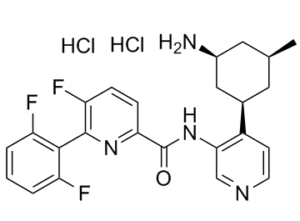
PIM447 2HCl (also known as LGH447 dihydrochloride), the dihydrochloride salt of PIM447, is a novel and potent pan-PIM (proviral insertion site of Moloney murine leukemia) kinase inhibitor with Ki values of 6 pM, 18 pM, 9 pM for PIM1, PIM2, PIM3 respectively. It also inhibits GSK3β, PKN1, and PKCτ, but at a significantly lower potency with IC50 between 1 and 5 μM (>105-fold differential relative to the Ki on PIMs). PIM447 is cytotoxic for myeloma cells due to cell cycle disruption and induction of apoptosis mediated by a decrease in phospho-Bad (Ser112) and c-Myc levels and the inhibition of mTORC1 pathway. PIM447 is currently undergoing several clinical trials.
Physicochemical Properties
| Molecular Formula | C24H25CL2F3N4O | |
| Molecular Weight | 513.39 | |
| Exact Mass | 512.135 | |
| CAS # | 1820565-69-2 | |
| Related CAS # | PIM447;1210608-43-7;(1S,3R,5R)-PIM447 dihydrochloride | |
| PubChem CID | 122198133 | |
| Appearance | White to off-white solid powder | |
| Hydrogen Bond Donor Count | 4 | |
| Hydrogen Bond Acceptor Count | 7 | |
| Rotatable Bond Count | 4 | |
| Heavy Atom Count | 34 | |
| Complexity | 630 | |
| Defined Atom Stereocenter Count | 3 | |
| SMILES | C[C@H]1C[C@H](C[C@H](C1)N)C2=C(C=NC=C2)NC(=O)C3=NC(=C(C=C3)F)C4=C(C=CC=C4F)F.Cl.Cl |
|
| InChi Key | BVRSHQQSBGCMJE-ALGQTRDQSA-N | |
| InChi Code | InChI=1S/C24H23F3N4O.2ClH/c1-13-9-14(11-15(28)10-13)16-7-8-29-12-21(16)31-24(32)20-6-5-19(27)23(30-20)22-17(25)3-2-4-18(22)26;;/h2-8,12-15H,9-11,28H2,1H3,(H,31,32);2*1H/t13-,14+,15-;;/m0../s1 | |
| Chemical Name | N-[4-[(1R,3S,5S)-3-amino-5-methylcyclohexyl]pyridin-3-yl]-6-(2,6-difluorophenyl)-5-fluoropyridine-2-carboxamide;dihydrochloride | |
| Synonyms |
|
|
| HS Tariff Code | 2934.99.9001 | |
| Storage |
Powder-20°C 3 years 4°C 2 years In solvent -80°C 6 months -20°C 1 month Note: Please store this product in a sealed and protected environment, avoid exposure to moisture. |
|
| Shipping Condition | Room temperature (This product is stable at ambient temperature for a few days during ordinary shipping and time spent in Customs) |
Biological Activity
| ln Vitro | With IC50 values ranging from 0.2 to 3.3 μM for sensitive cell lines (MM1S, MM1R, RPMI-8226, MM144, U266, and NCI-H929) and less sensitive cell lines (OPM-2, RPMI-LR5, U266-Dox4, and U266-LR7) with IC50 values >7 μM at 48 hours, PIM-447 dihydrochloride (0.05-10 μM; 24, 48, and 72 hours) is inhibitory to MM cells [1]. When PIM-447 dihydrochloride is at 5 μM, it significantly increases annexin-sensitive cell lines (MM1S, NCI-H929, and RPMI-8226) (approximately 30%), but it does not cause significant levels of apoptosis at concentrations of 0.1–10 μM over 24, 48, or 72 hours. PIM447 causes apoptosis in all cell lines at 10 μM, but it affects OPM-2 and RPMI-LR5 less severely [1]. In MM1S, RPMI-8226, and NCI-H929 cells, PIM447 increases cleavage of effector caspases 3 and 7, and promotes cleavage of initiating caspases, such as caspases 8 and 9. cutting with PARP [1]. PIM447 (0.1–1 μM) reduces the proliferation phase of the cell cycle (S and G2/M) and raises the proportion of cells in the G0/G1 phase. Compared to OPM-2, the impact of MM1S cells is more noticeable at low concentrations (0.1–1 μM) [1]. |
| ln Vivo | In a mouse model of bone marrow disseminated human multiple myeloma, PIM447 (oral gavage; 100 mg/kg; 5 times/week) significantly controlled tumor progression and serum levels of hIgλ secreted by RPMI-8226-luc cells [1]. |
| Cell Assay |
Cell Viability Assay[1] Cell Types: Sensitive MM Cell Types: MM1S, MM1R, RPMI-8226, MM144, U266 and NCI-H929 cells Less sensitive MM Cell Types: OPM-2,RPMI-LR5, U266-Dox4 and U266- LR7cells Tested Concentrations: 0.05-10 µM Incubation Duration: 24, 48 and 72 hrs (hours) Experimental Results: Was cytotoxic for MM cells (PIM kinases highly expressed). Apoptosis Analysis[1] Cell Types: Sensitive MM Cell Types: MM1S, NCI-H929 and RPMI -8226 cells Less sensitive MM Cell Types: OPM-2 and RPMI-LR5 cells Tested Concentrations: 0.05-10 µM Incubation Duration: 24, 48 and 72 hrs (hours) Experimental Results: Induced cell apoptosis at higer doses, had no effects at 0.1-1 uM. Western Blot Analysis[1] Cell Types: Sensitive MM Cell Types: MM1S, NCI-H929 and RPMI-8226 cells Tested Concentrations: 0.05-10 µM Incubation Duration: 24, 48 hrs (hours) Experimental Results: Increased the cleavage of the effector caspases 3 and 7, and the PARP cleavage. Cell Cycle Analysis[1] Cell Types: MM1S, OPM-2 cells Tested Concentrations: 0.1, 0.5 or 1 µM Incubation Duration: 48 hrs (hours) Experimental Results: Increased the cleavage of the effector ca |
| Animal Protocol |
Animal/Disease Models: RPMI-8226-luc cells are injected intravenously (iv)into 6weeks old female NODSCID-IL-2Rγ-/-(NSG) mice[1] Doses: 100 mg/kg Route of Administration: po (oral gavage); 100 mg/kg; 5 times/week Experimental Results: Was well tolerated, as the body weight of mice did not decrease by more than 10%. Increased bone volume density and trabecular number and decreased trabecular separation relative to vehicle group. |
| References |
[1]. The novel pan-PIM kinase inhibitor, PIM447, displays dual anti-myeloma and bone protective effects, and potently synergizes with current standards of care. Clin Cancer Res. 2016 Jul 20. [2]. Identification of N-(4-((1R,3S,5S)-3-Amino-5-methylcyclohexyl)pyridin-3-yl)-6-(2,6-difluorophenyl)-5-fluoropicolinamide (PIM447), a Potent and Selective Proviral Insertion Site of Moloney Murine Leukemia (PIM) 1, 2, and 3 Kinase Inhibitor in Clinical Trials for Hematological Malignancies. J Med Chem. 2015 Nov 12;58(21):8373-86. [3]. Control of translational activation by PIM kinase in activated B-cell diffuse large B-cell lymphoma confers sensitivity to inhibition by PIM447. Oncotarget. 2016 Aug 20. |
Solubility Data
| Solubility (In Vitro) |
|
|||
| Solubility (In Vivo) |
Solubility in Formulation 1: ≥ 2.5 mg/mL (4.87 mM) (saturation unknown) in 10% DMSO + 40% PEG300 + 5% Tween80 + 45% Saline (add these co-solvents sequentially from left to right, and one by one), clear solution. For example, if 1 mL of working solution is to be prepared, you can add 100 μL of 25.0 mg/mL clear DMSO stock solution to 400 μL PEG300 and mix evenly; then add 50 μL Tween-80 to the above solution and mix evenly; then add 450 μL normal saline to adjust the volume to 1 mL. Preparation of saline: Dissolve 0.9 g of sodium chloride in 100 mL ddH₂ O to obtain a clear solution. Solubility in Formulation 2: ≥ 2.5 mg/mL (4.87 mM) (saturation unknown) in 10% DMSO + 90% (20% SBE-β-CD in Saline) (add these co-solvents sequentially from left to right, and one by one), clear solution. For example, if 1 mL of working solution is to be prepared, you can add 100 μL of 25.0 mg/mL clear DMSO stock solution to 900 μL of 20% SBE-β-CD physiological saline solution and mix evenly. Preparation of 20% SBE-β-CD in Saline (4°C,1 week): Dissolve 2 g SBE-β-CD in 10 mL saline to obtain a clear solution. (Please use freshly prepared in vivo formulations for optimal results.) |
| Preparing Stock Solutions | 1 mg | 5 mg | 10 mg | |
| 1 mM | 1.9478 mL | 9.7392 mL | 19.4784 mL | |
| 5 mM | 0.3896 mL | 1.9478 mL | 3.8957 mL | |
| 10 mM | 0.1948 mL | 0.9739 mL | 1.9478 mL |