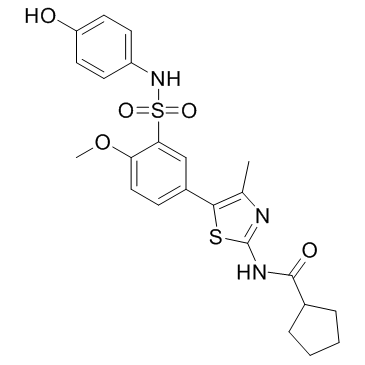
PI4KIIIβ-IN-9 (PI4KIIIbeta-IN-9) is a novel, potent and selective PI4KIIIβ (Type III phosphatidylinositol 4-kinase) inhibitor with an IC50 of 7 nM with >1000-fold over class I and class III PI3Ks. PI4KIIIbeta-IN-9 inhibits PI3K and PI3K with respective IC50 values of 152 nM and 1046 nM. The enzyme type III phosphatidylinositol 4-kinase (PI4KIII), which is involved in a number of pathogenic processes, is crucial in mediating membrane trafficking. It is a crucial host factor that facilitates RNA virus replication. It will be crucial to define this enzyme's cellular functions through the design of potent and targeted inhibitors, which could result in brand-new antiviral therapeutics. Antiviral activity against the hepatitis C virus was demonstrated by PI4KIII-IN-9. The molecular foundation of specificity is revealed by the co-crystal structure of PI4KIII bound to one of PI4KIII-IN-9. This research will be essential for developing new PI4KIII inhibitors that could be highly effective antiviral
Physicochemical Properties
| Molecular Formula | C23H25N3O5S2 |
| Molecular Weight | 487.59 |
| Exact Mass | 487.123 |
| Elemental Analysis | C, 56.66; H, 5.17; N, 8.62; O, 16.41; S, 13.15 |
| CAS # | 1429624-84-9 |
| PubChem CID | 71533728 |
| Appearance | White to off-white solid powder |
| Density | 1.4±0.1 g/cm3 |
| Index of Refraction | 1.659 |
| LogP | 3.91 |
| Hydrogen Bond Donor Count | 3 |
| Hydrogen Bond Acceptor Count | 8 |
| Rotatable Bond Count | 7 |
| Heavy Atom Count | 33 |
| Complexity | 763 |
| Defined Atom Stereocenter Count | 0 |
| SMILES | CC(N=C1NC(C2CCCC2)=O)=C(S1)C3=CC=C(C(S(=O)(NC4=CC=C(O)C=C4)=O)=C3)OC |
| InChi Key | KAXNDTMKFONXJM-UHFFFAOYSA-N |
| InChi Code | InChI=1S/C23H25N3O5S2/c1-14-21(32-23(24-14)25-22(28)15-5-3-4-6-15)16-7-12-19(31-2)20(13-16)33(29,30)26-17-8-10-18(27)11-9-17/h7-13,15,26-27H,3-6H2,1-2H3,(H,24,25,28) |
| Chemical Name | N-(5-(3-(N-(4-hydroxyphenyl)sulfamoyl)-4-methoxyphenyl)-4-methylthiazol-2-yl)cyclopentanecarboxamide |
| Synonyms | PI4KIIIβ-IN-9; PI4KIIIbeta-IN-9; PI4KIIIβ-IN 9; PI4KIIIbeta-IN 9; PI4KIIIβ-IN9; PI4KIIIbeta-IN9 |
| HS Tariff Code | 2934.99.9001 |
| Storage |
Powder-20°C 3 years 4°C 2 years In solvent -80°C 6 months -20°C 1 month |
| Shipping Condition | Room temperature (This product is stable at ambient temperature for a few days during ordinary shipping and time spent in Customs) |
Biological Activity
| Targets |
PI4KIIIβ ( IC50 = 7 nM ); PI4KIIIα ( IC50 = 2.6 μM ); PI3Kδ ( IC50 = 152 nM ); PI3Kγ ( IC50 = 1046 nM ); PI3Kα ( IC50 = 2 μM ); PI3KC2γ ( IC50 = 1 μM ); PI4KIIIbeta-IN-9 is a potent and selective inhibitor of phosphatidylinositol 4-kinase IIIβ (PI4KIIIβ). It shows >140-fold selectivity over PI3Kγ, >20-fold selectivity over PI3Kδ (PI3K6), and no inhibition of vps34 at concentrations up to 20 μM. It also shows weak inhibition of PI3KC2γ (IC50 ~1 μM), PI3Kα (IC50 ~2 μM), and PI4KIIIα (IC50 ~2.6 μM), with <50% inhibition at 20 μM for PI4KIIα, PI4KIIβ, and PI3Kβ. [1] |
| ln Vitro |
PI4KIIIbeta-IN-9 (Compound 9) exhibits weak inhibition of PI3KC2 (IC50 1 M), PI3K (2 M), and PI4KIII (2.6 M), and 50% inhibition of PI4K2, PI4K2, and PI3K at concentrations up to 20 M. The crescent-shaped PI4KIIIbeta-IN-9 (Compound 9) conforms to the active site of PI4KIII. This molecule interacts closely with PI4KIII[1]. In a biochemical kinase assay, PI4KIIIbeta-IN-9 inhibits PI4KIIIβ with an IC50 of 7 nM. [1] In a cellular Hepatitis C virus (HCV) replication assay using a Huh7.5 cell line stably infected with a Gaussia luciferase-reporting HCV clone (J6/JFH1-GLuc), PI4KIIIbeta-IN-9 exhibits anti-viral activity. [1] A cell viability assay (Presto Blue) performed alongside the HCV replication assay showed that PI4KIIIbeta-IN-9 had low cellular toxicity in this model, with the compound showing one of the best combinations of antiviral efficacy and low toxicity among the tested derivatives. [1] |
| Enzyme Assay |
Lipid kinase assays were performed using recombinant enzymes. For PI4KIIIβ, the reaction mixture contained enzyme, phosphatidylinositol (PI) substrate presented in liposomes (with DOPS and DOPC lipids), BSA, MgCl2, Triton X-100, EGTA, DTT, and ATP (including γ32P-ATP for detection). The reaction was initiated by adding the ATP mixture to the enzyme-inhibitor-substrate complex and proceeded for 30 minutes. The reaction was stopped, and the product was captured on a nitrocellulose membrane, washed, and quantified using phosphorimaging. Inhibitors were diluted in DMSO and assay buffer and pre-incubated with the enzyme and substrate mixture before starting the reaction. [1] Similar membrane capture assay formats were used for testing activity against other lipid kinases (PI3Kγ, PI3Kδ, vps34, PI4KIIIα, PI4KIIα, PI4KIIβ, PI3Kα, PI3Kβ, PI3KC2γ), with variations in buffer composition, substrate (PI or PIP2), cofactor (MgCl2 or MnCl2), and reaction time as detailed in the experimental section. [1] |
| Cell Assay |
The anti-HCV activity of PI4KIIIbeta-IN-9 was assessed using Huh7.5 cells stably infected with a fully infectious HCV reporter virus (J6/JFH1-GLuc) encoding Gaussia luciferase. Cells were plated in 96-well plates and treated with serially diluted compounds one hour after plating. After three days of incubation, cell viability was measured using a Presto Blue cell viability reagent according to the manufacturer's protocol. HCV replication was measured by quantifying Gaussia luciferase activity secreted into the supernatant using a luciferase reagent. Luminescence and viability were read using a plate reader, and EC50 (anti-viral potency) and CC50 (cytotoxicity) values were calculated. [1] |
| Toxicity/Toxicokinetics |
In the cellular HCV replication assay, a cell viability test (Presto Blue) indicated that PI4KIIIbeta-IN-9 exhibited low cellular toxicity, contributing to a favorable antiviral potency-to-toxicity profile. [1] The literature mentions conflicting reports on the lethality of PI4KIIIβ inhibitors in mice from other studies. [1] |
| References |
[1]. Design and Structural Characterization of Potent and Selective Inhibitors of Phosphatidylinositol 4 Kinase IIIβ. J Med Chem. 2016 Mar 10;59(5):1830-9. |
| Additional Infomation |
PI4KIIIbeta-IN-9 is a derivative of the previously reported inhibitor PIK93 (compound 1), designed through structure-based drug design to improve potency and selectivity for PI4KIIIβ over related lipid kinases like PI3Kγ and vps34. [1] The co-crystal structure of PI4KIIIβ bound to PI4KIIIbeta-IN-9 was solved at 3.2 Å resolution. The structure reveals key interactions: hydrogen bonds between the thiazole/acetamide moiety and Val598, between the sulfonamide and Lys549, and between the para-hydroxy group on the phenol ring and Gly660. The structure also explains the selectivity mechanism: the cyclopentyl acetamide group and the methoxy group on the central phenyl ring cause steric clashes with residues in the binding pockets of PI3Kγ and vps34. [1] PI4KIIIβ is a host factor essential for the replication of several RNA viruses, including Hepatitis C Virus (HCV), by generating PI4P-enriched membranes for viral replication complexes. Inhibitors like PI4KIIIbeta-IN-9 are therefore investigated as potential broad-spectrum antiviral agents. [1] |
Solubility Data
| Solubility (In Vitro) | DMSO : ~100 mg/mL (~205.5 mM) |
| Solubility (In Vivo) |
Solubility in Formulation 1: ≥ 2.5 mg/mL (5.13 mM) (saturation unknown) in 10% DMSO + 40% PEG300 + 5% Tween80 + 45% Saline (add these co-solvents sequentially from left to right, and one by one), clear solution. For example, if 1 mL of working solution is to be prepared, you can add 100 μL of 25.0 mg/mL clear DMSO stock solution to 400 μL PEG300 and mix evenly; then add 50 μL Tween-80 to the above solution and mix evenly; then add 450 μL normal saline to adjust the volume to 1 mL. Preparation of saline: Dissolve 0.9 g of sodium chloride in 100 mL ddH₂ O to obtain a clear solution. Solubility in Formulation 2: ≥ 2.5 mg/mL (5.13 mM) (saturation unknown) in 10% DMSO + 90% (20% SBE-β-CD in Saline) (add these co-solvents sequentially from left to right, and one by one), clear solution. For example, if 1 mL of working solution is to be prepared, you can add 100 μL of 25.0 mg/mL clear DMSO stock solution to 900 μL of 20% SBE-β-CD physiological saline solution and mix evenly. Preparation of 20% SBE-β-CD in Saline (4°C,1 week): Dissolve 2 g SBE-β-CD in 10 mL saline to obtain a clear solution. Solubility in Formulation 3: ≥ 2.5 mg/mL (5.13 mM) (saturation unknown) in 10% DMSO + 90% Corn Oil (add these co-solvents sequentially from left to right, and one by one), clear solution. For example, if 1 mL of working solution is to be prepared, you can add 100 μL of 25.0 mg/mL clear DMSO stock solution to 900 μL of corn oil and mix evenly. (Please use freshly prepared in vivo formulations for optimal results.) |
| Preparing Stock Solutions | 1 mg | 5 mg | 10 mg | |
| 1 mM | 2.0509 mL | 10.2545 mL | 20.5090 mL | |
| 5 mM | 0.4102 mL | 2.0509 mL | 4.1018 mL | |
| 10 mM | 0.2051 mL | 1.0255 mL | 2.0509 mL |