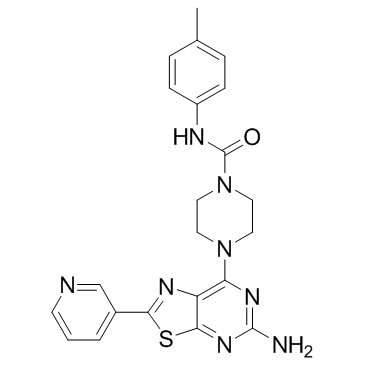
PI4KIII beta inhibitor 3, extracted from WO 2013034738 A1, is a novel and potent PI4KIIIβ inhibitor with IC50 of 5.7 nM.
Physicochemical Properties
| Molecular Formula | C22H22N8OS |
| Molecular Weight | 446.52808 |
| Exact Mass | 446.164 |
| CAS # | 1245319-54-3 |
| PubChem CID | 46916382 |
| Appearance | Light yellow to yellow solid powder |
| LogP | 4.05 |
| Hydrogen Bond Donor Count | 2 |
| Hydrogen Bond Acceptor Count | 8 |
| Rotatable Bond Count | 3 |
| Heavy Atom Count | 32 |
| Complexity | 639 |
| Defined Atom Stereocenter Count | 0 |
| InChi Key | UWTRKIJAGTTXNM-UHFFFAOYSA-N |
| InChi Code | InChI=1S/C22H22N8OS/c1-14-4-6-16(7-5-14)25-22(31)30-11-9-29(10-12-30)18-17-20(28-21(23)27-18)32-19(26-17)15-3-2-8-24-13-15/h2-8,13H,9-12H2,1H3,(H,25,31)(H2,23,27,28) |
| Chemical Name | 4-(5-amino-2-pyridin-3-yl-[1,3]thiazolo[5,4-d]pyrimidin-7-yl)-N-(4-methylphenyl)piperazine-1-carboxamide |
| Synonyms | PI4KIII beta inhibitor 3 |
| HS Tariff Code | 2934.99.9001 |
| Storage |
Powder-20°C 3 years 4°C 2 years In solvent -80°C 6 months -20°C 1 month Note: This product requires protection from light (avoid light exposure) during transportation and storage. |
| Shipping Condition | Room temperature (This product is stable at ambient temperature for a few days during ordinary shipping and time spent in Customs) |
Biological Activity
| ln Vitro | PI4KIII beta inhibitor 3 is a PI4KIII inhibitor that was taken out of WO/2013034738 A1 patent. The IC50 value of formula 3's substance is 5.7 nM. In a mixed lymphocyte reaction (MLR) assay, PI4KIII beta inhibitor 3 exhibits strong immunosuppressive activity with an IC50 value of 3 nM. PI4KIII beta inhibitor 3 has an IC50 value of less than 1 nM for both IL2 and IFNγ secretion inhibition. Thus, in terms of blocking the release of IL2 and IFNγ, PI4KIII beta inhibitor 3 is just as efficient as conventional immunosuppressants like cyclosporin A. IFNy and IL-2 are released by cyclosporin A, with IC50 values of less than 1 nM and 2 nM, respectively [1]. |
| ln Vivo | In an arthritis prevention model, PI4KIII beta inhibitor 3 (40 mg/kg daily, n = 12) reduces the severity of symptoms and delays the onset of arthritis symptoms when compared to vehicle control (MC 1%, n = 12). In a mouse model of collagen-induced arthritis, anti-CII IgG titers and histological scores are decreased by PI4KIII beta inhibitor 3. In three out of six grafts per group, oral administration of PI4KIII beta inhibitor 3 led to a prolonged graft survival at day thirty. Up to 60 days after treatment was stopped, some grafts persisted in beating, indicating the possibility that graft tolerance was induced. Animals receiving functional grafts at day 60 were challenged with a second graft from the same donor strain or from a different source in order to evaluate the procedural tolerance phenotype. There is no medical intervention. While a second graft from the same donor strain remained functional for over 90 days (n=2), the second graft from a third party was rejected by day 8 (n=2) [1]. |
| References |
[1]. Autoimmune and inflammatory disorder therapy. From PCT Int. Appl. (2013), WO 2013034738 A1. |
Solubility Data
| Solubility (In Vitro) | DMSO : ~20 mg/mL (~44.79 mM) |
| Solubility (In Vivo) |
Note: Listed below are some common formulations that may be used to formulate products with low water solubility (e.g. < 1 mg/mL), you may test these formulations using a minute amount of products to avoid loss of samples. Injection Formulations (e.g. IP/IV/IM/SC) Injection Formulation 1: DMSO : Tween 80: Saline = 10 : 5 : 85 (i.e. 100 μL DMSO stock solution → 50 μL Tween 80 → 850 μL Saline) *Preparation of saline: Dissolve 0.9 g of sodium chloride in 100 mL ddH ₂ O to obtain a clear solution. Injection Formulation 2: DMSO : PEG300 :Tween 80 : Saline = 10 : 40 : 5 : 45 (i.e. 100 μL DMSO → 400 μLPEG300 → 50 μL Tween 80 → 450 μL Saline) Injection Formulation 3: DMSO : Corn oil = 10 : 90 (i.e. 100 μL DMSO → 900 μL Corn oil) Example: Take the Injection Formulation 3 (DMSO : Corn oil = 10 : 90) as an example, if 1 mL of 2.5 mg/mL working solution is to be prepared, you can take 100 μL 25 mg/mL DMSO stock solution and add to 900 μL corn oil, mix well to obtain a clear or suspension solution (2.5 mg/mL, ready for use in animals). Injection Formulation 4: DMSO : 20% SBE-β-CD in saline = 10 : 90 [i.e. 100 μL DMSO → 900 μL (20% SBE-β-CD in saline)] *Preparation of 20% SBE-β-CD in Saline (4°C,1 week): Dissolve 2 g SBE-β-CD in 10 mL saline to obtain a clear solution. Injection Formulation 5: 2-Hydroxypropyl-β-cyclodextrin : Saline = 50 : 50 (i.e. 500 μL 2-Hydroxypropyl-β-cyclodextrin → 500 μL Saline) Injection Formulation 6: DMSO : PEG300 : castor oil : Saline = 5 : 10 : 20 : 65 (i.e. 50 μL DMSO → 100 μLPEG300 → 200 μL castor oil → 650 μL Saline) Injection Formulation 7: Ethanol : Cremophor : Saline = 10: 10 : 80 (i.e. 100 μL Ethanol → 100 μL Cremophor → 800 μL Saline) Injection Formulation 8: Dissolve in Cremophor/Ethanol (50 : 50), then diluted by Saline Injection Formulation 9: EtOH : Corn oil = 10 : 90 (i.e. 100 μL EtOH → 900 μL Corn oil) Injection Formulation 10: EtOH : PEG300:Tween 80 : Saline = 10 : 40 : 5 : 45 (i.e. 100 μL EtOH → 400 μLPEG300 → 50 μL Tween 80 → 450 μL Saline) Oral Formulations Oral Formulation 1: Suspend in 0.5% CMC Na (carboxymethylcellulose sodium) Oral Formulation 2: Suspend in 0.5% Carboxymethyl cellulose Example: Take the Oral Formulation 1 (Suspend in 0.5% CMC Na) as an example, if 100 mL of 2.5 mg/mL working solution is to be prepared, you can first prepare 0.5% CMC Na solution by measuring 0.5 g CMC Na and dissolve it in 100 mL ddH2O to obtain a clear solution; then add 250 mg of the product to 100 mL 0.5% CMC Na solution, to make the suspension solution (2.5 mg/mL, ready for use in animals). Oral Formulation 3: Dissolved in PEG400 Oral Formulation 4: Suspend in 0.2% Carboxymethyl cellulose Oral Formulation 5: Dissolve in 0.25% Tween 80 and 0.5% Carboxymethyl cellulose Oral Formulation 6: Mixing with food powders Note: Please be aware that the above formulations are for reference only. InvivoChem strongly recommends customers to read literature methods/protocols carefully before determining which formulation you should use for in vivo studies, as different compounds have different solubility properties and have to be formulated differently. (Please use freshly prepared in vivo formulations for optimal results.) |
| Preparing Stock Solutions | 1 mg | 5 mg | 10 mg | |
| 1 mM | 2.2395 mL | 11.1975 mL | 22.3949 mL | |
| 5 mM | 0.4479 mL | 2.2395 mL | 4.4790 mL | |
| 10 mM | 0.2239 mL | 1.1197 mL | 2.2395 mL |