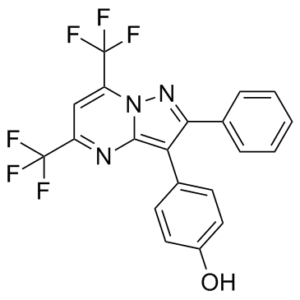
PHTPP is an estrogen receptor (ERβ) antagonist. It exhibits 36-fold selectivity for ERβ relative to ERα. PHTPP has no effect on basal cAMP production but reduces FSH-mediated cAMP production by 80%. PHTPP does not suppress E2-stimulated ERα activity, but it does inhibit E2-stimulated ERβ activity (at a concentration of 10-6 M). When taken in large quantities, PHTPP both promotes and modestly elevates the expression of class 1 Igf1 mRNA in response to DPN.
Physicochemical Properties
| Molecular Formula | C20H11F6N3O | |
| Molecular Weight | 423.31 | |
| Exact Mass | 423.081 | |
| Elemental Analysis | C, 56.75; H, 2.62; F, 26.93; N, 9.93; O, 3.78 | |
| CAS # | 805239-56-9 | |
| Related CAS # |
|
|
| PubChem CID | 11201035 | |
| Appearance | Light yellow to yellow solid powder | |
| Density | 1.48g/cm3 | |
| Index of Refraction | 1.584 | |
| LogP | 5.806 | |
| Hydrogen Bond Donor Count | 1 | |
| Hydrogen Bond Acceptor Count | 9 | |
| Rotatable Bond Count | 2 | |
| Heavy Atom Count | 30 | |
| Complexity | 586 | |
| Defined Atom Stereocenter Count | 0 | |
| SMILES | FC(C1C=C(C(F)(F)F)N2C(=C(C(C3C=CC=CC=3)=N2)C2C=CC(O)=CC=2)N=1)(F)F |
|
| InChi Key | AEZPAUSGTAHLOQ-UHFFFAOYSA-N | |
| InChi Code | InChI=1S/C20H11F6N3O/c21-19(22,23)14-10-15(20(24,25)26)29-18(27-14)16(11-6-8-13(30)9-7-11)17(28-29)12-4-2-1-3-5-12/h1-10,30H | |
| Chemical Name | 4-[2-phenyl-5,7-bis(trifluoromethyl)pyrazolo[1,5-a]pyrimidin-3-yl]phenol | |
| Synonyms |
|
|
| HS Tariff Code | 2934.99.9001 | |
| Storage |
Powder-20°C 3 years 4°C 2 years In solvent -80°C 6 months -20°C 1 month |
|
| Shipping Condition | Room temperature (This product is stable at ambient temperature for a few days during ordinary shipping and time spent in Customs) |
Biological Activity
| Targets |
ERβ
Estrogen Receptor beta (ERβ) (36-fold binding selectivity over ERα) [1] - Estrogen Receptor beta (ERβ) [2] |
| ln Vitro |
PHTPP shows no appreciable agonism on ERα or Erβ, but is completely effective as an ERβ antagonist[1]. PHTPP treatment inhibits the growth and invasion of bladder cancer (BCa) cells as well as the expression of MCM5[2]. PHTPP (chemical name: 4-[2-Phenyl-5,7-bis(trifluoromethyl)pyrazolo[1,5-a]pyrimidin-3-yl]phenol) is a potency- and efficacy-selective ERβ antagonist. In transcription assays, it exhibited full antagonist activity on ERβ without significant activity on ERα. Molecular modeling revealed that its ERβ binding selectivity is derived from differing orientations in the ligand binding pockets of ERα vs. ERβ [1] - In ERβ-positive human bladder cancer (BCa) cell lines (J82, 647v, T24), treatment with PHTPP reduced cell growth and invasion. Mechanistically, PHTPP suppressed the expression of minichromosome maintenance complex component 5 (MCM5), a DNA replication licensing factor involved in tumor cell growth. Restoring MCM5 expression partially reversed the growth reduction induced by PHTPP [2] |
| ln Vivo |
PHTPP can prevent the growth and invasion of bladder cancer, improving the survival rate in a mouse model of bladder cancer induced by the carcinogen N-butyl-N-(4-hydroxybutyl) nitrosamine (BBN)[2]. In the carcinogen N-butyl-N-(4-hydroxybutyl) nitrosamine (BBN)-induced mouse BCa model, treatment with PHTPP controlled BCa burden and mortality. This in vivo effect is consistent with its in vitro activity of suppressing ERβ signaling, which promotes BCa progression via regulating MCM5 [2] |
| Enzyme Assay |
Radioligand binding assay for ER subtype selectivity: Prepare samples containing ERα or ERβ proteins. Incubate the proteins with a radiolabeled estrogen ligand in the presence or absence of varying concentrations of PHTPP. Measure the binding affinity of PHTPP to ERα and ERβ by detecting the displacement of the radiolabeled ligand. Calculate the binding selectivity ratio between ERβ and ERα based on the assay results [1] |
| Cell Assay |
For 24 hours, HEK 293 cells are cultured in DMEM enhanced with 10% fetal bovine serum stripped of charcoal. Subsequently, the cells are transfected with the Erβ expressing vector (pcDNA3-ERβ), the estrogen response element (ERE) firefly luciferase reporter, and the SV40-driven renilla expressing vector as a control. After 8 hours, DMSO or 10 nM 2,3-bis(4-hydroxyphenyl)-propionitrile (DPN) with varying concentrations of PHTPP are added. Cells are lysed with lysis buffer and analyzed after a 24-hour period. Cell growth and invasion assays: Seed ERβ-positive human BCa cells (J82, 647v, T24) in appropriate culture plates. Treat the cells with PHTPP at specified concentrations. For growth assay, monitor cell proliferation over a certain period and quantify the cell number or viability. For invasion assay, use Transwell inserts coated with extracellular matrix; seed treated cells in the upper chamber, incubate for a set time, and count the number of cells that have invaded to the lower chamber [2] - Western blot analysis: Treat BCa cells with PHTPP for a designated time. Lyse the cells, extract total proteins, separate them by electrophoresis, and transfer to a membrane. Incubate the membrane with specific antibodies against MCM5 and a loading control (e.g., β-actin). Detect the protein bands and quantify the expression level of MCM5 to assess the effect of PHTPP [2] - Transcription assay for ER activity: Transfect cells with ERα or ERβ expression plasmids along with an estrogen-responsive reporter plasmid. Treat the transfected cells with PHTPP alone or in combination with estrogen. Measure the reporter gene activity (e.g., luciferase activity) to evaluate the antagonist activity of PHTPP on ERα and ERβ [1] |
| Animal Protocol |
Female B6 mice 10 μl of 10 mM PHTPP per mouse i.p. BBN-induced mouse BCa model: Use wild-type mice (gender not specified) as experimental animals. Administer BBN to induce bladder cancer development. Once the model is established, treat the mice with PHTPP (dosage, administration route, and frequency not specified in the literature). Monitor the mice for BCa burden (e.g., tumor size, number) and survival rate over the treatment period. At the end of the experiment, sacrifice the mice, dissect the bladder tissues, and perform pathological analysis to confirm the anti-tumor effect of PHTPP [2] |
| References |
[1]. J Med Chem . 2004 Nov 18;47(24):5872-93. [2]. Carcinogenesis . 2014 Mar;35(3):651-61. |
| Additional Infomation |
4-[2-phenyl-5,7-bis(trifluoromethyl)-3-pyrazolo[1,5-a]pyrimidinyl]phenol is a member of pyrazoles and a ring assembly. PHTPP belongs to the pyrazolo[1,5-a]pyrimidine class of compounds, which are novel subtype-selective estrogen receptor ligands [1] - ERβ plays a positive role in promoting BCa progression. PHTPP targets ERβ to suppress BCa development, making it a potential therapeutic agent for bladder cancer. Targeting ERβ through PHTPP, ERβ-shRNA, or downstream targets such as MCM5 could serve as potential therapeutic approaches for bladder cancer [2] - PHTPP can be used as a tool compound to study the biological function of ERβ due to its high selectivity for ERβ and antagonist activity specifically on ERβ [1] |
Solubility Data
| Solubility (In Vitro) |
|
|||
| Solubility (In Vivo) |
Solubility in Formulation 1: ≥ 2.5 mg/mL (5.91 mM) (saturation unknown) in 10% DMSO + 40% PEG300 + 5% Tween80 + 45% Saline (add these co-solvents sequentially from left to right, and one by one), clear solution. For example, if 1 mL of working solution is to be prepared, you can add 100 μL of 25.0 mg/mL clear DMSO stock solution to 400 μL PEG300 and mix evenly; then add 50 μL Tween-80 to the above solution and mix evenly; then add 450 μL normal saline to adjust the volume to 1 mL. Preparation of saline: Dissolve 0.9 g of sodium chloride in 100 mL ddH₂ O to obtain a clear solution. Solubility in Formulation 2: ≥ 2.5 mg/mL (5.91 mM) (saturation unknown) in 10% DMSO + 90% Corn Oil (add these co-solvents sequentially from left to right, and one by one), clear solution. For example, if 1 mL of working solution is to be prepared, you can add 100 μL of 25.0 mg/mL clear DMSO stock solution to 900 μL of corn oil and mix evenly. (Please use freshly prepared in vivo formulations for optimal results.) |
| Preparing Stock Solutions | 1 mg | 5 mg | 10 mg | |
| 1 mM | 2.3623 mL | 11.8117 mL | 23.6233 mL | |
| 5 mM | 0.4725 mL | 2.3623 mL | 4.7247 mL | |
| 10 mM | 0.2362 mL | 1.1812 mL | 2.3623 mL |