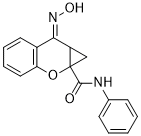
PHCCC is a potent PAM (positive allosteric modulator) of mGluR4 and a Group I metabotropic glutamate receptor antagonist with IC50 of ~ 3 μM. In vitro, it enhances L-AP4-mediated inhibition of striatopallidal synaptic transmission and has 67 times the potency of (S)-4-carboxyphenylglycine. exhibits antiparkinsonian properties in vivo in rats. PHCCC acts as a proconvulsant in three models of juvenile rats' epileptic seizures. PHCCC inhibits the proliferation of cerebellar granule cell neuroprecursors while enhancing their differentiation. PHCCC demonstrated neuroprotection in mixed cultures of mouse cortical neurons against NMDA- and betaAP-toxicity. This neuroprotection was inhibited by MSOP, a group-III mGluR antagonist, and was additional to that produced by the extremely effective mGluR1 antagonist CPCCOEt. Our findings support the existence of a novel pharmacological site on mGluR4, which could be a therapeutic target.
Physicochemical Properties
| Molecular Formula | C17H14N2O3 |
| Molecular Weight | 294.3047 |
| Exact Mass | 294.1 |
| Elemental Analysis | C, 69.38; H, 4.79; N, 9.52; O, 16.31 |
| CAS # | 179068-02-1 |
| Related CAS # | 179068-02-1 |
| PubChem CID | 5866327 |
| Appearance | White to off-white solid powder |
| Density | 1.4±0.1 g/cm3 |
| Boiling Point | 579.1±50.0 °C at 760 mmHg |
| Flash Point | 304.0±30.1 °C |
| Vapour Pressure | 0.0±1.7 mmHg at 25°C |
| Index of Refraction | 1.700 |
| LogP | 1.88 |
| Hydrogen Bond Donor Count | 2 |
| Hydrogen Bond Acceptor Count | 4 |
| Rotatable Bond Count | 2 |
| Heavy Atom Count | 22 |
| Complexity | 486 |
| Defined Atom Stereocenter Count | 0 |
| SMILES | O1C2=C([H])C([H])=C([H])C([H])=C2/C(/C2([H])C([H])([H])C12C(N([H])C1C([H])=C([H])C([H])=C([H])C=1[H])=O)=N/O[H] |
| InChi Key | FPXPIEZPAXSELW-CYVLTUHYSA-N |
| InChi Code | InChI=1S/C17H14N2O3/c20-16(18-11-6-2-1-3-7-11)17-10-13(17)15(19-21)12-8-4-5-9-14(12)22-17/h1-9,13,21H,10H2,(H,18,20)/b19-15- |
| Chemical Name | (7E)-7-hydroxyimino-N-phenyl-1,7a-dihydrocyclopropa[b]chromene-1a-carboxamide |
| Synonyms | PHCCC |
| HS Tariff Code | 2934.99.9001 |
| Storage |
Powder-20°C 3 years 4°C 2 years In solvent -80°C 6 months -20°C 1 month |
| Shipping Condition | Room temperature (This product is stable at ambient temperature for a few days during ordinary shipping and time spent in Customs) |
Biological Activity
| Targets | Group I mGluR receptors ( IC50 = 3 μM ) |
| ln Vitro | PHCCC increased L-(+)-2-amino-4-phosphonobutyric acid's (L-AP4) ability to block transmission at the striatopallidal synapse[2]. |
| ln Vivo | PHCCC (75 nmol/2.5 μl; intracerebroventricular) exhibits antiparkinsonian properties in a model of dopamine depletion akinesia[2]. |
| References |
[1]. Metabotropic glutamate receptors as drug targets. Curr Drug Targets. 2007;8(5):651-681. [2]. Allosteric modulation of group III metabotropic glutamate receptor 4: a potential approach to Parkinson's disease treatment. Proc Natl Acad Sci U S A. 2003 Nov 11;100(23):13668-73. |
| Additional Infomation | 7-hydroxyimino-N-phenyl-1,7a-dihydrocyclopropa[b][1]benzopyran-1a-carboxamide is a 1-benzopyran. |
Solubility Data
| Solubility (In Vitro) | DMSO: ~12.5 mg/mL (~42.5 mM) |
| Solubility (In Vivo) |
Solubility in Formulation 1: ≥ 1.25 mg/mL (4.25 mM) (saturation unknown) in 10% DMSO + 40% PEG300 + 5% Tween80 + 45% Saline (add these co-solvents sequentially from left to right, and one by one), clear solution. For example, if 1 mL of working solution is to be prepared, you can add 100 μL of 12.5 mg/mL clear DMSO stock solution to 400 μL PEG300 and mix evenly; then add 50 μL Tween-80 to the above solution and mix evenly; then add 450 μL normal saline to adjust the volume to 1 mL. Preparation of saline: Dissolve 0.9 g of sodium chloride in 100 mL ddH₂ O to obtain a clear solution. Solubility in Formulation 2: ≥ 1.25 mg/mL (4.25 mM) (saturation unknown) in 10% DMSO + 90% (20% SBE-β-CD in Saline) (add these co-solvents sequentially from left to right, and one by one), clear solution. For example, if 1 mL of working solution is to be prepared, you can add 100 μL of 12.5 mg/mL clear DMSO stock solution to 900 μL of 20% SBE-β-CD physiological saline solution and mix evenly. Preparation of 20% SBE-β-CD in Saline (4°C,1 week): Dissolve 2 g SBE-β-CD in 10 mL saline to obtain a clear solution. Solubility in Formulation 3: ≥ 1.25 mg/mL (4.25 mM) (saturation unknown) in 10% DMSO + 90% Corn Oil (add these co-solvents sequentially from left to right, and one by one), clear solution. For example, if 1 mL of working solution is to be prepared, you can add 100 μL of 12.5 mg/mL clear DMSO stock solution to 900 μL of corn oil and mix evenly. (Please use freshly prepared in vivo formulations for optimal results.) |
| Preparing Stock Solutions | 1 mg | 5 mg | 10 mg | |
| 1 mM | 3.3979 mL | 16.9895 mL | 33.9789 mL | |
| 5 mM | 0.6796 mL | 3.3979 mL | 6.7958 mL | |
| 10 mM | 0.3398 mL | 1.6989 mL | 3.3979 mL |