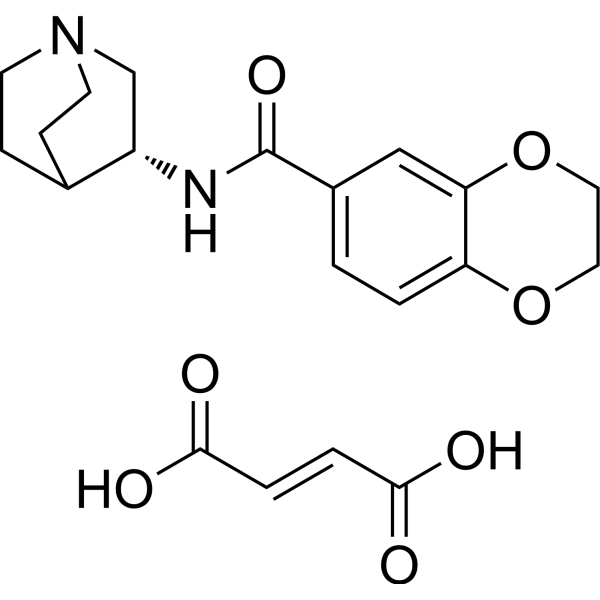
Physicochemical Properties
| Molecular Formula | C20H24N2O7 |
| Molecular Weight | 404.413765907288 |
| Exact Mass | 404.158 |
| CAS # | 527680-57-5 |
| Related CAS # | PHA 568487 free base;527680-56-4 |
| PubChem CID | 56972212 |
| Appearance | Typically exists as solid at room temperature |
| LogP | 1.322 |
| Hydrogen Bond Donor Count | 3 |
| Hydrogen Bond Acceptor Count | 8 |
| Rotatable Bond Count | 4 |
| Heavy Atom Count | 29 |
| Complexity | 514 |
| Defined Atom Stereocenter Count | 1 |
| SMILES | C1CN2CCC1[C@H](C2)NC(=O)C3=CC4=C(C=C3)OCCO4.C(=C/C(=O)O)\C(=O)O |
| InChi Key | QYQZUGYJVHHHEE-QDSMGTAFSA-N |
| InChi Code | InChI=1S/C16H20N2O3.C4H4O4/c19-16(17-13-10-18-5-3-11(13)4-6-18)12-1-2-14-15(9-12)21-8-7-20-14;5-3(6)1-2-4(7)8/h1-2,9,11,13H,3-8,10H2,(H,17,19);1-2H,(H,5,6)(H,7,8)/b;2-1+/t13-;/m0./s1 |
| Chemical Name | N-[(3R)-1-azabicyclo[2.2.2]octan-3-yl]-2,3-dihydro-1,4-benzodioxine-6-carboxamide;(E)-but-2-enedioic acid |
| HS Tariff Code | 2934.99.9001 |
| Storage |
Powder-20°C 3 years 4°C 2 years In solvent -80°C 6 months -20°C 1 month |
| Shipping Condition | Room temperature (This product is stable at ambient temperature for a few days during ordinary shipping and time spent in Customs) |
Biological Activity
| ln Vitro | PHA 568487 reduces oxidative stress and phosphorylation of NF-κb p65 while increasing the expression of antioxidant genes. The effects of methyllycaconitine (MLA) are the opposite[2]. PHA raises the expression of NADPH oxidase and antioxidant genes, which are linked to a decrease in NF-kB p65 phosphorylation in macrophages and microglia[3]. |
| ln Vivo | PHA 568487 reduces behavioral dysfunction and neuronal damage in mice that have both ischemic stroke and stroke with a fractured tibia[2]. When administered intraperitoneally (1.25 mg/kg; treated daily), PHA 568487 significantly reduces the volumes of brain infarcts and improves the neurologic outcome in ischemic rats[4]. |
| Animal Protocol |
Animal/Disease Models: C57BL/6J male mice (10-12 weeks old)[2] Doses: PHA 568487 (PHA; 0.4 and 0.8 mg/kg); Methyllycaconitine (MLA; 4 and 6 mg/kg) Route of Administration: Injected intraperitoneally (ip) once on day 1, or twice on days 1 and 2, after pMCAO Experimental Results: Injection of PHA (0.8 mg/kg) and MLA (6 mg/kg) on days 1 and 2 after pMCAO yielded the best effect on infarct volume and behavior tests. Animal/Disease Models: Adult male SD (Sprague-Dawley) rats (297 6±8.3 g)[4] Doses: 1.25 mg/kg Route of Administration: Ip;0.1 mL; treated daily Experimental Results: demonstrated a significant reduction of the cerebral infarct volumes and an improvement of the neurologic outcome. |
| References |
[1]. Multiple species metabolism of PHA-568487, a selective alpha 7 nicotinic acetylcholine receptor agonist. Drug Metab Lett. 2010 Aug;4(3):162-72. [2]. Alpha-7 nicotinic acetylcholine receptor agonist treatment reduces neuroinflammation, oxidative stress, and brain injury in mice with ischemic stroke and bone fracture. J Neurochem. 2014 Nov;131(4):498-508. [3]. Activation of Alpha-7 Nicotinic Acetylcholine Receptor Reduces Brain Edema in Mice with Ischemic Stroke and Bone Fracture. Mol Neurobiol. 2017 Dec;54(10):8278-8286. [4]. In vivo imaging of Α7 nicotinic receptors as a novel method to monitor neuroinflammation after cerebral ischemia. Glia. 2018 Aug;66(8):1611-1624. |
Solubility Data
| Solubility (In Vitro) | DMSO: 250 mg/mL (618.18 mM) |
| Solubility (In Vivo) |
Solubility in Formulation 1: 2.08 mg/mL (5.14 mM) in 10% DMSO + 40% PEG300 + 5% Tween80 + 45% Saline (add these co-solvents sequentially from left to right, and one by one), suspension solution; with sonication. For example, if 1 mL of working solution is to be prepared, you can add 100 μL of 20.8 mg/mL clear DMSO stock solution to 400 μL PEG300 and mix evenly; then add 50 μL Tween-80 to the above solution and mix evenly; then add 450 μL normal saline to adjust the volume to 1 mL. Preparation of saline: Dissolve 0.9 g of sodium chloride in 100 mL ddH₂ O to obtain a clear solution. Solubility in Formulation 2: ≥ 2.08 mg/mL (5.14 mM) (saturation unknown) in 10% DMSO + 90% (20% SBE-β-CD in Saline) (add these co-solvents sequentially from left to right, and one by one), clear solution. For example, if 1 mL of working solution is to be prepared, you can add 100 μL of 20.8 mg/mL clear DMSO stock solution to 900 μL of 20% SBE-β-CD physiological saline solution and mix evenly. Preparation of 20% SBE-β-CD in Saline (4°C,1 week): Dissolve 2 g SBE-β-CD in 10 mL saline to obtain a clear solution. Solubility in Formulation 3: ≥ 2.08 mg/mL (5.14 mM) (saturation unknown) in 10% DMSO + 90% Corn Oil (add these co-solvents sequentially from left to right, and one by one), clear solution. For example, if 1 mL of working solution is to be prepared, you can add 100 μL of 20.8 mg/mL clear DMSO stock solution to 900 μL of corn oil and mix evenly. (Please use freshly prepared in vivo formulations for optimal results.) |
| Preparing Stock Solutions | 1 mg | 5 mg | 10 mg | |
| 1 mM | 2.4727 mL | 12.3637 mL | 24.7274 mL | |
| 5 mM | 0.4945 mL | 2.4727 mL | 4.9455 mL | |
| 10 mM | 0.2473 mL | 1.2364 mL | 2.4727 mL |