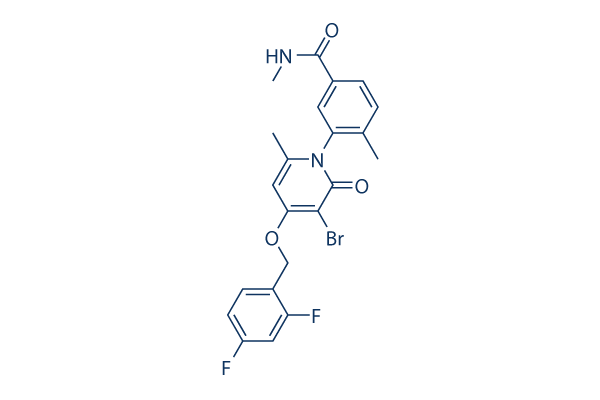
Physicochemical Properties
| Molecular Formula | C22H19BRF2N2O3 | |
| Molecular Weight | 477.3 | |
| Exact Mass | 476.054 | |
| Elemental Analysis | C, 55.36; H, 4.01; Br, 16.74; F, 7.96; N, 5.87; O, 10.06 | |
| CAS # | 586379-66-0 | |
| Related CAS # |
|
|
| PubChem CID | 22049997 | |
| Appearance | White to off-white solid powder | |
| Density | 1.5±0.1 g/cm3 | |
| Boiling Point | 593.2±50.0 °C at 760 mmHg | |
| Flash Point | 312.6±30.1 °C | |
| Vapour Pressure | 0.0±1.7 mmHg at 25°C | |
| Index of Refraction | 1.629 | |
| LogP | 3.24 | |
| Hydrogen Bond Donor Count | 1 | |
| Hydrogen Bond Acceptor Count | 5 | |
| Rotatable Bond Count | 5 | |
| Heavy Atom Count | 30 | |
| Complexity | 742 | |
| Defined Atom Stereocenter Count | 0 | |
| SMILES | O=C(C1=CC=C(C(N2C(C)=CC(OCC3=CC=C(C=C3F)F)=C(C2=O)Br)=C1)C)NC |
|
| InChi Key | KCAJXIDMCNPGHZ-UHFFFAOYSA-N | |
| InChi Code | InChI=1S/C22H19BrF2N2O3/c1-12-4-5-14(21(28)26-3)9-18(12)27-13(2)8-19(20(23)22(27)29)30-11-15-6-7-16(24)10-17(15)25/h4-10H,11H2,1-3H3,(H,26,28) | |
| Chemical Name | 3-[3-bromo-4-[(2,4-difluorophenyl)methoxy]-6-methyl-2-oxopyridin-1-yl]-N,4-dimethylbenzamide | |
| Synonyms | PH 797804; PH797804; PH-797804 | |
| HS Tariff Code | 2934.99.9001 | |
| Storage |
Powder-20°C 3 years 4°C 2 years In solvent -80°C 6 months -20°C 1 month |
|
| Shipping Condition | Room temperature (This product is stable at ambient temperature for a few days during ordinary shipping and time spent in Customs) |
Biological Activity
| Targets | p38α (IC50 = 26 nM); p38α (Ki = 5.8 nM); p38β (Ki = 40 nM) |
| ln Vitro | PH-797804 blocks LPS-induced TNF-α production and p38 kinase activity in the human monocytic U937 cell line, with comparable IC50 of 5.9 nM and 1.1 nM. At concentrations up to 1 μM, PH-797804 has no inhibitory impact on the JNK pathway (c-Jun phosphorylation) or ERK pathway (ERK phosphorylation) in U937 cells. With an IC50 of 3 nM in primary rat bone marrow cells, PH-797804 inhibits RANKL- and M-CSF-induced osteoclast formation in a concentration-dependent manner.[1] The activity of PH-797804 is specific because the IC50 values for it against the following targets have been found to be higher than 200 μM (unless otherwise noted): CDK2, ERK2, IKK1, IKK2, IKKi, MAPKAP2, MAPKAP3, MKK7 (>100 μM), MNK, MSK (>164 μM), PRAK, RSK2, and TBK1.[2] |
| ln Vivo | In both rats and cynomolgus monkeys, oral administration of PH-797804 effectively reduces the acute inflammatory reactions brought on by systemically administered endotoxin. In chronic disease models, PH-797804 treatment for 10 days shows strong anti-inflammatory activity, significantly lowering joint inflammation and related bone loss in rats with streptococcal cell wall-induced arthritis and mice with collagen-induced arthritis. In rats and cynomolgus monkeys, the ED50 values were 0.07 mg/kg and 0.095 mg/kg, respectively, according to dose-response analysis. In a human endotoxin challenge model, PH-797804 inhibits LPS-induced TNF-α, IL-6, and MK-2 activity in a dose- and concentration-dependent manner.[1] |
| Enzyme Assay | The phosphorylation of GST-c-Jun or the epidermal growth factor receptor peptide (EGFRP) by p38 kinases is assessed using a resin capture assay method. 25 mM HEPES, pH 7.5, 10 mM magnesium acetate, 0.05 to 0.3 μCi of [γ-33P]ATP, 0.8 mM dithiothreitol, and either 200 μM EGFRP or 10 μM GST-c-Jun for p38 kinase reactions are included in reaction mixtures. To begin the reaction, 25 nM p38α kinase is added, resulting in a final volume of 50 μl. For 30 minutes, the p38α kinase reactions are incubated at 25 °C. Under these circumstances, both p38 kinase's product formation is time-dependently linear. The addition of 150 μl of AG 1 × 8 ion exchange resin in 900 mM sodium formate, pH 3.0, stops the reaction and removes the unreacted [γ-33P]ATP. Solutions are thoroughly combined and then left to stand for 5 minutes. The phosphorylated substrate is extracted from the mixture in a 50-μl aliquot, which is then transferred to a 96-well plate. A TopCount NXT microplate scintillation and luminescence counter is used to add 150 μL of the MicroScint-40 scintillation cocktail to each well and measure the radioactivity levels. |
| Cell Assay | The 3-(4,5-dimethylthiazol-2-yl)-) diphenyl tetrazolium bromide assay is used to measure cell viability. With a reference wavelength of 630 nm and a test wavelength of 570 nm, absorbance is measured on an ELISA plate reader. |
| Animal Protocol |
LPS-induced chronic inflammation rat model 0.001-1 mg/kg Oral gavage 4 hours before LPS administration |
| References |
[1]. Anti-inflammatory properties of a novel N-phenyl pyridinone inhibitor of p38 mitogen-activated protein kinase: preclinical-to-clinical translation. J Pharmacol Exp Ther, 2009, 331(3), 882-895. [2]. Structural bioinformatics-based prediction of exceptional selectivity of p38 MAP kinase inhibitor PH-797804. Biochemistry, 2009, 48(27), 6402-6411. |
| Additional Infomation |
PH 797804 is a member of the class of benzamides obtained by formal condensation of the carboxy group of 3-{3-bromo-4-[(2,4-difluorobenzyl)oxy]-6-methyl-2-oxopyridin-1-yl}-4-methylbenzoic acid with the amino group of methylamine. It has a role as an EC 2.7.11.24 (mitogen-activated protein kinase) inhibitor and an anti-inflammatory agent. It is a member of benzamides, an organofluorine compound, a pyridone, an organobromine compound and an aromatic ether. PH-797804 has been investigated for the treatment of Osteoarthritis. |
Solubility Data
| Solubility (In Vitro) |
|
|||
| Solubility (In Vivo) |
Solubility in Formulation 1: ≥ 3 mg/mL (6.29 mM) (saturation unknown) in 10% DMSO + 40% PEG300 + 5% Tween80 + 45% Saline (add these co-solvents sequentially from left to right, and one by one), clear solution. For example, if 1 mL of working solution is to be prepared, you can add 100 μL of 30.0 mg/mL clear DMSO stock solution to 400 μL PEG300 and mix evenly; then add 50 μL Tween-80 to the above solution and mix evenly; then add 450 μL normal saline to adjust the volume to 1 mL. Preparation of saline: Dissolve 0.9 g of sodium chloride in 100 mL ddH₂ O to obtain a clear solution. Solubility in Formulation 2: ≥ 2.5 mg/mL (5.24 mM) (saturation unknown) in 10% DMSO + 90% Corn Oil (add these co-solvents sequentially from left to right, and one by one), clear solution. For example, if 1 mL of working solution is to be prepared, you can add 100 μL of 25.0 mg/mL clear DMSO stock solution to 900 μL of corn oil and mix evenly. Solubility in Formulation 3: 2% DMSO+30% PEG 300+5% Tween 80+ddH2O: 5mg/mL (Please use freshly prepared in vivo formulations for optimal results.) |
| Preparing Stock Solutions | 1 mg | 5 mg | 10 mg | |
| 1 mM | 2.0951 mL | 10.4756 mL | 20.9512 mL | |
| 5 mM | 0.4190 mL | 2.0951 mL | 4.1902 mL | |
| 10 mM | 0.2095 mL | 1.0476 mL | 2.0951 mL |