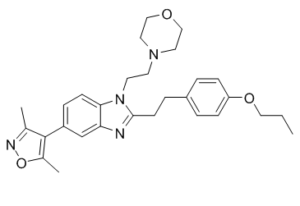
PF-CBP1 (also known as PF-06670910) is a novel, potent and highly selective inhibitor of the CREB binding protein bromodomain (CBP BRD). Bromodomains are involved in transcriptional regulation through the recognition of acetyl lysine modifications on diverse proteins. Selective pharmacological modulators of bromodomains are lacking, although the largely hydrophobic nature of the pocket makes these modules attractive targets for small-molecule inhibitors. PF-CBP1 downregulated a number of inflammatory genes in macrophages that were not affected by a selective BET bromodomain inhibitor. In addition, the CBP bromodomain inhibitor modulated the mRNA level of the regulator of G-protein signaling 4 (RGS4) gene in neurons, suggesting a potential therapeutic opportunity for CBP inhibitors in the treatment of neurological disorders.
Physicochemical Properties
| CAS # | 962928-21-7 |
| Related CAS # | PF-CBP1 hydrochloride;2070014-93-4 |
| Appearance | Typically exists as solid at room temperature |
| InChi Key | CGWBJJZOKGZCSJ-UHFFFAOYSA-N |
| InChi Code | InChI=1S/C29H36N4O3/c1-4-17-35-25-9-5-23(6-10-25)7-12-28-30-26-20-24(29-21(2)31-36-22(29)3)8-11-27(26)33(28)14-13-32-15-18-34-19-16-32/h5-6,8-11,20H,4,7,12-19H2,1-3H3 |
| Chemical Name | 4-(2-(5-(3,5-Dimethylisoxazol-4-yl)-2-(4-propoxyphenethyl)-1H-benzo[d]imidazol-1-yl)ethyl)morpholine |
| Synonyms | PF-06670910; PF 06670910; PF06670910; PF-CBP1; PF-CBP-1; PF-CBP 1. |
| HS Tariff Code | 2934.99.9001 |
| Storage |
Powder-20°C 3 years 4°C 2 years In solvent -80°C 6 months -20°C 1 month |
| Shipping Condition | Room temperature (This product is stable at ambient temperature for a few days during ordinary shipping and time spent in Customs) |
Biological Activity
| ln Vitro | Key inflammatory genes in primary macrophages are modulated by PF-CBP1. Parkinson's disease-related RGS4 in neurons is downregulated by PF-CBP1. In the biochemical tests, PF-CBP1 is 139-fold selective over BRD4, and by ITC, it is more than 105-fold selective. As has been shown for other CBP inhibitors, F-CBP1 is likewise a strong inhibitor of EP300[1]. |
| References | Chem Biol.2015 Dec 17;22(12):1588-96. |
Solubility Data
| Solubility (In Vitro) | May dissolve in DMSO (in most cases), if not, try other solvents such as H2O, Ethanol, or DMF with a minute amount of products to avoid loss of samples |
| Solubility (In Vivo) |
Note: Listed below are some common formulations that may be used to formulate products with low water solubility (e.g. < 1 mg/mL), you may test these formulations using a minute amount of products to avoid loss of samples. Injection Formulations (e.g. IP/IV/IM/SC) Injection Formulation 1: DMSO : Tween 80: Saline = 10 : 5 : 85 (i.e. 100 μL DMSO stock solution → 50 μL Tween 80 → 850 μL Saline) *Preparation of saline: Dissolve 0.9 g of sodium chloride in 100 mL ddH ₂ O to obtain a clear solution. Injection Formulation 2: DMSO : PEG300 :Tween 80 : Saline = 10 : 40 : 5 : 45 (i.e. 100 μL DMSO → 400 μLPEG300 → 50 μL Tween 80 → 450 μL Saline) Injection Formulation 3: DMSO : Corn oil = 10 : 90 (i.e. 100 μL DMSO → 900 μL Corn oil) Example: Take the Injection Formulation 3 (DMSO : Corn oil = 10 : 90) as an example, if 1 mL of 2.5 mg/mL working solution is to be prepared, you can take 100 μL 25 mg/mL DMSO stock solution and add to 900 μL corn oil, mix well to obtain a clear or suspension solution (2.5 mg/mL, ready for use in animals). Injection Formulation 4: DMSO : 20% SBE-β-CD in saline = 10 : 90 [i.e. 100 μL DMSO → 900 μL (20% SBE-β-CD in saline)] *Preparation of 20% SBE-β-CD in Saline (4°C,1 week): Dissolve 2 g SBE-β-CD in 10 mL saline to obtain a clear solution. Injection Formulation 5: 2-Hydroxypropyl-β-cyclodextrin : Saline = 50 : 50 (i.e. 500 μL 2-Hydroxypropyl-β-cyclodextrin → 500 μL Saline) Injection Formulation 6: DMSO : PEG300 : castor oil : Saline = 5 : 10 : 20 : 65 (i.e. 50 μL DMSO → 100 μLPEG300 → 200 μL castor oil → 650 μL Saline) Injection Formulation 7: Ethanol : Cremophor : Saline = 10: 10 : 80 (i.e. 100 μL Ethanol → 100 μL Cremophor → 800 μL Saline) Injection Formulation 8: Dissolve in Cremophor/Ethanol (50 : 50), then diluted by Saline Injection Formulation 9: EtOH : Corn oil = 10 : 90 (i.e. 100 μL EtOH → 900 μL Corn oil) Injection Formulation 10: EtOH : PEG300:Tween 80 : Saline = 10 : 40 : 5 : 45 (i.e. 100 μL EtOH → 400 μLPEG300 → 50 μL Tween 80 → 450 μL Saline) Oral Formulations Oral Formulation 1: Suspend in 0.5% CMC Na (carboxymethylcellulose sodium) Oral Formulation 2: Suspend in 0.5% Carboxymethyl cellulose Example: Take the Oral Formulation 1 (Suspend in 0.5% CMC Na) as an example, if 100 mL of 2.5 mg/mL working solution is to be prepared, you can first prepare 0.5% CMC Na solution by measuring 0.5 g CMC Na and dissolve it in 100 mL ddH2O to obtain a clear solution; then add 250 mg of the product to 100 mL 0.5% CMC Na solution, to make the suspension solution (2.5 mg/mL, ready for use in animals). Oral Formulation 3: Dissolved in PEG400 Oral Formulation 4: Suspend in 0.2% Carboxymethyl cellulose Oral Formulation 5: Dissolve in 0.25% Tween 80 and 0.5% Carboxymethyl cellulose Oral Formulation 6: Mixing with food powders Note: Please be aware that the above formulations are for reference only. InvivoChem strongly recommends customers to read literature methods/protocols carefully before determining which formulation you should use for in vivo studies, as different compounds have different solubility properties and have to be formulated differently. (Please use freshly prepared in vivo formulations for optimal results.) |