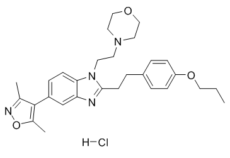
PF-CBP1 HCl (also known as PF-06670910 HCl) is a novel, potent and highly selective inhibitor of the CREB binding protein bromodomain (CBP BRD). Bromodomains are involved in transcriptional regulation through the recognition of acetyl lysine modifications on diverse proteins. Selective pharmacological modulators of bromodomains are lacking, although the largely hydrophobic nature of the pocket makes these modules attractive targets for small-molecule inhibitors. PF-CBP1 downregulated a number of inflammatory genes in macrophages that were not affected by a selective BET bromodomain inhibitor. In addition, the CBP bromodomain inhibitor modulated the mRNA level of the regulator of G-protein signaling 4 (RGS4) gene in neurons, suggesting a potential therapeutic opportunity for CBP inhibitors in the treatment of neurological disorders.
Physicochemical Properties
| Molecular Formula | C29H37CLN4O3 |
| Molecular Weight | 525.082086324692 |
| Exact Mass | 524.255 |
| Elemental Analysis | C, 66.34; H, 7.10; Cl, 6.75; N, 10.67; O, 9.14 |
| CAS # | 2070014-93-4 |
| Related CAS # | PF-CBP1;1962928-21-7 |
| PubChem CID | 119081416 |
| Appearance | White to yellow solid powder |
| Hydrogen Bond Donor Count | 1 |
| Hydrogen Bond Acceptor Count | 6 |
| Rotatable Bond Count | 10 |
| Heavy Atom Count | 37 |
| Complexity | 654 |
| Defined Atom Stereocenter Count | 0 |
| InChi Key | HFOZCHHWLMTUTP-UHFFFAOYSA-N |
| InChi Code | InChI=1S/C29H36N4O3.ClH/c1-4-17-35-25-9-5-23(6-10-25)7-12-28-30-26-20-24(29-21(2)31-36-22(29)3)8-11-27(26)33(28)14-13-32-15-18-34-19-16-32;/h5-6,8-11,20H,4,7,12-19H2,1-3H3;1H |
| Chemical Name | 4-(2-(5-(3,5-Dimethylisoxazol-4-yl)-2-(4-propoxyphenethyl)-1H-benzo[d]imidazol-1-yl)ethyl)morpholine hydrochloride |
| Synonyms | PF-06670910; PF 06670910; PF06670910; PF-CBP1 HCl; PF-CBP1; hydrochloride; PF-CBP1; PF-CBP-1; PF-CBP 1; |
| HS Tariff Code | 2934.99.9001 |
| Storage |
Powder-20°C 3 years 4°C 2 years In solvent -80°C 6 months -20°C 1 month Note: Please store this product in a sealed and protected environment, avoid exposure to moisture. |
| Shipping Condition | Room temperature (This product is stable at ambient temperature for a few days during ordinary shipping and time spent in Customs) |
Biological Activity
| ln Vitro | ITC is a label-free method for calculating KD values; it is more than 105 times more selective than BRD4 (Kd>20 μM) and PF-CBP1 targets CBP (Kd=0.19 μM) [1]. In comparison to BRD4 and a panel of other proteins (for BRD2-1, BRD3-1, BRD3-2, BRD4-1, BRD4-2, BRDT-), PF-CBP1 is 100 times more selective for the CBP bromodomain [1]. The IC50 values for the aforementioned proteins, TAF1-2 and TAF1L-2, are 1.24 μM, 1.38 μM, 4.22 μM, 1.54 μM, 9.75 μM, 2.44 μM, 3.39 μM, and 7.29 μM, respectively. LPS-induced IL-6 and IFN-b production in J774 cells was moderately inhibited by PF-CBP1 at 10 μM (3-10 μM; 30 min pretreatment; 4 Hours). Significant reduction in IL-1b expression occurs when the concentration reaches 3 μM [1]. PF-CBP1 (100 nM-1000 nM; 24 hours) dramatically lowers (by 49%) the levels of RGS4 mRNA in cortical neuronal cells in comparison to vehicle [1]. |
| References |
[1]. Transcriptional Profiling of a Selective CREB Binding Protein Bromodomain Inhibitor Highlights Therapeutic Opportunities. Chem Biol. 2015 Dec 17;22(12):1588-96. |
Solubility Data
| Solubility (In Vitro) |
DMSO : ~100 mg/mL (~190.45 mM) H2O : ~1 mg/mL (~1.90 mM) |
| Solubility (In Vivo) |
Solubility in Formulation 1: ≥ 2.5 mg/mL (4.76 mM) (saturation unknown) in 10% DMSO + 40% PEG300 + 5% Tween80 + 45% Saline (add these co-solvents sequentially from left to right, and one by one), clear solution. For example, if 1 mL of working solution is to be prepared, you can add 100 μL of 25.0 mg/mL clear DMSO stock solution to 400 μL PEG300 and mix evenly; then add 50 μL Tween-80 to the above solution and mix evenly; then add 450 μL normal saline to adjust the volume to 1 mL. Preparation of saline: Dissolve 0.9 g of sodium chloride in 100 mL ddH₂ O to obtain a clear solution. Solubility in Formulation 2: ≥ 2.5 mg/mL (4.76 mM) (saturation unknown) in 10% DMSO + 90% (20% SBE-β-CD in Saline) (add these co-solvents sequentially from left to right, and one by one), clear solution. For example, if 1 mL of working solution is to be prepared, you can add 100 μL of 25.0 mg/mL clear DMSO stock solution to 900 μL of 20% SBE-β-CD physiological saline solution and mix evenly. Preparation of 20% SBE-β-CD in Saline (4°C,1 week): Dissolve 2 g SBE-β-CD in 10 mL saline to obtain a clear solution. Solubility in Formulation 3: ≥ 2.5 mg/mL (4.76 mM) (saturation unknown) in 10% DMSO + 90% Corn Oil (add these co-solvents sequentially from left to right, and one by one), clear solution. For example, if 1 mL of working solution is to be prepared, you can add 100 μL of 25.0 mg/mL clear DMSO stock solution to 900 μL of corn oil and mix evenly. Solubility in Formulation 4: 100 mg/mL (190.45 mM) in PBS (add these co-solvents sequentially from left to right, and one by one), clear solution; with ultrasonication. (Please use freshly prepared in vivo formulations for optimal results.) |
| Preparing Stock Solutions | 1 mg | 5 mg | 10 mg | |
| 1 mM | 1.9045 mL | 9.5224 mL | 19.0447 mL | |
| 5 mM | 0.3809 mL | 1.9045 mL | 3.8089 mL | |
| 10 mM | 0.1904 mL | 0.9522 mL | 1.9045 mL |