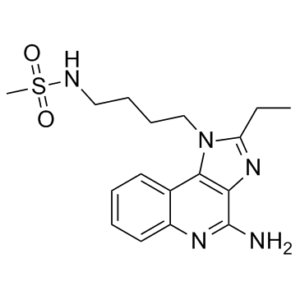
PF-4878691 (formerly 3M-852A or IMDZQ) is a novel and potent Toll-like receptor 7 (TLR7) agonist modeled so as to dissociate its antiviral activities from its inflammatory activities. It has the potential for the treatment of hematological malignancies and HCV infection. In a proof-of-mechanism study in healthy volunteers who received doses of 3, 6, and 9 mg of PF-4878691 twice a week for 2 weeks, PF-4878691 induced biomarkers of the immune and interferon (IFN) responses in a dose-dependent and dose-frequency-related manner. A novel finding was induction of TLR7 expression in vivo in response to PF-4878691, leading to an amplified biomarker response. A nonresponder at the 9-mg dose had a polymorphism in the IFN-α receptor 1 subunit (Val168Leu). Two subjects who had received 9-mg doses experienced serious adverse events (SAEs), characterized by flu-like symptoms, hypotension, and lymphopenia, leading to early termination of the study. TLR7 stimulation results in a pharmacologic response at levels commensurate with predicted antiviral efficacy, but these doses are associated with SAEs, raising concerns about the therapeutic window of this class of compounds for the treatment of HCV infection.
Physicochemical Properties
| Molecular Formula | C17H23N5O2S | |
| Molecular Weight | 361.46 | |
| Exact Mass | 361.157 | |
| CAS # | 532959-63-0 | |
| Related CAS # |
|
|
| PubChem CID | 10309114 | |
| Appearance | White to off-white solid powder | |
| LogP | 3.46 | |
| Hydrogen Bond Donor Count | 2 | |
| Hydrogen Bond Acceptor Count | 6 | |
| Rotatable Bond Count | 7 | |
| Heavy Atom Count | 25 | |
| Complexity | 538 | |
| Defined Atom Stereocenter Count | 0 | |
| InChi Key | YZOQZEXYFLXNKA-UHFFFAOYSA-N | |
| InChi Code | InChI=1S/C17H23N5O2S/c1-3-14-21-15-16(12-8-4-5-9-13(12)20-17(15)18)22(14)11-7-6-10-19-25(2,23)24/h4-5,8-9,19H,3,6-7,10-11H2,1-2H3,(H2,18,20) | |
| Chemical Name |
|
|
| Synonyms |
|
|
| HS Tariff Code | 2934.99.9001 | |
| Storage |
Powder-20°C 3 years 4°C 2 years In solvent -80°C 6 months -20°C 1 month |
|
| Shipping Condition | Room temperature (This product is stable at ambient temperature for a few days during ordinary shipping and time spent in Customs) |
Biological Activity
| ln Vitro | Inducing a complex interpretation network, PF-4878691 (10 μM, 4 h) maximizes responses to RNA viruses, boosts costimulatory capacity, and increases the innate antiviral immune response of plasmacytoid dendritic cells. Neurite cell death rate [2]. |
| ln Vivo | In BALB/c and C57bl/6j mice, PF-4878691 (10–150 mg, oral gavage, single dose) causes pharmacological effects [1]. |
| Animal Protocol |
Animal/Disease Models: balb/c (Bagg ALBino) mouse, C57bl/6 J mice [3] Doses: 30 mg/kg, 60 mg/kg, 90 mg/kg, 150 mg/kg Route of Administration: po (oral gavage) Experimental Results: Induces dose- and time-dependent lymphopenia and 2,5-oligoadenylate synthetase (2,5, OAS). Causes cardiovascular changes. TLR7 receptor RNA was Dramatically increased. |
| References |
[1]. The innate immune response, clinical outcomes, and ex vivo HCV antiviral efficacy of a TLR7 agonist (PF-4878691). Clin Pharmacol Ther. 2011 Jun;89(6):821-9. [2]. Transcriptional networks in plasmacytoid dendritic cells stimulated with synthetic TLR 7 agonists . BMC immunology, 2007, 8: 1-19. [3]. Antiviral applications of Toll-like receptor agonists. J Antimicrob Chemother. 2012 Apr;67(4):789-801. |
| Additional Infomation |
852A has been used in trials studying the treatment of Melanoma, Neoplasms, Breast Cancer, Ovarian Cancer, and Cervical Cancer, among others. TLR7 Agonist 852A is a synthetic imidazoquinoline Toll-like receptor 7 (TLR7) agonist with immunostimulating and potential antitumor activities. TLR7 agonist 852A binds to and activates TLR7, thereby stimulating plasmacytoid dendritic cells (pDC) through the TLR7-MyD88-dependent signaling pathway. Activation of pDC results in secretion of interferon alpha, the production of proimflammatory cytokines, the upregulation of co-stimulatory molecules, and enhanced T and B-cell stimulatory responses. |
Solubility Data
| Solubility (In Vitro) |
|
|||
| Solubility (In Vivo) |
Solubility in Formulation 1: ≥ 1.92 mg/mL (5.31 mM) (saturation unknown) in 10% DMSO + 40% PEG300 + 5% Tween80 + 45% Saline (add these co-solvents sequentially from left to right, and one by one), clear solution. For example, if 1 mL of working solution is to be prepared, you can add 100 μL of 19.2 mg/mL clear DMSO stock solution to 400 μL PEG300 and mix evenly; then add 50 μL Tween-80 to the above solution and mix evenly; then add 450 μL normal saline to adjust the volume to 1 mL. Preparation of saline: Dissolve 0.9 g of sodium chloride in 100 mL ddH₂ O to obtain a clear solution. Solubility in Formulation 2: ≥ 1.92 mg/mL (5.31 mM) (saturation unknown) in 10% DMSO + 90% (20% SBE-β-CD in Saline) (add these co-solvents sequentially from left to right, and one by one), clear solution. For example, if 1 mL of working solution is to be prepared, you can add 100 μL of 19.2 mg/mL clear DMSO stock solution to 900 μL of 20% SBE-β-CD physiological saline solution and mix evenly. Preparation of 20% SBE-β-CD in Saline (4°C,1 week): Dissolve 2 g SBE-β-CD in 10 mL saline to obtain a clear solution. Solubility in Formulation 3: ≥ 1.92 mg/mL (5.31 mM) (saturation unknown) in 10% DMSO + 90% Corn Oil (add these co-solvents sequentially from left to right, and one by one), clear solution. For example, if 1 mL of working solution is to be prepared, you can add 100 μL of 19.2 mg/mL clear DMSO stock solution to 900 μL of corn oil and mix evenly. (Please use freshly prepared in vivo formulations for optimal results.) |
| Preparing Stock Solutions | 1 mg | 5 mg | 10 mg | |
| 1 mM | 2.7666 mL | 13.8328 mL | 27.6656 mL | |
| 5 mM | 0.5533 mL | 2.7666 mL | 5.5331 mL | |
| 10 mM | 0.2767 mL | 1.3833 mL | 2.7666 mL |