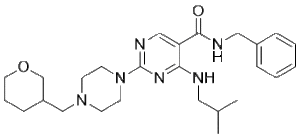
PF-4840154 is a novel, potent, selective agonist of the rat and human TrpA1 channel with EC50s of 97 and 23 nM, respectively. TrpA1 is an ion channel involved in nociceptive and inflammatory pain. It is implicated in the detection of chemical irritants through covalent binding to a cysteine-rich intracellular region of the protein. PF-4840154 was identified from an HTS of the Pfizer chemical collection, a class of pyrimidines emerged as a non-reactive, non-covalently binding family of agonists of the rat and human TrpA1 channel. Given the issues identified with the reference agonist Mustard Oil (MO) in screening, a new, non-covalently binding agonist was optimized and proved to be a superior agent to MO for screening purposes. Compound 16a (PF-4840154) is a potent, selective agonist of the rat and human TrpA1 channel and elicited TrpA1-mediated nocifensive behaviour in mouse.
Physicochemical Properties
| Molecular Formula | C26H38N6O2 |
| Molecular Weight | 466.61892 |
| Exact Mass | 466.305 |
| CAS # | 1332708-14-1 |
| PubChem CID | 53380803 |
| Appearance | White to off-white solid powder |
| Density | 1.2±0.1 g/cm3 |
| Index of Refraction | 1.589 |
| LogP | 6.03 |
| Hydrogen Bond Donor Count | 2 |
| Hydrogen Bond Acceptor Count | 7 |
| Rotatable Bond Count | 9 |
| Heavy Atom Count | 34 |
| Complexity | 606 |
| Defined Atom Stereocenter Count | 0 |
| InChi Key | PPANZCQXFYBGHN-UHFFFAOYSA-N |
| InChi Code | InChI=1S/C26H38N6O2/c1-20(2)15-27-24-23(25(33)28-16-21-7-4-3-5-8-21)17-29-26(30-24)32-12-10-31(11-13-32)18-22-9-6-14-34-19-22/h3-5,7-8,17,20,22H,6,9-16,18-19H2,1-2H3,(H,28,33)(H,27,29,30) |
| Chemical Name | N-benzyl-4-(2-methylpropylamino)-2-[4-(oxan-3-ylmethyl)piperazin-1-yl] pyrimidine-5-carboxamide |
| Synonyms | PF-4840154; PF 4840154; PF4840154. |
| HS Tariff Code | 2934.99.9001 |
| Storage |
Powder-20°C 3 years 4°C 2 years In solvent -80°C 6 months -20°C 1 month |
| Shipping Condition | Room temperature (This product is stable at ambient temperature for a few days during ordinary shipping and time spent in Customs) |
Biological Activity
| Targets |
Transient receptor potential ankyrin 1 (TrpA1) channel – a potent, selective, non-covalent agonist (potency values (e.g., EC₅₀) for TrpA1 are not provided in the main text). hERG channel – significant blockade was observed (IC₅₀ ≈ 580 nM). [1] |
| ln Vitro |
PF-4840154 was identified as a potent and selective agonist of both the rat and human TrpA1 channels. It showed no agonist or antagonist activity on other established pain targets such as the human TrpV1, TrpV4, and TrpM8 channels. [1] When profiled on a broad panel of over 100 proteins (Cerep Panel), PF-4840154 showed micromolar activity on less than 10% of the targets. Notable weak inhibitions were observed at the Sigma receptor (1.1 µM), the D₃ receptor (1.9 µM), a chloride channel (1.5 µM), and the Dopamine (1.6 µM) and Noradrenaline (2.8 µM) transporters. [1] |
| ln Vivo |
Mice treated intraplantarly with PF-4840154 (30 nmol) exhibit TrpA1-mediated nociceptive behavior [1]. Intraplantar (i.pl.) injection of PF-4840154 (30 nmol) in wild-type (WT) mice elicited a significant increase in the time spent licking the injected paw compared to vehicle, indicating a nocifensive response. This effect was significantly reduced in TrpA1 knockout (KO) mice. [1] Pre-treatment with the selective TrpA1 antagonist HC-030031 (100 mg/kg) significantly reduced the time spent licking the injected paw in PF-4840154-treated wild-type mice, demonstrating that the in vivo effect is mediated by TrpA1 activation. [1] |
| Cell Assay |
FLIPR-based TrpA1 Agonist Assay: A high-throughput screening (HTS) of a compound collection was performed using a FLIPR-based assay in an antagonist format, with Mustard Oil as the reference agonist. Hits were triaged to identify non-desensitizing, non-covalent agonists. The assay was used to identify and optimize the pyrimidine class of TrpA1 agonists, leading to PF-4840154. [1] |
| Animal Protocol |
Animal/Disease Models: Female CD1 mice (25-30g) (TrpA1+/+ mice) [1] Doses: 30 nmol Route of Administration: Intraplantar (i.pl) Injection Experimental Results: Intense licking behavior was induced. Mouse Formalin Test (TrpA1-mediated Nocifensive Behaviour): Female TrpA1 wild-type (WT) and knockout (KO) mice, or CD1 mice, were used. PF-4840154 (30 nmol in an unspecified vehicle) or vehicle control was administered via intraplantar (i.pl.) injection into the hind paw. The total time spent licking the injected paw was recorded over a specified period (e.g., 1 hour) as a measure of nocifensive behaviour. [1] Pharmacological Antagonism Study: In a separate experiment, CD1 mice were pre-treated with the selective TrpA1 antagonist HC-030031 (100 mg/kg in a vehicle of 10% DMSO in saline) or vehicle (10% DMSO in saline) administered intraperitoneally (i.p.) or via another systemic route (not specified) prior to the intraplantar injection of PF-4840154 (30 nmol). Nocifensive behaviour (licking time) was then recorded. [1] |
| ADME/Pharmacokinetics |
PF-4840154 was stable in aqueous solution. Its solubility at pH 7.2 was 3 µg/mL (6.4 µmol/L). This solubility was sufficient for its intended use as a reference agonist in screening assays, where the top concentration needed was 1.5 µmol/L. [1] |
| References |
[1]. Design and pharmacological evaluation of PF-4840154, a non-electrophilic reference agonist of the TrpA1 channel. Bioorg Med Chem Lett. 2011 Aug 15;21(16):4857-4859. |
| Additional Infomation |
PF-4840154 (compound 16a) is a novel, non-electrophilic, non-covalently binding agonist of the TrpA1 channel, developed as a superior alternative to the problematic reference agonist Mustard Oil (which is toxic, volatile, and unstable). It belongs to a class of pyrimidine derivatives identified through HTS. The compound is non-volatile, stable in aqueous solution, and suitable for use as a reference tool compound in TrpA1 screening assays. Its in vivo nocifensive effects are genetically and pharmacologically confirmed to be TrpA1-mediated. [1] |
Solubility Data
| Solubility (In Vitro) | DMSO : ~50 mg/mL (~107.15 mM) |
| Solubility (In Vivo) |
Solubility in Formulation 1: ≥ 2.5 mg/mL (5.36 mM) (saturation unknown) in 10% DMSO + 40% PEG300 + 5% Tween80 + 45% Saline (add these co-solvents sequentially from left to right, and one by one), clear solution. For example, if 1 mL of working solution is to be prepared, you can add 100 μL of 25.0 mg/mL clear DMSO stock solution to 400 μL PEG300 and mix evenly; then add 50 μL Tween-80 to the above solution and mix evenly; then add 450 μL normal saline to adjust the volume to 1 mL. Preparation of saline: Dissolve 0.9 g of sodium chloride in 100 mL ddH₂ O to obtain a clear solution. Solubility in Formulation 2: ≥ 2.5 mg/mL (5.36 mM) (saturation unknown) in 10% DMSO + 90% (20% SBE-β-CD in Saline) (add these co-solvents sequentially from left to right, and one by one), clear solution. For example, if 1 mL of working solution is to be prepared, you can add 100 μL of 25.0 mg/mL clear DMSO stock solution to 900 μL of 20% SBE-β-CD physiological saline solution and mix evenly. Preparation of 20% SBE-β-CD in Saline (4°C,1 week): Dissolve 2 g SBE-β-CD in 10 mL saline to obtain a clear solution. Solubility in Formulation 3: ≥ 2.5 mg/mL (5.36 mM) (saturation unknown) in 10% DMSO + 90% Corn Oil (add these co-solvents sequentially from left to right, and one by one), clear solution. For example, if 1 mL of working solution is to be prepared, you can add 100 μL of 25.0 mg/mL clear DMSO stock solution to 900 μL of corn oil and mix evenly. (Please use freshly prepared in vivo formulations for optimal results.) |
| Preparing Stock Solutions | 1 mg | 5 mg | 10 mg | |
| 1 mM | 2.1431 mL | 10.7154 mL | 21.4307 mL | |
| 5 mM | 0.4286 mL | 2.1431 mL | 4.2861 mL | |
| 10 mM | 0.2143 mL | 1.0715 mL | 2.1431 mL |