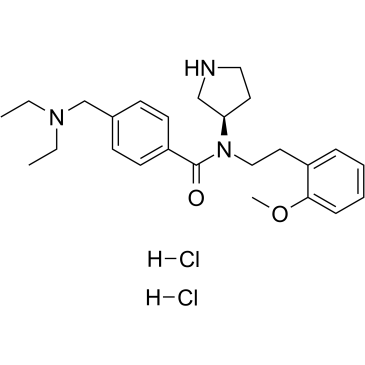
PF429242 dihydrochloride is a novel, potent, reversible and competitive S1P [sterol regulatory element-binding protein (SREBP) site 1 protease] inhibitor with an IC50 of 170 nM. PF 429242 showed no significant inhibition of trypsin, elastase, proteinase K, plasmin, kallikren, factor XIa, thrombin, or furin at concentrations up to 100 μM and only modest inhibition of urokinase (IC50 = 50 μM) and factor Xa (IC50 = 100 μM). PF-429242 is selective for site 1 protease against a panel of serine proteases. PF-429242 inhibits rate of cholesterol synthesis in CHO cells with IC50 of 0.53 μM.
Physicochemical Properties
| Molecular Formula | C25H37CL2N3O2 |
| Molecular Weight | 482.486184835434 |
| Exact Mass | 481.226 |
| CAS # | 2248666-66-0 |
| Related CAS # | PF-429242;947303-87-9 |
| PubChem CID | 90488837 |
| Appearance | White to light brown solid powder |
| Hydrogen Bond Donor Count | 3 |
| Hydrogen Bond Acceptor Count | 4 |
| Rotatable Bond Count | 10 |
| Heavy Atom Count | 32 |
| Complexity | 503 |
| Defined Atom Stereocenter Count | 1 |
| SMILES | CCN(CC)CC1=CC=C(C=C1)C(=O)N(CCC2=CC=CC=C2OC)[C@@H]3CCNC3.Cl.Cl |
| InChi Key | GSUZWFZKTIOWTI-MQWQBNKOSA-N |
| InChi Code | InChI=1S/C25H35N3O2.2ClH/c1-4-27(5-2)19-20-10-12-22(13-11-20)25(29)28(23-14-16-26-18-23)17-15-21-8-6-7-9-24(21)30-3;;/h6-13,23,26H,4-5,14-19H2,1-3H3;2*1H/t23-;;/m1../s1 |
| Chemical Name | 4-(diethylaminomethyl)-N-[2-(2-methoxyphenyl)ethyl]-N-[(3R)-pyrrolidin-3-yl]benzamide;dihydrochloride |
| HS Tariff Code | 2934.99.9001 |
| Storage |
Powder-20°C 3 years 4°C 2 years In solvent -80°C 6 months -20°C 1 month Note: Please store this product in a sealed and protected environment, avoid exposure to moisture. |
| Shipping Condition | Room temperature (This product is stable at ambient temperature for a few days during ordinary shipping and time spent in Customs) |
Biological Activity
| ln Vitro | In Chinese hamster ovary cells, 10 μM PF-429242 disrupts the natural processing of SREBP. As well as downregulating endogenous SREBP target gene expression in cultured HepG2 cells, PF-429242 also inhibited the signal of the SRE luciferase reporter gene in human embryonic kidney 293 cells. With an inhibitory concentration of 0.5 μM, PF-429242 suppresses the synthesis of cholesterol in HepG2 cells [1]. Viral RNA copies and infectious virus titers were dramatically reduced in cell culture fluids upon the addition of PF-429242 (30 μM). In human HEK-293, Hep G2, and non-human primate LLC-MK2 cell cultures, PF-429242 treatment also decreased the formation of DENV2 [2]. This chemical, PF-429242, has strong antiviral action against both LCMV and LASV in cultured cells. It also effectively prevents GPC processing by prototypic arenaviruses, such as lymphocytic choriomeningitis virus (LCMV) and LASV [3]. |
| ln Vivo | The expression of hepatic SREBP target genes was suppressed and the rates of hepatic fatty acid and cholesterol synthesis were decreased in mice given PF-429242 treatment for a full day [1]. |
| References |
[1]. Pharmacologic inhibition of site 1 protease activity inhibits sterol regulatory element-binding protein processing and reduces lipogenic enzyme gene expression and lipid synthesis in cultured cells and experimental animals. J Pharmacol. [2]. Suppressive Effects of the Site 1 Protease (S1P) Inhibitor, PF-429242, on Dengue Virus Propagation. Viruses. 2016 Feb 10;8(2). pii: E46. doi: 10.3390/v8020046. [3]. Antiviral activity of a small-molecule inhibitor of arenavirus glycoprotein processing by the cellular site 1 protease. J Virol. 2011 Jan;85(2):795-803. |
Solubility Data
| Solubility (In Vitro) |
DMSO : ≥ 83.3 mg/mL (~172.65 mM) H2O : ~50 mg/mL (~103.63 mM) |
| Solubility (In Vivo) |
Solubility in Formulation 1: ≥ 2.5 mg/mL (5.18 mM) (saturation unknown) in 10% DMSO + 40% PEG300 + 5% Tween80 + 45% Saline (add these co-solvents sequentially from left to right, and one by one), clear solution. For example, if 1 mL of working solution is to be prepared, you can add 100 μL of 25.0 mg/mL clear DMSO stock solution to 400 μL PEG300 and mix evenly; then add 50 μL Tween-80 to the above solution and mix evenly; then add 450 μL normal saline to adjust the volume to 1 mL. Preparation of saline: Dissolve 0.9 g of sodium chloride in 100 mL ddH₂ O to obtain a clear solution. Solubility in Formulation 2: ≥ 2.5 mg/mL (5.18 mM) (saturation unknown) in 10% DMSO + 90% (20% SBE-β-CD in Saline) (add these co-solvents sequentially from left to right, and one by one), clear solution. For example, if 1 mL of working solution is to be prepared, you can add 100 μL of 25.0 mg/mL clear DMSO stock solution to 900 μL of 20% SBE-β-CD physiological saline solution and mix evenly. Preparation of 20% SBE-β-CD in Saline (4°C,1 week): Dissolve 2 g SBE-β-CD in 10 mL saline to obtain a clear solution. Solubility in Formulation 3: ≥ 2.5 mg/mL (5.18 mM) (saturation unknown) in 10% DMSO + 90% Corn Oil (add these co-solvents sequentially from left to right, and one by one), clear solution. For example, if 1 mL of working solution is to be prepared, you can add 100 μL of 25.0 mg/mL clear DMSO stock solution to 900 μL of corn oil and mix evenly. Solubility in Formulation 4: 100 mg/mL (207.26 mM) in PBS (add these co-solvents sequentially from left to right, and one by one), clear solution; with ultrasonication. (Please use freshly prepared in vivo formulations for optimal results.) |
| Preparing Stock Solutions | 1 mg | 5 mg | 10 mg | |
| 1 mM | 2.0726 mL | 10.3629 mL | 20.7258 mL | |
| 5 mM | 0.4145 mL | 2.0726 mL | 4.1452 mL | |
| 10 mM | 0.2073 mL | 1.0363 mL | 2.0726 mL |