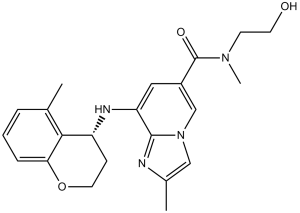
PF 3716556 (PF3716556; PF-3716556) is a novel, potent and selective P-CAB (potassium-competitive acid blocker: acid pump antagonist) with anti-acid reflux activity. It inhibits P-CAB with pIC50 of 6.026 and 7.095 for the inhibition of porcine H+,K+-ATPase activity in ion-leaky and ion-tight assay, respectively. PF-3716556 inhibits gastric acid secretion and thus has the potential for the treatment of gastroesophageal reflux disease. It displays no activity at Na+,K+-ATPase. PF-03716556 did not display any species differences, exhibiting highly selective profile including the canine kidney Na(+),K(+)-ATPase.
Physicochemical Properties
| Molecular Formula | C22H26N4O3 | |
| Molecular Weight | 394.47 | |
| Exact Mass | 394.2 | |
| Elemental Analysis | C, 66.99; H, 6.64; N, 14.20; O, 12.17 | |
| CAS # | 928774-43-0 | |
| Related CAS # |
|
|
| PubChem CID | 25134521 | |
| Appearance | White to yellow solid powder | |
| Density | 1.3±0.1 g/cm3 | |
| Melting Point | 143-145°C | |
| Index of Refraction | 1.651 | |
| LogP | 2.6 | |
| Hydrogen Bond Donor Count | 2 | |
| Hydrogen Bond Acceptor Count | 5 | |
| Rotatable Bond Count | 5 | |
| Heavy Atom Count | 29 | |
| Complexity | 576 | |
| Defined Atom Stereocenter Count | 1 | |
| SMILES | CC1=C2[C@@H](CCOC2=CC=C1)NC3=CC(=CN4C3=NC(=C4)C)C(=O)N(C)CCO |
|
| InChi Key | YBHKBMJREUZHOV-QGZVFWFLSA-N | |
| InChi Code | InChI=1S/C22H26N4O3/c1-14-5-4-6-19-20(14)17(7-10-29-19)24-18-11-16(22(28)25(3)8-9-27)13-26-12-15(2)23-21(18)26/h4-6,11-13,17,24,27H,7-10H2,1-3H3/t17-/m1/s1 | |
| Chemical Name | N-(2-hydroxyethyl)-N,2-dimethyl-8-{[(4R)-5-methyl-3,4-dihydro-2H-chromen-4-yl]amino}imidazo[1,2-a]pyridine-6-carboxamide | |
| Synonyms |
|
|
| HS Tariff Code | 2934.99.9001 | |
| Storage |
Powder-20°C 3 years 4°C 2 years In solvent -80°C 6 months -20°C 1 month |
|
| Shipping Condition | Room temperature (This product is stable at ambient temperature for a few days during ordinary shipping and time spent in Customs) |
Biological Activity
| Targets | H+/K+-ATPase or acid pump (pIC50 = ~6.0) |
| ln Vitro | PF 03716556, with a pIC50 of 7.095 at pH 7.4, inhibits H+, K+-ATPase activity in porcine ion tight membrane vesicles in a concentration-dependent manner[1]. The affinities for a range of receptors, ion channels, and enzymes were determined to analyze selectivity profile. Acid secretion in Ghosh-Schild rats and Heidenhain pouch dogs were measured by titrating perfusate and gastric juice samples. PF-03716556 demonstrated 3-fold greater inhibitory activity than 5,6-dimethyl-2-(4-fluorophenylamino)-4-(1-methyl-1,2,3,4-tetrahydroisoquinoline-2-yl)pyrimidine (revaprazan), the only acid pump antagonist that has been available on the market, in ion-tight assay. The compound did not display any species differences, exhibiting highly selective profile including the canine kidney Na(+),K(+)-ATPase. Kinetics experiments revealed that PF-03716556 has a competitive and reversible mode of action. |
| ln Vivo | Rats treated with PF 03716556 (1–10 mg/kg; intraduodenal; once; male Sprague-Dawley rats) exhibit dose-dependent inhibition of gastric acid output [1].More rapid onset of action than 5-methoxy-2-{[(4-methoxy-3,5-dimethyl-2-pyridyl)methyl]-sulfinyl}-benzimidazole (omeprazole) and 3-fold greater potency than revaprazan were observed in Ghosh-Schild rats and Heidenhain pouch dogs. PF-03716556, a novel acid pump antagonist, could improve upon or even replace current pharmacological treatment for gastroesophageal reflux disease. |
| Animal Protocol |
Animal/Disease Models: Male SD (Sprague-Dawley) rats (250 -300 g) treated with Pentagastrin[1] Doses: 1 mg/kg, 3 mg/kg, 10 mg/kg Route of Administration: Intraduodenal administration; once Experimental Results: Inhibited gastric acid secretion in a dose-dependent manner. |
| References |
[1]. N-(2-hydroxyethyl)-N,2-dimethyl-8-{[(4R)-5-methyl-3,4-dihydro-2H-chromen-4-yl]amino}imidazo[1,2-a]pyridine-6-carboxamide (PF-03716556), a novel, potent, and selective acid pump antagonist for the treatment of gastroesophageal reflux disease. J Pharmacol Exp Ther. 2009 Feb;328(2):671-9. |
| Additional Infomation |
Inhibition of H+,K+-ATPase Activity in Vitro. PF-03716556 inhibited H+,K+-ATPase activity of porcine ion-leaky membrane vesicles in a concentration-dependent manner, with a pIC50 value of 6.026 ± 0.112 at pH 6.4 (Fig. 2A). In the ion-leaky membranes of canine vesicles and human recombinant cells, the pIC50 values at pH 6.4 were 6.038 ± 0.039 (Fig. 2A) and 6.009 ± 0.209 (Fig. 2B), respectively. In porcine ion-leaky membrane vesicles, revaprazan and omeprazole inhibited H+,K+-ATPase activity in a ...[1] The gastric H+,K+-ATPase, a transmembrane enzyme present in parietal cells, is the target molecule for APAs. In this study, we assessed the inhibitory effect of PF-03716556 on the gastric H+,K+-ATPase in the enzymatic fraction (ion-leaky assay) or on the enzyme within ion-tight vesicles (ion-tight assay). Isolated ion-tight vesicles have a low ion-permeability; because the binding site for both K+ and APAs resides inside ion-tight vesicles, enzymatic action of the gastric H+,K+-ATPase exchanges...[1] Inhibition of H(+),K(+)-ATPase is accepted as the most effective way of controlling gastric acid secretion. However, current acid suppressant therapy for gastroesophageal reflux disease, using histamine H(2) receptor antagonists and proton pump inhibitors, does not fully meet the needs of all patients because of their mechanism of action. This study sought to characterize the in vitro and in vivo pharmacology of a novel acid pump antagonist, N-(2-Hydroxyethyl)-N,2-dimethyl-8-{[(4R)-5-methyl-3,4-dihydro-2H-chromen-4-yl]amino}imidazo[1,2-a]pyridine-6-carboxamide (PF-03716556), and to compare it with other acid suppressants. Porcine, canine, and human recombinant gastric H(+),K(+)-ATPase activities were measured by ion-leaky and ion-tight assay. The affinities for a range of receptors, ion channels, and enzymes were determined to analyze selectivity profile. Acid secretion in Ghosh-Schild rats and Heidenhain pouch dogs were measured by titrating perfusate and gastric juice samples. PF-03716556 demonstrated 3-fold greater inhibitory activity than 5,6-dimethyl-2-(4-fluorophenylamino)-4-(1-methyl-1,2,3,4-tetrahydroisoquinoline-2-yl)pyrimidine (revaprazan), the only acid pump antagonist that has been available on the market, in ion-tight assay. The compound did not display any species differences, exhibiting highly selective profile including the canine kidney Na(+),K(+)-ATPase. Kinetics experiments revealed that PF-03716556 has a competitive and reversible mode of action. More rapid onset of action than 5-methoxy-2-{[(4-methoxy-3,5-dimethyl-2-pyridyl)methyl]-sulfinyl}-benzimidazole (omeprazole) and 3-fold greater potency than revaprazan were observed in Ghosh-Schild rats and Heidenhain pouch dogs. PF-03716556, a novel acid pump antagonist, could improve upon or even replace current pharmacological treatment for gastroesophageal reflux disease.[1] |
Solubility Data
| Solubility (In Vitro) |
|
|||
| Solubility (In Vivo) |
Note: Listed below are some common formulations that may be used to formulate products with low water solubility (e.g. < 1 mg/mL), you may test these formulations using a minute amount of products to avoid loss of samples. Injection Formulations (e.g. IP/IV/IM/SC) Injection Formulation 1: DMSO : Tween 80: Saline = 10 : 5 : 85 (i.e. 100 μL DMSO stock solution → 50 μL Tween 80 → 850 μL Saline) *Preparation of saline: Dissolve 0.9 g of sodium chloride in 100 mL ddH ₂ O to obtain a clear solution. Injection Formulation 2: DMSO : PEG300 :Tween 80 : Saline = 10 : 40 : 5 : 45 (i.e. 100 μL DMSO → 400 μLPEG300 → 50 μL Tween 80 → 450 μL Saline) Injection Formulation 3: DMSO : Corn oil = 10 : 90 (i.e. 100 μL DMSO → 900 μL Corn oil) Example: Take the Injection Formulation 3 (DMSO : Corn oil = 10 : 90) as an example, if 1 mL of 2.5 mg/mL working solution is to be prepared, you can take 100 μL 25 mg/mL DMSO stock solution and add to 900 μL corn oil, mix well to obtain a clear or suspension solution (2.5 mg/mL, ready for use in animals). Injection Formulation 4: DMSO : 20% SBE-β-CD in saline = 10 : 90 [i.e. 100 μL DMSO → 900 μL (20% SBE-β-CD in saline)] *Preparation of 20% SBE-β-CD in Saline (4°C,1 week): Dissolve 2 g SBE-β-CD in 10 mL saline to obtain a clear solution. Injection Formulation 5: 2-Hydroxypropyl-β-cyclodextrin : Saline = 50 : 50 (i.e. 500 μL 2-Hydroxypropyl-β-cyclodextrin → 500 μL Saline) Injection Formulation 6: DMSO : PEG300 : castor oil : Saline = 5 : 10 : 20 : 65 (i.e. 50 μL DMSO → 100 μLPEG300 → 200 μL castor oil → 650 μL Saline) Injection Formulation 7: Ethanol : Cremophor : Saline = 10: 10 : 80 (i.e. 100 μL Ethanol → 100 μL Cremophor → 800 μL Saline) Injection Formulation 8: Dissolve in Cremophor/Ethanol (50 : 50), then diluted by Saline Injection Formulation 9: EtOH : Corn oil = 10 : 90 (i.e. 100 μL EtOH → 900 μL Corn oil) Injection Formulation 10: EtOH : PEG300:Tween 80 : Saline = 10 : 40 : 5 : 45 (i.e. 100 μL EtOH → 400 μLPEG300 → 50 μL Tween 80 → 450 μL Saline) Oral Formulations Oral Formulation 1: Suspend in 0.5% CMC Na (carboxymethylcellulose sodium) Oral Formulation 2: Suspend in 0.5% Carboxymethyl cellulose Example: Take the Oral Formulation 1 (Suspend in 0.5% CMC Na) as an example, if 100 mL of 2.5 mg/mL working solution is to be prepared, you can first prepare 0.5% CMC Na solution by measuring 0.5 g CMC Na and dissolve it in 100 mL ddH2O to obtain a clear solution; then add 250 mg of the product to 100 mL 0.5% CMC Na solution, to make the suspension solution (2.5 mg/mL, ready for use in animals). Oral Formulation 3: Dissolved in PEG400 Oral Formulation 4: Suspend in 0.2% Carboxymethyl cellulose Oral Formulation 5: Dissolve in 0.25% Tween 80 and 0.5% Carboxymethyl cellulose Oral Formulation 6: Mixing with food powders Note: Please be aware that the above formulations are for reference only. InvivoChem strongly recommends customers to read literature methods/protocols carefully before determining which formulation you should use for in vivo studies, as different compounds have different solubility properties and have to be formulated differently. (Please use freshly prepared in vivo formulations for optimal results.) |
| Preparing Stock Solutions | 1 mg | 5 mg | 10 mg | |
| 1 mM | 2.5350 mL | 12.6752 mL | 25.3505 mL | |
| 5 mM | 0.5070 mL | 2.5350 mL | 5.0701 mL | |
| 10 mM | 0.2535 mL | 1.2675 mL | 2.5350 mL |