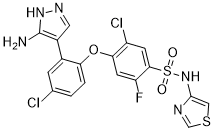
PF-05089771 (PF05089771) is a potent and subtype selective NaV1.7 inhibitor (IC50 = 11 nM) and Nav1.8 voltage-gated sodium channel blocker with the potential to be used in the treatment of chronic neuropathic pain. As of June 2014, it has completed phase II clinical trials for wisdom tooth removal and primary erythromelalgia. PF-05089771 binds to a site in the voltage sensing domain and interacts with the voltage-sensor domain (VSD) of domain IV. PF-05089771 exhibits a slow onset of block that is depolarization and concentration dependent, with a similarly slow recovery from block. Furthermore, the onset of block by PF-05089771 develops with similar rates using protocols that bias channels into predominantly fast- or slow-inactivated states, suggesting that channel inhibition is less dependent on the availability of a particular inactivated state than the relative time that the channel is depolarized.
Physicochemical Properties
| Molecular Formula | C18H12CL2FN5O3S2 | |
| Molecular Weight | 500.34 | |
| Exact Mass | 498.974 | |
| Elemental Analysis | C, 43.21; H, 2.42; Cl, 14.17; F, 3.80; N, 14.00; O, 9.59; S, 12.82 | |
| CAS # | 1235403-62-9 | |
| Related CAS # | PF 05089771 tosylate;1430806-04-4 | |
| PubChem CID | 46840946 | |
| Appearance | White to off-white solid | |
| LogP | 6.889 | |
| Hydrogen Bond Donor Count | 3 | |
| Hydrogen Bond Acceptor Count | 9 | |
| Rotatable Bond Count | 6 | |
| Heavy Atom Count | 31 | |
| Complexity | 721 | |
| Defined Atom Stereocenter Count | 0 | |
| SMILES | ClC1=C([H])C(=C(C([H])=C1OC1C([H])=C([H])C(=C([H])C=1C1C([H])=NN([H])C=1N([H])[H])Cl)F)S(N([H])C1=C([H])SC([H])=N1)(=O)=O |
|
| InChi Key | ZYSCOUXLBXGGIM-UHFFFAOYSA-N | |
| InChi Code | InChI=1S/C18H12Cl2FN5O3S2/c19-9-1-2-14(10(3-9)11-6-24-25-18(11)22)29-15-5-13(21)16(4-12(15)20)31(27,28)26-17-7-30-8-23-17/h1-8,26H,(H3,22,24,25) | |
| Chemical Name | 4-(2-(5-amino-1H-pyrazol-4-yl)-4-chlorophenoxy)-5-chloro-2-fluoro-N-(thiazol-4-yl)benzenesulfonamide | |
| Synonyms |
|
|
| HS Tariff Code | 2934.99.9001 | |
| Storage |
Powder-20°C 3 years 4°C 2 years In solvent -80°C 6 months -20°C 1 month |
|
| Shipping Condition | Room temperature (This product is stable at ambient temperature for a few days during ordinary shipping and time spent in Customs) |
Biological Activity
| Targets |
hNav1.7: (IC50 =11 nM); cynNav1.7 (IC50 =12 nM); dogNav1.7 (IC50 =13 nM); ratNav1.7 (IC50 = 171 nM), musNav1.7 (IC50 = 8 nM)
PF-05089771 targets voltage-gated sodium channel Nav1.7 (IC50 = 17 nM for human Nav1.7 in HEK293 cells under fast-inactivated conditions; IC50 = 14 nM for human Nav1.7 in HEK293 cells under slow-inactivated conditions) [2] PF-05089771 targets Nav1.7 [1] PF-05089771 targets Nav1.7[3] |
| ln Vitro |
It has been found that PF-05089771 exhibits a range of selectivity over TTX-sensitive (TTX-S) channels (10-fold for Nav1.2 to 900-fold for Nav1.3 and Nav1.4) and is more than 1000-fold selective over tetrodotoxin-resistant (TTX-R) Nav1.5 and Nav1.8 channels (IC50s >10 μM)[1]. The majority of TTX-S current (75.5 ± 10.5%, n = 5, Fig. 5D) is blocked by PF-05089771 (30 nM), while a full block was achieved at 100 nM[1]. 1. PF-05089771 potently and selectively inhibited Nav1.7 currents in HEK293 cells stably expressing human Nav1.7, with equivalent inhibitory potency against fast-inactivated (IC50=17 nM) and slow-inactivated (IC50=14 nM) Nav1.7 channels; the inhibition was voltage-dependent, with higher potency at depolarized potentials [2] 2. PF-05089771 showed minimal inhibition of other voltage-gated sodium channel subtypes (Nav1.1, Nav1.2, Nav1.3, Nav1.4, Nav1.5, Nav1.6, Nav1.8, Nav1.9) at concentrations up to 10 μM, confirming high subtype selectivity for Nav1.7 [2] 3. In dissociated mouse dorsal root ganglion (DRG) neurons, PF-05089771 (100 nM) inhibited action potential firing in small-diameter nociceptive neurons, reduced axonal conduction velocity, and suppressed presynaptic neurotransmitter release at DRG-sensory neuron synapses [1] 4. PF-05089771 (10-1000 nM) concentration-dependently reduced the amplitude of Nav1.7-mediated sodium currents in mouse DRG nociceptor neurons, with complete inhibition at 1000 nM [1] |
| ln Vivo |
Compared to vehicle, peroral or inhaled PF-05089771 administration caused about 50–60 % inhibition of cough at the doses that did not alter respiratory rate [3]. 1. In guinea pigs, oral administration of PF-05089771 (3, 10, 30 mg/kg) dose-dependently reduced citric acid-induced cough frequency (maximal inhibition of 65% at 30 mg/kg, p<0.001 vs vehicle); the anti-cough effect was observed as early as 1 h post-administration and persisted for up to 6 h [3] 2. PF-05089771 (30 mg/kg, oral) did not affect baseline respiratory rate, tidal volume, or minute ventilation in guinea pigs, indicating no off-target effects on respiratory function [3] 3. In mice, intraperitoneal administration of PF-05089771 (10 mg/kg) reduced nociceptive behavior in formalin-induced pain models (phase 1: 40% reduction, p<0.01; phase 2: 55% reduction, p<0.001 vs vehicle) and hot plate test (increased latency by 80%, p<0.001 vs vehicle) [1] 4. PF-05089771 (10 mg/kg, i.p.) inhibited action potential propagation in peripheral nociceptive axons in mice, as measured by electrophysiological recording of saphenous nerve activity [1] |
| Enzyme Assay |
The inhibitory profile of PF-05089771 suggests that a conformational change in the domain IV VSD after depolarization is necessary and sufficient to reveal a high-affinity binding site with which PF-05089771 interacts, stabilizing the channel in a nonconducting conformation from which recovery is slow [2]. 1. Whole-cell patch-clamp electrophysiology assays were performed on HEK293 cells stably expressing human Nav1.7 (and other Nav subtypes) to evaluate the inhibitory effect of PF-05089771 on fast/slow-inactivated Nav1.7 channels; cells were voltage-clamped at -120 mV, and fast inactivation was induced by a 500-ms prepulse to -10 mV, while slow inactivation was induced by a 10-min prepulse to -60 mV; peak sodium current amplitude was measured after applying a test pulse to 0 mV, and IC50 values were calculated from concentration-response curves [2] |
| Cell Assay |
Voltage clamp HEK cells or mouse DRG neurons were continuously superfused with extracellular solution (ECS) containing (in mM): 30 NaCl, 110 Choline Cl, 3 KCl, 0.8 MgCl2, 1.8 CaCl2, 0.05 CdCl2, 10 Glucose, 10 HEPES, 5 Sucrose (300–310 mOsm, titrated to pH 7.4 with TEA-OH). The patch pipette (intracellular) solution (ICS) contained (in mM): 5 NaCl, 135 CsF, 10 CsCl, 2 MgATP, 10 HEPES, 5 EGTA (290–300 mOsm, titrated to pH 7.2 with KOH). For human DRG recordings the following solutions were used (ECS in mM):150 NaCl, 4 BaCl, 2 CaCl2, 1 MgCl2, 0.1 CdCl2, 10 Glucose, 10 HEPES, (300–310 mOsm titrated to pH 7.3 with Na-OH). ICS in mM: 140 CsF, 10 NaCl, 1 EGTA, 1 MgCl2, 10 HEPES, 10 glucose, (290–300 mOsm, titrated to pH 7.3 with Cs-OH). Series resistance compensation was routinely applied to at least 75%. Before acquisition, 20 ms pulses to 0 mV were repeatedly applied (0.05 Hz) from Vm = -120 mV until stable current responses were obtained. All experiments were carried out at room temperature (21–24°C). IC50 values were generated in HEK 293 cell lines by voltage clamping at -120 mV before stepping to the V0.5 of inactivation for 5 seconds in order to accumulate compound binding. This was followed by a 100 ms return to -120 mV preceding a 20 ms test step to 0 mV. Cells with large TTX-S currents (>5 nA mouse, >8 nA human) and cells with series resistance values greater than 15 MΩ, or variable series resistance were omitted from analysis [2]. 1. Mouse DRG neurons were dissociated and cultured; whole-cell patch-clamp recordings were conducted to measure action potential firing, axonal conduction velocity, and sodium current amplitude in small-diameter nociceptive neurons treated with PF-05089771 (10-1000 nM); synaptic transmission was assessed by recording excitatory postsynaptic currents (EPSCs) at DRG-sensory neuron synapses after drug treatment [1] 2. HEK293 cells stably expressing human Nav1.7 were cultured in standard medium; cells were plated on glass coverslips and treated with PF-05089771 at concentrations ranging from 1 nM to 10 μM for 10 min before electrophysiological recording; voltage-clamp protocols were used to distinguish fast and slow inactivation states of Nav1.7 channels [2] |
| Animal Protocol |
The guinea pigs were randomly divided into several groups. The animals in the first group received systemic peroral (p.o.) injection of NaV1.7 inhibitor PF-05089771 (15 mg/kg, in 1 ml water) or vehicle (DMSO) 2.5 h prior to inhalation challenge by aerosolized capsaicin (25 μM) for 5 min. The drug solution or vehicle was injected randomly by p.o. administration in the dose of 1 mL in guinea pig weighing about 350 g. The drug solution as a mixture was always vortexed before each use. The application of the substance was slow to ensure that the animal swallowed the whole volume of the tested drug solution. Because of the unpaired design of this experiment, capsaicin-induced cough without any intervention was compared between the groups 10 days later and no significant difference was observed (data not shown). The animals in the second design inhaled aerosol of PF-05089771 (100 μM) or vehicle for 10 min before inhalation of capsaicin (25 μM) containing PF-05089771 (100 μM) or vehicle for 5 min. The experiment had paired design in which two cough challenges were separated by 10 days. The animals received randomly PF-05089771 first or the vehicle first. We also created a third smaller group of animals that underwent a similar protocol with PF-05089771 in the lower concentration of 10 μM. To find out the potential effect of NaV1.7 inhibitor on respiratory rate, respiratory cycles were counted during a 1 min period. The respiratory rate was determined within the last minute of the PF-05089771 inhalation. In the experiment with systemic p.o. administration of PF-05089771, respiratory rate was determined during the first minute of capsaicin inhalation because in the first minute no cough was detected in 16 animals and only one cough was detected in 4 animals [3]. 1. Guinea pig cough model: Male Dunkin-Hartley guinea pigs (250-350 g) were used; PF-05089771 was dissolved in 0.5% methylcellulose/0.1% Tween 80 in water and administered orally at doses of 3, 10, 30 mg/kg (volume: 10 mL/kg) 1 h before citric acid challenge; citric acid (0.4 M) was nebulized for 10 min, and cough frequency was counted for 15 min post-challenge; respiratory parameters (rate, tidal volume, minute ventilation) were measured using whole-body plethysmography [3] 2. Mouse pain models: C57BL/6 mice (20-25 g) were used; PF-05089771 was dissolved in 10% DMSO/90% saline and administered intraperitoneally at 10 mg/kg (volume: 10 mL/kg) 30 min before formalin injection (20 μL of 5% formalin into hind paw) or hot plate test (55°C); formalin-induced nociceptive behavior (licking/biting) was recorded for 60 min (phase 1: 0-10 min, phase 2: 15-60 min), and hot plate latency was measured (maximum cutoff: 60 s) [1] 3. Mouse axonal conduction assay: C57BL/6 mice were anesthetized with isoflurane; PF-05089771 (10 mg/kg, i.p.) was administered, and electrophysiological recordings of saphenous nerve action potentials were performed at 30, 60, 90 min post-administration to measure conduction velocity and amplitude [1] |
| References |
[1]. Alexandrou AJ, et al. Subtype-Selective Small Molecule Inhibitors Reveal a Fundamental Role for Nav1.7 in Nociceptor Electrogenesis, Axonal Conduction and Presynaptic Release. PLoS One. 2016 Apr 6;11(4):e0152405. [2]. Theile JW, et al. The Selective Nav1.7 Inhibitor, PF-05089771, Interacts Equivalently with Fast and Slow Inactivated Nav1.7 Channels. Mol Pharmacol. 2016 Nov;90(5):540-548. [3]. The effect of the voltage-gated sodium channel NaV1.7 blocker PF-05089771 on cough in the guinea pig. Respir Physiol Neurobiol. 2022 May:299:103856. |
| Additional Infomation |
PF-05089771 is under investigation in clinical trial NCT01529671 (A Safety And Tolerability Study Of PF-05089771 In Healthy Subjects And In Subjects With Otseoarthritis Of The Knee). 1. Nav1.7 is a voltage-gated sodium channel subtype predominantly expressed in peripheral nociceptive neurons (DRG), and its dysfunction is linked to congenital pain insensitivity and chronic pain disorders [1] 2. PF-05089771 is a selective Nav1.7 inhibitor that binds to the inactivated state of Nav1.7 channels, blocking sodium influx and inhibiting nociceptor electrogenesis, axonal conduction, and presynaptic neurotransmitter release [1] 3. Unlike most Nav1.7 inhibitors, PF-05089771 interacts equivalently with fast and slow inactivated Nav1.7 channels, which may contribute to its sustained analgesic and anti-cough effects [2] 4. Nav1.7 is expressed in airway sensory nerves, and inhibition of Nav1.7 by PF-05089771 reduces cough reflex sensitivity in guinea pigs, suggesting potential therapeutic utility for chronic cough [3] 5. PF-05089771 exhibits high subtype selectivity for Nav1.7, minimizing off-target effects on cardiac (Nav1.5) and central nervous system (Nav1.1/1.2/1.6) sodium channels [2] |
Solubility Data
| Solubility (In Vitro) |
|
|||
| Solubility (In Vivo) |
Solubility in Formulation 1: 2.5 mg/mL (5.00 mM) in 10% DMSO + 90% (20% SBE-β-CD in Saline) (add these co-solvents sequentially from left to right, and one by one), suspension solution; with sonication. For example, if 1 mL of working solution is to be prepared, you can add 100 μL of 25.0 mg/mL clear DMSO stock solution to 900 μL of 20% SBE-β-CD physiological saline solution and mix evenly. Preparation of 20% SBE-β-CD in Saline (4°C,1 week): Dissolve 2 g SBE-β-CD in 10 mL saline to obtain a clear solution. Solubility in Formulation 2: ≥ 2.25 mg/mL (4.50 mM) (saturation unknown) in 10% DMSO + 40% PEG300 + 5% Tween80 + 45% Saline (add these co-solvents sequentially from left to right, and one by one), clear solution. For example, if 1 mL of working solution is to be prepared, you can add 100 μL of 22.5 mg/mL clear DMSO stock solution to 400 μL PEG300 and mix evenly; then add 50 μL Tween-80 to the above solution and mix evenly; then add 450 μL normal saline to adjust the volume to 1 mL. Preparation of saline: Dissolve 0.9 g of sodium chloride in 100 mL ddH₂ O to obtain a clear solution. Solubility in Formulation 3: ≥ 2.25 mg/mL (4.50 mM) (saturation unknown) in 10% DMSO + 90% Corn Oil (add these co-solvents sequentially from left to right, and one by one), clear solution. For example, if 1 mL of working solution is to be prepared, you can add 100 μL of 22.5 mg/mL clear DMSO stock solution to 900 μL of corn oil and mix evenly. (Please use freshly prepared in vivo formulations for optimal results.) |
| Preparing Stock Solutions | 1 mg | 5 mg | 10 mg | |
| 1 mM | 1.9986 mL | 9.9932 mL | 19.9864 mL | |
| 5 mM | 0.3997 mL | 1.9986 mL | 3.9973 mL | |
| 10 mM | 0.1999 mL | 0.9993 mL | 1.9986 mL |