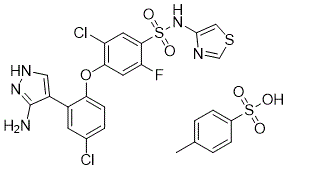
PF-05089771 Tosylate, the tosylate salt of PF05089771, is a potent and subtype selective NaV1.7 inhibitor with IC50 of 11 nM. It is also a Nav1.8 voltage-gated sodium channel blocker with the potential to be used in the treatment of chronic neuropathic pain.
Physicochemical Properties
| Molecular Formula | C25H20CL2FN5O6S3 | |
| Molecular Weight | 672.54 | |
| Exact Mass | 670.993 | |
| CAS # | 1430806-04-4 | |
| Related CAS # | PF 05089771;1235403-62-9 | |
| PubChem CID | 71554187 | |
| Appearance | Typically exists as solid at room temperature | |
| Hydrogen Bond Donor Count | 4 | |
| Hydrogen Bond Acceptor Count | 12 | |
| Rotatable Bond Count | 7 | |
| Heavy Atom Count | 42 | |
| Complexity | 927 | |
| Defined Atom Stereocenter Count | 0 | |
| SMILES | C1C(Cl)=C(OC2C(C3C(N)=NNC=3)=CC(Cl)=CC=2)C=C(F)C=1S(=O)(=O)NC1=CSC=N1.C1C=C(C)C=CC=1S(=O)(=O)O |
|
| InChi Key | NVKBPDYKPNYMDR-UHFFFAOYSA-N | |
| InChi Code | InChI=1S/C18H12Cl2FN5O3S2.C7H8O3S/c19-9-1-2-14(10(3-9)11-6-24-25-18(11)22)29-15-5-13(21)16(4-12(15)20)31(27,28)26-17-7-30-8-23-17;1-6-2-4-7(5-3-6)11(8,9)10/h1-8,26H,(H3,22,24,25);2-5H,1H3,(H,8,9,10) | |
| Chemical Name | 4-[2-(5-amino-1H-pyrazol-4-yl)-4-chlorophenoxy]-5-chloro-2-fluoro-N-(1,3-thiazol-4-yl)benzenesulfonamide;4-methylbenzenesulfonic acid | |
| Synonyms |
|
|
| HS Tariff Code | 2934.99.9001 | |
| Storage |
Powder-20°C 3 years 4°C 2 years In solvent -80°C 6 months -20°C 1 month |
|
| Shipping Condition | Room temperature (This product is stable at ambient temperature for a few days during ordinary shipping and time spent in Customs) |
Biological Activity
| Targets |
hNav1.7: (IC50 =11 nM); cynNav1.7 (IC50 =12 nM); dogNav1.7 (IC50 =13 nM); ratNav1.7 (IC50 = 171 nM), musNav1.7 (IC50 = 8 nM)
Nav1.7 (voltage-gated sodium channel subtype 1.7) (IC50 = 11 nM for human Nav1.7; IC50 = 12 nM for cynomolgus Nav1.7; IC50 = 13 nM for dog Nav1.7; IC50 = 171 nM for rat Nav1.7; IC50 = 8 nM for mouse Nav1.7) [1][2] |
| ln Vitro |
It has been found that PF-05089771 exhibits a range of selectivity over TTX-sensitive (TTX-S) channels (10-fold for Nav1.2 to 900-fold for Nav1.3 and Nav1.4) and is more than 1000-fold selective over tetrodotoxin-resistant (TTX-R) Nav1.5 and Nav1.8 channels (IC50s >10 μM)[1]. PF-05089771 (30 nM) inhibits the majority of TTX-S current (75.5 ± 10.5%, n = 5) and 100 nM resulted in total block[1]. State-dependent inhibition: PF-05089771 binds preferentially to inactivated states of Nav1.7 with high affinity (IC50 = 11 nM), but shows minimal binding to resting channels (IC50 ~ 10 μM) [2][3] - Binding kinetics: At 100 nM concentration, inhibition develops with a time constant of 67 ± 4 seconds for channels inactivated at 0 mV and 90 ± 7 seconds for channels inactivated at -60 mV. Recovery from inhibition is slow and incomplete [2] - Equal interaction with fast and slow inactivated states: The rate of inhibition is similar regardless of whether channels are predominantly in fast-inactivated or slow-inactivated states, indicating that PF-05089771 does not preferentially target a specific inactivated state [2] - Mechanism of action: Binds to the extracellular surface of the voltage-sensing domain (VSD) of domain IV (DIV) of Nav1.7, stabilizing the channel in a non-conductive conformation [2][6] - Specificity: Selective for Nav1.7 over other sodium channel subtypes (Nav1.1, Nav1.2, Nav1.3, Nav1.4, Nav1.5, Nav1.6, Nav1.8, Nav1.9) [1][3] |
| ln Vivo |
Compared to vehicle, peroral or inhaled PF-05089771 administration caused about 50–60 % inhibition of cough at the doses that did not alter respiratory rate [3]. Analgesic effects in rodents: - Intrathecal administration produces rapid (within 15 minutes) and long-lasting (>4 hours) analgesia in various pain models (nociceptive, inflammatory, neuropathic pain, morphine-tolerant pain, and acute/chronic itch) [11] - Effects are reversed by naloxone pretreatment, suggesting involvement of endogenous opioid pathways [11] - In mouse models of inflammatory pain, systemic administration reduces mechanical allodynia and thermal hyperalgesia [1][3] - Antitussive effects in guinea pigs: - Inhibits capsaicin-induced cough in conscious guinea pigs in a dose-dependent manner [5][10] - Reduces cough frequency by 50% at a dose of 3 mg/kg when administered intravenously [5] - The antitussive effect is mediated through inhibition of vagal afferent C-fibers in the airways [5][7] |
| Enzyme Assay |
The inhibitory profile of PF-05089771 suggests that a conformational change in the domain IV VSD after depolarization is necessary and sufficient to reveal a high-affinity binding site with which PF-05089771 interacts, stabilizing the channel in a nonconducting conformation from which recovery is slow [2]. Nav1.7 channel inhibition assay: - Recombinant human Nav1.7 channels expressed in HEK293 cells or Xenopus oocytes are voltage-clamped using the whole-cell patch clamp technique [1][2] - The protocol consists of: 1. 8-second conditioning pulse to a membrane potential that results in 50% inactivation (V0.5, typically -84 ± 1 mV) 2. 2-ms hyperpolarizing pulse to -120 mV to partially relieve inactivation 3. 20-ms test pulse to 0 mV to measure peak sodium current [2] - PF-05089771 is applied extracellularly at various concentrations (0.01-10 μM) and inhibition of sodium current is measured [2] - IC50 values are calculated from concentration-response curves [1][2] |
| Cell Assay |
Voltage clamp HEK cells or mouse DRG neurons were continuously superfused with extracellular solution (ECS) containing (in mM): 30 NaCl, 110 Choline Cl, 3 KCl, 0.8 MgCl2, 1.8 CaCl2, 0.05 CdCl2, 10 Glucose, 10 HEPES, 5 Sucrose (300–310 mOsm, titrated to pH 7.4 with TEA-OH). The patch pipette (intracellular) solution (ICS) contained (in mM): 5 NaCl, 135 CsF, 10 CsCl, 2 MgATP, 10 HEPES, 5 EGTA (290–300 mOsm, titrated to pH 7.2 with KOH). For human DRG recordings the following solutions were used (ECS in mM):150 NaCl, 4 BaCl, 2 CaCl2, 1 MgCl2, 0.1 CdCl2, 10 Glucose, 10 HEPES, (300–310 mOsm titrated to pH 7.3 with Na-OH). ICS in mM: 140 CsF, 10 NaCl, 1 EGTA, 1 MgCl2, 10 HEPES, 10 glucose, (290–300 mOsm, titrated to pH 7.3 with Cs-OH). Series resistance compensation was routinely applied to at least 75%. Before acquisition, 20 ms pulses to 0 mV were repeatedly applied (0.05 Hz) from Vm = -120 mV until stable current responses were obtained. All experiments were carried out at room temperature (21–24°C). IC50 values were generated in HEK 293 cell lines by voltage clamping at -120 mV before stepping to the V0.5 of inactivation for 5 seconds in order to accumulate compound binding. This was followed by a 100 ms return to -120 mV preceding a 20 ms test step to 0 mV. Cells with large TTX-S currents (>5 nA mouse, >8 nA human) and cells with series resistance values greater than 15 MΩ, or variable series resistance were omitted from analysis [2]. Nav1.7-expressing cell viability/proliferation assay: - Human embryonic kidney (HEK293) cells stably transfected with human Nav1.7 are seeded in 96-well plates at 5,000 cells/well [1] - After 24 hours, PF-05089771 is added at concentrations ranging from 0.01-10 μM and incubated for 24-72 hours [1] - Cell viability is assessed using MTT or ATP-based assays, with absorbance measured at 570 nm [1] |
| Animal Protocol |
The guinea pigs were randomly divided into several groups. The animals in the first group received systemic peroral (p.o.) injection of NaV1.7 inhibitor PF-05089771 (15 mg/kg, in 1 ml water) or vehicle (DMSO) 2.5 h prior to inhalation challenge by aerosolized capsaicin (25 μM) for 5 min. The drug solution or vehicle was injected randomly by p.o. administration in the dose of 1 mL in guinea pig weighing about 350 g. The drug solution as a mixture was always vortexed before each use. The application of the substance was slow to ensure that the animal swallowed the whole volume of the tested drug solution. Because of the unpaired design of this experiment, capsaicin-induced cough without any intervention was compared between the groups 10 days later and no significant difference was observed (data not shown). The animals in the second design inhaled aerosol of PF-05089771 (100 μM) or vehicle for 10 min before inhalation of capsaicin (25 μM) containing PF-05089771 (100 μM) or vehicle for 5 min. The experiment had paired design in which two cough challenges were separated by 10 days. The animals received randomly PF-05089771 first or the vehicle first. We also created a third smaller group of animals that underwent a similar protocol with PF-05089771 in the lower concentration of 10 μM. To find out the potential effect of NaV1.7 inhibitor on respiratory rate, respiratory cycles were counted during a 1 min period. The respiratory rate was determined within the last minute of the PF-05089771 inhalation. In the experiment with systemic p.o. administration of PF-05089771, respiratory rate was determined during the first minute of capsaicin inhalation because in the first minute no cough was detected in 16 animals and only one cough was detected in 4 animals [3]. 1. Analgesic efficacy in rodent pain models: - Subjects: Male Sprague-Dawley rats or C57BL/6 mice (6-8 weeks old) [1][11] - Pain models: - Inflammatory pain: Induced by intraplantar injection of complete Freund's adjuvant (CFA) or carrageenan in hind paw [1] - Neuropathic pain: Induced by chronic constriction injury (CCI) or spinal nerve ligation [11] - Drug administration: - Intrathecal route: PF-05089771 dissolved in sterile saline (1-10 μg/10 μL) is injected into the lumbar subarachnoid space using a 30-gauge needle [11] - Systemic route: PF-05089771 dissolved in vehicle (10% DMSO + 40% PEG 400 + 50% saline) is administered intravenously or orally at doses of 0.1-10 mg/kg [1] - Efficacy assessment: - Mechanical allodynia: Von Frey filaments applied to the plantar surface of hind paw; 50% withdrawal threshold is determined using the up-down method [1] - Thermal hyperalgesia: Hot plate (52°C) or radiant heat (Hargreaves apparatus) applied to hind paw; latency to withdrawal is recorded [1] ### 2. Antitussive efficacy in guinea pig cough model: - Subjects: Male Hartley guinea pigs (300-500 g) [5] - Cough induction: - Conscious guinea pigs are exposed to aerosolized capsaicin (10 μM in saline) for 30 seconds using a nebulizer [5] - Coughs are recorded for 5 minutes following capsaicin exposure [5] - Drug administration: - PF-05089771 dissolved in vehicle (saline + 10% DMSO) is administered intravenously via the marginal ear vein at doses of 0.3-3 mg/kg or orally at 10-30 mg/kg [5] - Animals are challenged with capsaicin 30 minutes after drug administration [5] - Efficacy assessment: - Cough frequency (number of coughs/5 minutes) is compared between treatment and vehicle control groups [5] - Percentage inhibition of cough is calculated as: (1 - (cough frequency in treated group/cough frequency in control group)) × 100% [5] |
| ADME/Pharmacokinetics |
Absorption: Orally bioavailable in rodents and non-human primates [3][4] - Distribution: - Readily crosses the blood-brain barrier (BBB) [3][11] - Volume of distribution (Vd) in rats is approximately 10 L/kg, indicating extensive tissue distribution [4] - Metabolism: - Primarily metabolized by hepatic cytochrome P450 enzymes, with CYP3A4 being the major isoform involved [4] - In human liver microsomes, the intrinsic clearance (CLint) is approximately 50 μL/min/mg protein [4] - Elimination: - Terminal half-life (t1/2) in rats is approximately 2-3 hours [4] - In humans, time to maximum concentration (Tmax) is reached within 4-6 hours after oral administration [4] - Excreted primarily in urine as metabolites, with less than 5% of the dose excreted unchanged [4] |
| Toxicity/Toxicokinetics |
Acute toxicity: In rodents, LD50 > 100 mg/kg following intravenous administration [3] - Cardiovascular safety: - At therapeutic concentrations, PF-05089771 shows minimal effects on cardiac sodium channels (Nav1.5), with IC50 > 10 μM, reducing the risk of QT prolongation and arrhythmias [3][6] - In in vitro cardiac action potential assays, concentrations up to 1 μM do not significantly affect action potential duration or conduction velocity [3] - Neurological safety: - Limited CNS penetration at therapeutic doses when administered systemically, minimizing potential for sedation, cognitive impairment, or motor dysfunction [3][11] - No significant effects on skeletal muscle function at therapeutic concentrations, as skeletal muscle primarily expresses Nav1.4, which is not significantly inhibited by PF-05089771 [3] |
| References |
[1]. Alexandrou AJ, et al. Subtype-Selective Small Molecule Inhibitors Reveal a Fundamental Role for Nav1.7 in Nociceptor Electrogenesis, Axonal Conduction and Presynaptic Release. PLoS One. 2016 Apr 6;11(4):e0152405. [2]. Theile JW, et al. The Selective Nav1.7 Inhibitor, PF-05089771, Interacts Equivalently with Fast and Slow Inactivated Nav1.7 Channels. Mol Pharmacol. 2016 Nov;90(5):540-548. [3]. The effect of the voltage-gated sodium channel NaV1.7 blocker PF-05089771 on cough in the guinea pig. Respir Physiol Neurobiol. 2022 May:299:103856. |
| Additional Infomation |
Therapeutic potential: - Pain disorders: Neuropathic pain, inflammatory pain, postoperative pain, cancer pain, and migraine [1][3][11] - Respiratory disorders: Chronic cough associated with asthma, chronic obstructive pulmonary disease (COPD), and idiopathic pulmonary fibrosis [5][7][10] - Itch disorders: Pruritus associated with atopic dermatitis, psoriasis, and uremia [11] - Structure-activity relationships: - PF-05089771 is an aryl sulfonamide derivative with a cycloalkyl ether substituent, which confers high selectivity for Nav1.7 [3][6] - The sulfonamide group is essential for binding to the extracellular VSD of Nav1.7 [6] - Clinical development status: - Completed Phase I clinical trials in healthy volunteers, demonstrating acceptable safety and pharmacokinetics [4][5] - Phase II trials in patients with chronic pain and cough are ongoing or completed [4][5] - Advantages over other sodium channel blockers: - Selective for Nav1.7, which is predominantly expressed in peripheral sensory neurons, minimizing central and cardiac side effects [1][3] - State-dependent inhibition preferentially targets hyperexcitable neurons that are firing repetitively, which is characteristic of pain and cough conditions [2][6] - Long duration of action due to slow dissociation from the channel, allowing for less frequent dosing [2] |
Solubility Data
| Solubility (In Vitro) |
|
|||
| Solubility (In Vivo) |
Note: Listed below are some common formulations that may be used to formulate products with low water solubility (e.g. < 1 mg/mL), you may test these formulations using a minute amount of products to avoid loss of samples. Injection Formulations (e.g. IP/IV/IM/SC) Injection Formulation 1: DMSO : Tween 80: Saline = 10 : 5 : 85 (i.e. 100 μL DMSO stock solution → 50 μL Tween 80 → 850 μL Saline) *Preparation of saline: Dissolve 0.9 g of sodium chloride in 100 mL ddH ₂ O to obtain a clear solution. Injection Formulation 2: DMSO : PEG300 :Tween 80 : Saline = 10 : 40 : 5 : 45 (i.e. 100 μL DMSO → 400 μLPEG300 → 50 μL Tween 80 → 450 μL Saline) Injection Formulation 3: DMSO : Corn oil = 10 : 90 (i.e. 100 μL DMSO → 900 μL Corn oil) Example: Take the Injection Formulation 3 (DMSO : Corn oil = 10 : 90) as an example, if 1 mL of 2.5 mg/mL working solution is to be prepared, you can take 100 μL 25 mg/mL DMSO stock solution and add to 900 μL corn oil, mix well to obtain a clear or suspension solution (2.5 mg/mL, ready for use in animals). Injection Formulation 4: DMSO : 20% SBE-β-CD in saline = 10 : 90 [i.e. 100 μL DMSO → 900 μL (20% SBE-β-CD in saline)] *Preparation of 20% SBE-β-CD in Saline (4°C,1 week): Dissolve 2 g SBE-β-CD in 10 mL saline to obtain a clear solution. Injection Formulation 5: 2-Hydroxypropyl-β-cyclodextrin : Saline = 50 : 50 (i.e. 500 μL 2-Hydroxypropyl-β-cyclodextrin → 500 μL Saline) Injection Formulation 6: DMSO : PEG300 : castor oil : Saline = 5 : 10 : 20 : 65 (i.e. 50 μL DMSO → 100 μLPEG300 → 200 μL castor oil → 650 μL Saline) Injection Formulation 7: Ethanol : Cremophor : Saline = 10: 10 : 80 (i.e. 100 μL Ethanol → 100 μL Cremophor → 800 μL Saline) Injection Formulation 8: Dissolve in Cremophor/Ethanol (50 : 50), then diluted by Saline Injection Formulation 9: EtOH : Corn oil = 10 : 90 (i.e. 100 μL EtOH → 900 μL Corn oil) Injection Formulation 10: EtOH : PEG300:Tween 80 : Saline = 10 : 40 : 5 : 45 (i.e. 100 μL EtOH → 400 μLPEG300 → 50 μL Tween 80 → 450 μL Saline) Oral Formulations Oral Formulation 1: Suspend in 0.5% CMC Na (carboxymethylcellulose sodium) Oral Formulation 2: Suspend in 0.5% Carboxymethyl cellulose Example: Take the Oral Formulation 1 (Suspend in 0.5% CMC Na) as an example, if 100 mL of 2.5 mg/mL working solution is to be prepared, you can first prepare 0.5% CMC Na solution by measuring 0.5 g CMC Na and dissolve it in 100 mL ddH2O to obtain a clear solution; then add 250 mg of the product to 100 mL 0.5% CMC Na solution, to make the suspension solution (2.5 mg/mL, ready for use in animals). Oral Formulation 3: Dissolved in PEG400 Oral Formulation 4: Suspend in 0.2% Carboxymethyl cellulose Oral Formulation 5: Dissolve in 0.25% Tween 80 and 0.5% Carboxymethyl cellulose Oral Formulation 6: Mixing with food powders Note: Please be aware that the above formulations are for reference only. InvivoChem strongly recommends customers to read literature methods/protocols carefully before determining which formulation you should use for in vivo studies, as different compounds have different solubility properties and have to be formulated differently. (Please use freshly prepared in vivo formulations for optimal results.) |
| Preparing Stock Solutions | 1 mg | 5 mg | 10 mg | |
| 1 mM | 1.4869 mL | 7.4345 mL | 14.8690 mL | |
| 5 mM | 0.2974 mL | 1.4869 mL | 2.9738 mL | |
| 10 mM | 0.1487 mL | 0.7435 mL | 1.4869 mL |