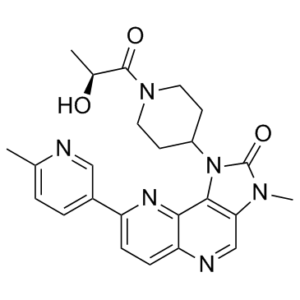
PF-04979064 is a novel, potent and selective PI3K/mTOR dual kinase inhibitor with Kis of 0.13 nM and 1.42 nM for PI3Kα and mTOR, Oncologists have focused a lot of their research on PI3K, AKT, and mTOR, three important kinases from the PI3K signaling pathway, to treat a variety of cancers. A tricyclic imidazo[1,5]naphthyridine series lead optimization effort was conducted in order to find a structurally distinct back-up candidate to PF-04691502, which is currently being tested for the treatment of solid tumors in phase I/II clinical trials. The combination of structure-based drug design and physical property-based optimization led to the development of the potent and specific PI3K/mTOR dual kinase inhibitor PF-04979064.
Physicochemical Properties
| Molecular Formula | C24H26N6O3 |
| Molecular Weight | 446.5016 |
| Exact Mass | 446.206 |
| Elemental Analysis | C, 64.56; H, 5.87; N, 18.82; O, 10.75 |
| CAS # | 1220699-06-8 |
| Related CAS # | 1220699-06-8 |
| PubChem CID | 46866705 |
| Appearance | White to yellow solid powder |
| Density | 1.4±0.1 g/cm3 |
| Boiling Point | 682.0±55.0 °C at 760 mmHg |
| Flash Point | 366.3±31.5 °C |
| Vapour Pressure | 0.0±2.2 mmHg at 25°C |
| Index of Refraction | 1.668 |
| LogP | 0.35 |
| Hydrogen Bond Donor Count | 1 |
| Hydrogen Bond Acceptor Count | 6 |
| Rotatable Bond Count | 3 |
| Heavy Atom Count | 33 |
| Complexity | 744 |
| Defined Atom Stereocenter Count | 1 |
| SMILES | O=C1N(C([H])([H])[H])C2=C([H])N=C3C([H])=C([H])C(C4=C([H])N=C(C([H])([H])[H])C([H])=C4[H])=NC3=C2N1C1([H])C([H])([H])C([H])([H])N(C([C@]([H])(C([H])([H])[H])O[H])=O)C([H])([H])C1([H])[H] |
| InChi Key | GACQNUHFDBEIQH-HNNXBMFYSA-N |
| InChi Code | InChI=1S/C24H26N6O3/c1-14-4-5-16(12-25-14)18-6-7-19-21(27-18)22-20(13-26-19)28(3)24(33)30(22)17-8-10-29(11-9-17)23(32)15(2)31/h4-7,12-13,15,17,31H,8-11H2,1-3H3/t15-/m0/s1 |
| Chemical Name | 1-[1-[(2S)-2-hydroxypropanoyl]piperidin-4-yl]-3-methyl-8-(6-methylpyridin-3-yl)imidazo[4,5-c][1,5]naphthyridin-2-one |
| Synonyms | PF-04979064; PF 04979064; PF04979064 |
| HS Tariff Code | 2934.99.9001 |
| Storage |
Powder-20°C 3 years 4°C 2 years In solvent -80°C 6 months -20°C 1 month |
| Shipping Condition | Room temperature (This product is stable at ambient temperature for a few days during ordinary shipping and time spent in Customs) |
Biological Activity
| Targets |
PI3Kα (Ki = 0.13 nM); PI3Kγ (Ki = 0.111 nM); PI3Kδ (Ki = 0.122 nM); mTOR (Ki = 1.42 nM) PF-04979064 is tested against human class I PI3K isoforms PI3Kα, PI3Kγ, and PI3Kδ, with PI3Kα Ki of 0.13 nM, PI3Kγ Ki of 0.111 nM, and PI3Kδ Ki of 0.122 nM[1]. |
| ln Vitro |
PF-04979064 is tested against human class I PI3K isoforms PI3Kα, PI3Kγ, and PI3Kδ, with PI3Kα Ki of 0.13 nM, PI3Kγ Ki of 0.111 nM, and PI3Kδ Ki of 0.122 nM[1]. In a cellular assay measuring inhibition of AKT phosphorylation at serine 473 (pAKT) in BT20 cells, PF-04979064 exhibited an IC50 of 9.10 nM [1]. The compound demonstrated high kinome selectivity, showing less than 25% inhibition against a panel of 36 tested kinases at a concentration of 1 μM [1]. The compound exhibited high permeability in the RRCK assay (17.2 x 10⁻⁶ cm/sec) and very good kinetic solubility (539 μM) [1] |
| ln Vivo |
The in vivo PK profile of PF-04979064 in rats shows progress, showing Vdss=5.23 L/kg, Cl=19.3 mL/min/kg, T1/2=1.85 h, and F%=61%[1]. PF-04979064 demonstrated dose-dependent tumor growth inhibition (TGI) in a U87MG human glioblastoma mouse xenograft model. When administered orally once daily (QD), it achieved 88% TGI at the highest tested and tolerated dose of 40 mg/kg QD [1]. A robust pharmacokinetic/pharmacodynamic (PK/PD) correlation was observed. Following a single oral dose of 40 mg/kg in U87MG tumor-bearing mice, maximum inhibition of tumor AKT phosphorylation (pS473) coincided with high free drug plasma concentrations at 1 hour post-dose. Minimal inhibition was observed at 24 hours post-dose when free drug plasma concentrations were very low [1] . |
| Enzyme Assay |
The inhibition constants (Ki) against various kinase targets (mPI3Kα, mTOR, human PI3K isoforms) for PF-04979064 were determined using established in vitro biochemical assays, as referenced in the literature. The specific experimental procedures for these kinase activity assays are described in a previous publication (reference 5 and 6 within the article), which details methods for measuring inhibition of PI3K and mTOR kinase activity. Coefficients of variance for these assays were typically less than 20% (n=2) [1]. A crystal structure of PF-04979064 bound to PI3Kγ was determined, confirming its binding mode. Key interactions included a hydrogen bond between the naphthyridine ring nitrogen and the hinge residue, a hydrogen bond between the methylpyridine nitrogen and a conserved water molecule, and additional hydrogen bonds from the amide carbonyl to Lys833 and from the alcohol moiety to Asp964 [1] |
| Cell Assay |
The cellular potency of PF-04979064 was assessed in a BT20 cell-based assay measuring the inhibition of AKT phosphorylation at serine 473 (pAKT). The detailed protocol for this cellular assay is referenced from previous work (reference 5 and 6 within the article). In brief, cells are treated with the compound, lysed, and the levels of phosphorylated AKT (pS473) are quantified to determine the IC50 value, which represents the concentration causing 50% inhibition of phosphorylation [1] . |
| Animal Protocol |
Efficacy Study: For the in vivo tumor growth inhibition study, U87MG tumor cells were implanted subcutaneously into nude mice. Once tumors were established, mice were randomized and treated with PF-04979064 administered orally (PO) once daily (QD). Tumor sizes were measured periodically. Tumor growth inhibition was calculated by comparing tumor volumes in treated groups to the vehicle control group. Statistical significance was determined using one-way ANOVA [1]. PK/PD Study: U87MG tumor-bearing mice were administered a single oral dose of PF-04979064 at 40 mg/kg. At various time points post-dosing, tumors and plasma were collected. Tumors were processed into lysates for analysis of AKT phosphorylation inhibition (pS473). Plasma samples were analyzed to determine the concentration of free drug [1]. Rat PK Study: PF-04979064 was administered to rats to determine its pharmacokinetic profile. The specific route, formulation, and dosing frequency for this study are not detailed in the provided text [1] . |
| ADME/Pharmacokinetics |
PF-04979064 exhibited low intrinsic clearance in human liver microsome (HLM) assays (< 10.3 mL/min/kg), indicating good metabolic stability against cytochrome P450 enzymes [1]. In rat pharmacokinetic studies, PF-04979064 showed a favorable profile: volume of distribution at steady state (Vdss) = 5.23 L/kg, clearance (Cl) = 19.3 mL/min/kg, half-life (T1/2) = 1.85 hours, and oral bioavailability (F%) = 61% [1]. The compound was identified as a substrate for aldehyde oxidase (AO). Its stability was assessed in a human liver S9 fraction assay, where it had a half-life (T1/2) of 38.7 minutes. An empirical scaling method was developed to predict human clearance for AO substrates, and the predicted total plasma clearance for PF-04979064 in humans was 8.1 mL/min/kg [1]. In silico estimates of its unbound fraction in plasma (fu, p) was 0.0875, and its blood-to-plasma ratio was 0.86 [1] |
| References |
[1]. Discovery of the Highly Potent PI3K/mTOR Dual Inhibitor PF-04979064 through Structure-Based Drug Design. ACS Med Chem Lett, 2012 Nov 7, 4(1):91-7. |
| Additional Infomation |
PF-04979064 was discovered through structure-based drug design and physical properties-based optimization from a lead compound (1) with high lipophilicity and poor ADMET properties. The optimization significantly increased lipophilic efficiency (LipE) by more than 4 units [1]. It was developed as a structurally differentiated back-up candidate to PF-04691502, another PI3K/mTOR dual inhibitor in clinical trials [1]. The compound's binding mode to PI3Kγ involves key hydrogen bond interactions in the hinge region and the phosphate-binding pocket, as confirmed by X-ray crystallography (PDB code: 4HVB) [1] . |
Solubility Data
| Solubility (In Vitro) | DMSO: ~10 mg/mL (~22.4 mM) |
| Solubility (In Vivo) |
Solubility in Formulation 1: ≥ 1 mg/mL (2.24 mM) (saturation unknown) in 10% DMSO + 40% PEG300 + 5% Tween80 + 45% Saline (add these co-solvents sequentially from left to right, and one by one), clear solution. For example, if 1 mL of working solution is to be prepared, you can add 100 μL of 10.0 mg/mL clear DMSO stock solution to 400 μL of PEG300 and mix evenly; then add 50 μL of Tween-80 to the above solution and mix evenly; then add 450 μL of normal saline to adjust the volume to 1 mL. Preparation of saline: Dissolve 0.9 g of sodium chloride in 100 mL ddH₂ O to obtain a clear solution. Solubility in Formulation 2: ≥ 1 mg/mL (2.24 mM) (saturation unknown) in 10% DMSO + 90% (20% SBE-β-CD in Saline) (add these co-solvents sequentially from left to right, and one by one), clear solution. For example, if 1 mL of working solution is to be prepared, you can add 100 μL of 10.0 mg/mL clear DMSO stock solution to 900 μL of 20% SBE-β-CD physiological saline solution and mix evenly. Preparation of 20% SBE-β-CD in Saline (4°C,1 week): Dissolve 2 g SBE-β-CD in 10 mL saline to obtain a clear solution. Solubility in Formulation 3: ≥ 1 mg/mL (2.24 mM) (saturation unknown) in 10% DMSO + 90% Corn Oil (add these co-solvents sequentially from left to right, and one by one), clear solution. For example, if 1 mL of working solution is to be prepared, you can add 100 μL of 10.0 mg/mL clear DMSO stock solution to 900 μL of corn oil and mix evenly. (Please use freshly prepared in vivo formulations for optimal results.) |
| Preparing Stock Solutions | 1 mg | 5 mg | 10 mg | |
| 1 mM | 2.2396 mL | 11.1982 mL | 22.3964 mL | |
| 5 mM | 0.4479 mL | 2.2396 mL | 4.4793 mL | |
| 10 mM | 0.2240 mL | 1.1198 mL | 2.2396 mL |