|
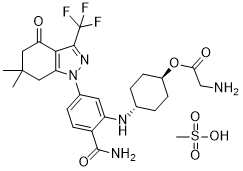
PF-04929113 mesylate (also known as SNX-5422 mesylate) is a potent and
selective inhibitor of heat shock protein 90 (HSP90) with Kd of 41 nM,
it induces Her-2 degradation with IC50 of 37 nM. PF-04929113 is a
synthetic prodrug of SNX-2112 with potential antineoplastic activity. PF-04929113 is
rapidly converted to SNX-2112, which accumulates in tumors relative to
normal tissues. SNX-2112 inhibits Hsp90, which may result in the
proteasomal degradation of oncogenic client proteins, including
HER2/ERBB2, and the inhibition of tumor cell proliferation.
|
Physicochemical Properties
| Molecular Formula |
C26H34F3N5O7S
|
| Molecular Weight |
617.64
|
| Exact Mass |
617.213
|
| CAS # |
1173111-67-5
|
| Related CAS # |
908115-27-5;1173111-67-5 (mesylate);
|
| PubChem CID |
44195570
|
| Appearance |
Typically exists as solid at room temperature
|
| LogP |
5.612
|
| Hydrogen Bond Donor Count |
4
|
| Hydrogen Bond Acceptor Count |
13
|
| Rotatable Bond Count |
7
|
| Heavy Atom Count |
42
|
| Complexity |
969
|
| Defined Atom Stereocenter Count |
0
|
| SMILES |
S(C([H])([H])[H])(=O)(=O)O[H].FC(C1C2C(C([H])([H])C(C([H])([H])[H])(C([H])([H])[H])C([H])([H])C=2N(C2C([H])=C([H])C(C(N([H])[H])=O)=C(C=2[H])N([H])C2([H])C([H])([H])C([H])([H])C([H])(C([H])([H])C2([H])[H])OC(C([H])([H])N([H])[H])=O)N=1)=O)(F)F
|
| InChi Key |
NVGFSTMGRRADRG-UHFFFAOYSA-N
|
| InChi Code |
InChI=1S/C25H30F3N5O4.CH4O3S/c1-24(2)10-18-21(19(34)11-24)22(25(26,27)28)32-33(18)14-5-8-16(23(30)36)17(9-14)31-13-3-6-15(7-4-13)37-20(35)12-29;1-5(2,3)4/h5,8-9,13,15,31H,3-4,6-7,10-12,29H2,1-2H3,(H2,30,36);1H3,(H,2,3,4)
|
| Chemical Name |
[4-[2-carbamoyl-5-[6,6-dimethyl-4-oxo-3-(trifluoromethyl)-5,7-dihydroindazol-1-yl]anilino]cyclohexyl] 2-aminoacetate;methanesulfonic acid
|
| Synonyms |
| SNX-5422 mesylate;SNX5422; SNX 5422; PF4929113; PF-4929113 mesylate; PF 4929113; PF04929113; PF 04929113; PF-04929113mesylate |
|
| HS Tariff Code |
2934.99.9001
|
| Storage |
Powder-20°C 3 years
4°C 2 years
In solvent -80°C 6 months
-20°C 1 month
|
| Shipping Condition |
Room temperature (This product is stable at ambient temperature for a few days during ordinary shipping and time spent in Customs)
|
|
Biological Activity
| ln Vitro |
In vitro activity:
PF-04929113 is a small-molecule Hsp90 inhibitor based on the
6,7-dihydro-indazol-4-one scaffold. PF-04929113 developed by Serenex,
converts to SNX-2122, which is the active Hsp90 inhibitor form.
PF-04929113 exhibits potent effects on Her-2 stability and causes
expected up-regulation of Hsp70. PF-04929113 shows potent
antiproliferative activity against a broad range of cancer cell types,
e.g. MCF-7 (IC50=16 nM), SW620 (IC50=19 nM), K562 (IC50=23 nM), SK-MEL-5
(IC50=25 nM), and A375 (IC50=51 nM).
Kinase Assay:
Hsp90 from porcine spleen extract is isolated by affinity capture on a
purine-affinity media. The Hsp90 loaded media is then challenged with
PF-04929113 at a given concentration, ranging from 0.8 to 500 μM, and
the amount of Hsp90 liberated at each concentration is determined by
Bradford protein assay. The resulting IC50 values are corrected for the
ATP ligand concentration and presented as apparent Kd values.
Cell Assay:
All assays are done in 96-well plates. All cell lines are purchased
from ATCC. Proliferation rates are measured by seeding cells (MCF-7,
SW620, K562, SK-MEL-5 and A375 cancer cell lines) into 96-well plates,
followed by compound addition 24 h later. After addition of PF-04929113,
cells are allowed to grow for either an additional 72 or 144 h
depending on rate of growth. At harvest, media is removed and DNA
content for individual wells is determined using CyQuant DNA dye. Levels
of Hsp90 client proteins and phosphor-regulated proteins in A375 are
measured by high content analysis (HCA) using an ArrayScan 4.5
instrument after 24 hours of treatment with PF-04929113, followed by
methanol fixation. After fixation in 4% PBS-buffered formalin and
permeablization with 0.1% TX-100, cells are probed with anti-Her2,
antiphospho-S6 (pS6), antipERK, and anti-Hsp70 primary antibodies,
followed by TRITC or FITC conjugated secondary antibodies. Nuclei are
also stained with Hoechst DNA binding dye. For each well, 250-500
individual nuclei are identified along with the average staining
intensity for the client and phospho-proteins for each cell. Average
client staining intensities are then calculated for each well. |
|
| ln Vivo |
| PF-04929113 inhibits human MM cell growth in vivo, and
immuno-histochemical analysis shows PF-04929113 significantly inhibits
p-ERK and p-Akt in treated mice. Meanwhile, PF-04929113 treatment
significantly decreases the percentage of CD31+ cells and MVD,
consistent with an inhibitory effect on angiogenesis in vivo. A 50 mg/kg
administration of PF-04929113 delivered 3 times per week significantly
delays castrate-resistant LNCaP tumor growth and prolongs cancer
specific survival. Immuno-histochemical analysis indicates increased
SP70 expression, and decreases Ki67, Akt, and AR expression, after
treatment with PF-04929113. Inhibition of tumor progression by
PF-04929113 may result from a combination of decreased proliferative
(reduced Ki67 and Akt expression) or increased apoptosis (increased
ApopTag staining) rates. |
|
| Animal Protocol |
| Dissolved
in 1% carboxy methylcellulose/0.5% Tween 80 at 10 mg/mL and stored at 4
°C for in vivo study; 20 or 40 mg/kg; oral gavage | | Fox Chase SCID mice bearing MM.1S cells | |
|
| References |
: J Med Chem. 2009;52(14):4288-305; Blood. 2009;113(4):846-55; Clin Cancer Res. 2011;17(8):2301-13.
|
| Additional Infomation |
Hsp90 Inhibitor SNX-5422 Mesylate is the orally bioavailable mesylate salt of a synthetic prodrug targeting the human heat-shock protein 90 (Hsp90) with potential antineoplastic activity. Although the mechanism of action remains to be fully elucidated, Hsp90 inhibitor SNX-5422 is rapidly converted to SNX-2112, which accumulates more readily in tumors relative to normal tissues. SNX-2112 inhibits Hsp90, which may result in the proteasomal degradation of oncogenic client proteins, including HER2/ERBB2, and the inhibition of tumor cell proliferation. Hsp90 is a molecular chaperone that plays a key role in the conformational maturation of oncogenic signaling proteins, such as HER2/ERBB2, AKT, RAF1, BCR-ABL, and mutated p53, as well as many other molecules that are important in cell cycle regulation or immune responses.
|
|
Solubility Data
| Solubility (In Vitro) |
| DMSO: 5 mg/mL (9.6 mM) | | Water:<1 mg/mL | | Ethanol: 3 mg/mL (5.2 mM) |
|
| Solubility (In Vivo) |
| 0.5% CMC+0.25% Tween 80: 25mg/mL |
(Please use freshly prepared in vivo formulations for optimal results.)
|
| Preparing Stock Solutions |
|
1 mg |
5 mg |
10 mg |
| 1 mM |
1.6191 mL |
8.0953 mL |
16.1907 mL |
| 5 mM |
0.3238 mL |
1.6191 mL |
3.2381 mL |
| 10 mM |
0.1619 mL |
0.8095 mL |
1.6191 mL |
*Note: Please select an appropriate solvent for the preparation of stock solution based on your experiment needs. For most products, DMSO can be used for preparing stock solutions (e.g. 5 mM, 10 mM, or 20 mM concentration); some products with high aqueous solubility may be dissolved in water directly. Solubility information is available at the above Solubility Data section. Once the stock solution is prepared, aliquot it to routine usage volumes and store at -20°C or -80°C. Avoid repeated freeze and thaw cycles. |