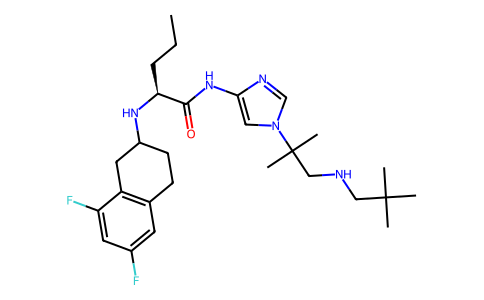
Physicochemical Properties
| Molecular Formula | C27H41F2N5O |
| Molecular Weight | 489.6558 |
| Exact Mass | 489.327 |
| CAS # | 865773-15-5 |
| PubChem CID | 46224413 |
| Appearance | Typically exists as solid at room temperature |
| Density | 1.2±0.1 g/cm3 |
| Boiling Point | 651.3±55.0 °C at 760 mmHg |
| Flash Point | 347.7±31.5 °C |
| Vapour Pressure | 0.0±1.9 mmHg at 25°C |
| Index of Refraction | 1.562 |
| LogP | 4.89 |
| Hydrogen Bond Donor Count | 3 |
| Hydrogen Bond Acceptor Count | 6 |
| Rotatable Bond Count | 11 |
| Heavy Atom Count | 35 |
| Complexity | 685 |
| Defined Atom Stereocenter Count | 2 |
| SMILES | FC1C=C(F)C=C2CCC(CC=12)N[C@@H](CCC)C(=O)NC1N=CN(C(C)(C)CNCC(C)(C)C)C=1 |
| InChi Key | VFCRKLWBYMDAED-REWPJTCUSA-N |
| InChi Code | InChI=1S/C27H41F2N5O/c1-7-8-23(32-20-10-9-18-11-19(28)12-22(29)21(18)13-20)25(35)33-24-14-34(17-31-24)27(5,6)16-30-15-26(2,3)4/h11-12,14,17,20,23,30,32H,7-10,13,15-16H2,1-6H3,(H,33,35)/t20-,23-/m0/s1 |
| Chemical Name | (2S)-2-[[(2S)-6,8-difluoro-1,2,3,4-tetrahydronaphthalen-2-yl]amino]-N-[1-[1-(2,2-dimethylpropylamino)-2-methylpropan-2-yl]imidazol-4-yl]pentanamide |
| Synonyms | PF 03084014; PF03084014; PF-03084014 |
| HS Tariff Code | 2934.99.9001 |
| Storage |
Powder-20°C 3 years 4°C 2 years In solvent -80°C 6 months -20°C 1 month |
| Shipping Condition | Room temperature (This product is stable at ambient temperature for a few days during ordinary shipping and time spent in Customs) |
Biological Activity
| ADME/Pharmacokinetics |
Absorption, Distribution and Excretion The following pharmacokinetics parameters in patients with desmoid tumors were calculated as follows: Cmax (508 (62) ng/mL), AUC0-tau (u 3370 (58) ng·h/mL), time to steady state (6 days), and Tmax (1.5 (0.5, 6.5) hours). Nirogacestat is excreted mostly in feces (38%) and urine 17%, with less than 1% of the unchanged drug remains in the urine. It can also be eliminated through expired air (9.7%). The apparent volume of distribution [Mean (%CV)] of nirogacestat is 1430 (65) L. The apparent systemic clearance [Mean (%CV)] of nirogacestat is 45 (58) L/hr. Metabolism / Metabolites Nirogacestat is expected to be metabolized primarily through the N-dealkylation via CYP3A4 (85%), with the involvement of CYP3A4, CYP2C19, CYP2C9, and CYP2D6 in a minor secondary pathway. Biological Half-Life The terminal elimination half-life [Mean (%CV)] of nirogacestat is 23 (37) hr . |
| Toxicity/Toxicokinetics |
Protein Binding Nirogacestat has a high level of serum protein binding of 99.6%, with 94.6% to serum albumin and 97.9% to alpha-1 acid glycoprotein. |
| Additional Infomation |
Nirogacestat is a member of the class of imidazoles that is 1H-imidazole substituted by a 1-[(2,2-dimethylpropyl)amino]-2-methylpropan-2-yl group at position 1 and a {N-[(2S)-6,8-difluoro-1,2,3,4-tetrahydronaphthalen-2-yl]-L-norvalyl}amino group at position 4. It is a gamma-secretase inhibitor whose hydrobromide salt is indicated for adult patients with progressing desmoid tumours who require systemic treatment. It has a role as an antineoplastic agent and a gamma-secretase modulator. It is a member of tetralins, an organofluorine compound, a secondary carboxamide, a secondary amino compound and a member of imidazoles. It is a conjugate base of a nirogacestat(2+). Nirogacestat is a small-molecule gamma-secretase inhibitor that was investigated as a potential treatment for desmoid tumors. Desmoid tumors are typically characterized by aberrant activation in Notch signaling. Interaction between the notch receptors and their ligands activates proteolytic cleavage by gamma-secretase; therefore, the inhibition of gamma-secretase can potentially inhibit Notch signaling and thus impede the growth of desmoid tumors. Nirogacestat was approved under the brand name OGSIVEO on November 27, 2023, by the FDA for the treatment of adult patients with progressing desmoid tumors who require systemic treatment. It was previously granted breakthrough therapy, fast track, and orphan drug designations for the treatment of desmoid tumors, and the final approval was based on positive results obtained in the Phase 3 DeFi trial, where a confirmed objective response rate was observed to be 41% compared to 8% with the placebo. Nirogacestat is a selective gamma secretase (GS) inhibitor with antitumor activity. Upon administration, nirogacestat targets and binds to GS, thereby blocking the proteolytic activation of Notch receptors. This inhibits the Notch signaling pathway and results in the induction of apoptosis in tumor cells that overexpress Notch. The integral membrane protein GS is a multi-subunit protease complex that cleaves single-pass transmembrane proteins, such as Notch receptors, at residues within their transmembrane domains. Overexpression of the Notch signaling pathway has been correlated with increased tumor cell growth and survival. Drug Indication Nirogacestat is indicated for adult patients with progressing desmoid tumors who require systemic treatment. Mechanism of Action Nirogacestat is a gamma secretase inhibitor that blocks proteolytic activation of the Notch receptor. When dysregulated, Notch can activate pathways that contribute to tumor growth. Pharmacodynamics There is an exposure-response relationship between nirogacestat exposure and Grade 3 hypophosphatemia with a higher risk of Grade 3 hypophosphatemia at higher exposure. At the recommended dosage, a mean increase in the QTc interval > 20 ms was not observed. |
Solubility Data
| Solubility (In Vitro) | May dissolve in DMSO (in most cases), if not, try other solvents such as H2O, Ethanol, or DMF with a minute amount of products to avoid loss of samples |
| Solubility (In Vivo) |
Note: Listed below are some common formulations that may be used to formulate products with low water solubility (e.g. < 1 mg/mL), you may test these formulations using a minute amount of products to avoid loss of samples. Injection Formulations (e.g. IP/IV/IM/SC) Injection Formulation 1: DMSO : Tween 80: Saline = 10 : 5 : 85 (i.e. 100 μL DMSO stock solution → 50 μL Tween 80 → 850 μL Saline) *Preparation of saline: Dissolve 0.9 g of sodium chloride in 100 mL ddH ₂ O to obtain a clear solution. Injection Formulation 2: DMSO : PEG300 :Tween 80 : Saline = 10 : 40 : 5 : 45 (i.e. 100 μL DMSO → 400 μLPEG300 → 50 μL Tween 80 → 450 μL Saline) Injection Formulation 3: DMSO : Corn oil = 10 : 90 (i.e. 100 μL DMSO → 900 μL Corn oil) Example: Take the Injection Formulation 3 (DMSO : Corn oil = 10 : 90) as an example, if 1 mL of 2.5 mg/mL working solution is to be prepared, you can take 100 μL 25 mg/mL DMSO stock solution and add to 900 μL corn oil, mix well to obtain a clear or suspension solution (2.5 mg/mL, ready for use in animals). Injection Formulation 4: DMSO : 20% SBE-β-CD in saline = 10 : 90 [i.e. 100 μL DMSO → 900 μL (20% SBE-β-CD in saline)] *Preparation of 20% SBE-β-CD in Saline (4°C,1 week): Dissolve 2 g SBE-β-CD in 10 mL saline to obtain a clear solution. Injection Formulation 5: 2-Hydroxypropyl-β-cyclodextrin : Saline = 50 : 50 (i.e. 500 μL 2-Hydroxypropyl-β-cyclodextrin → 500 μL Saline) Injection Formulation 6: DMSO : PEG300 : castor oil : Saline = 5 : 10 : 20 : 65 (i.e. 50 μL DMSO → 100 μLPEG300 → 200 μL castor oil → 650 μL Saline) Injection Formulation 7: Ethanol : Cremophor : Saline = 10: 10 : 80 (i.e. 100 μL Ethanol → 100 μL Cremophor → 800 μL Saline) Injection Formulation 8: Dissolve in Cremophor/Ethanol (50 : 50), then diluted by Saline Injection Formulation 9: EtOH : Corn oil = 10 : 90 (i.e. 100 μL EtOH → 900 μL Corn oil) Injection Formulation 10: EtOH : PEG300:Tween 80 : Saline = 10 : 40 : 5 : 45 (i.e. 100 μL EtOH → 400 μLPEG300 → 50 μL Tween 80 → 450 μL Saline) Oral Formulations Oral Formulation 1: Suspend in 0.5% CMC Na (carboxymethylcellulose sodium) Oral Formulation 2: Suspend in 0.5% Carboxymethyl cellulose Example: Take the Oral Formulation 1 (Suspend in 0.5% CMC Na) as an example, if 100 mL of 2.5 mg/mL working solution is to be prepared, you can first prepare 0.5% CMC Na solution by measuring 0.5 g CMC Na and dissolve it in 100 mL ddH2O to obtain a clear solution; then add 250 mg of the product to 100 mL 0.5% CMC Na solution, to make the suspension solution (2.5 mg/mL, ready for use in animals). Oral Formulation 3: Dissolved in PEG400 Oral Formulation 4: Suspend in 0.2% Carboxymethyl cellulose Oral Formulation 5: Dissolve in 0.25% Tween 80 and 0.5% Carboxymethyl cellulose Oral Formulation 6: Mixing with food powders Note: Please be aware that the above formulations are for reference only. InvivoChem strongly recommends customers to read literature methods/protocols carefully before determining which formulation you should use for in vivo studies, as different compounds have different solubility properties and have to be formulated differently. (Please use freshly prepared in vivo formulations for optimal results.) |
| Preparing Stock Solutions | 1 mg | 5 mg | 10 mg | |
| 1 mM | 2.0422 mL | 10.2112 mL | 20.4223 mL | |
| 5 mM | 0.4084 mL | 2.0422 mL | 4.0845 mL | |
| 10 mM | 0.2042 mL | 1.0211 mL | 2.0422 mL |