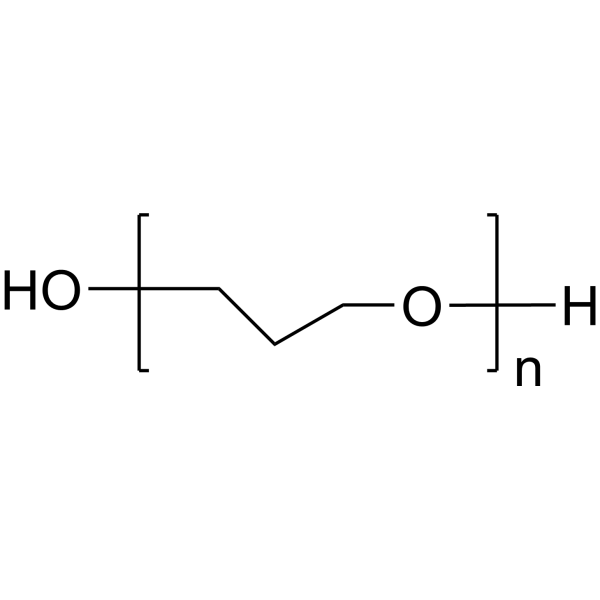
Physicochemical Properties
| Molecular Formula | (C2H4O)NH2O |
| Molecular Weight | 8000 |
| CAS # | 25322-68-3 |
| Appearance | White to off-white solid powder |
| Density | 1.125 |
| Boiling Point | 250ºC |
| Melting Point | -65ºC |
| Flash Point | 171ºC |
| Vapour Pressure | <0.01 mm Hg ( 20 °C) |
| Index of Refraction | 1.458-1.461 |
| LogP | 0 |
| HS Tariff Code | 2934.99.9001 |
| Storage |
Powder-20°C 3 years 4°C 2 years In solvent -80°C 6 months -20°C 1 month |
| Shipping Condition | Room temperature (This product is stable at ambient temperature for a few days during ordinary shipping and time spent in Customs) |
Biological Activity
| ln Vitro | Chlorella virus FJ-1 was isolated in Fujian Province of China. It can be precipitated by polyethylene glycol(PEG8000) and the best condition if 7% PEG8000 and 4% NaCl. But the precipitation efficiency of PEG8000 is lower than that of ultracentrifugation [1]. |
| Animal Protocol |
Aim: Although polyethylene glycol (PEG) is a neutral, biocompatible hydrophilic polymer recognized for its lack of interaction with biological barrier, its neurotoxicity has not been clearly identified in neurosurgery. This study is constructed to evaluate the possible neurotoxicity of a PEG hydrogel dural sealant.[2] Material and methods: After a burrhole was opened in the left parietal bone of the twenty five Wistar albino rats, the dura mater and cerebral cortex were incised and the experimental material (activated polyethylene glycol and polyethylene imine) was sprayed into the burrhole. Then brain tissues were harvested for histopathological and biochemical studies at 72 hours to investigate the acute stage changes and on 15th day to evaluate the chronic stage changes.[2] Results: There were statistically significant differences among the groups regarding the comparison of the values of the PMNL cell infiltration grades, gliosis and congestion in both acute and chronic stages. However, the values of the MNL cell infiltration grades, edema and fibrin formation, lipid peroxidation levels of harvested brain tissues were similar in all groups.[2] Conclusion: Although this study did not present the detailed histopathological and biochemical evaluation results, it indicated that the application of the PEG-based hydrogel sealant was not associated with neurotoxicity, delayed healing, or degenerative changes.[2] |
| References |
[1]. Precipitation of chlorella virus FJ-1 by polyethylene glycol(PEG8000). Wei Sheng Wu Xue Bao. 2000 Oct;40(5):556-8. [2]. Evaluation of the neurotoxicity of the polyethylene glycol hydrogel dural sealant. Turk Neurosurg. 2013;23(1):16-24. |
Solubility Data
| Solubility (In Vitro) | May dissolve in DMSO (in most cases), if not, try other solvents such as H2O, Ethanol, or DMF with a minute amount of products to avoid loss of samples |
| Solubility (In Vivo) |
Note: Listed below are some common formulations that may be used to formulate products with low water solubility (e.g. < 1 mg/mL), you may test these formulations using a minute amount of products to avoid loss of samples. Injection Formulations (e.g. IP/IV/IM/SC) Injection Formulation 1: DMSO : Tween 80: Saline = 10 : 5 : 85 (i.e. 100 μL DMSO stock solution → 50 μL Tween 80 → 850 μL Saline) *Preparation of saline: Dissolve 0.9 g of sodium chloride in 100 mL ddH ₂ O to obtain a clear solution. Injection Formulation 2: DMSO : PEG300 :Tween 80 : Saline = 10 : 40 : 5 : 45 (i.e. 100 μL DMSO → 400 μLPEG300 → 50 μL Tween 80 → 450 μL Saline) Injection Formulation 3: DMSO : Corn oil = 10 : 90 (i.e. 100 μL DMSO → 900 μL Corn oil) Example: Take the Injection Formulation 3 (DMSO : Corn oil = 10 : 90) as an example, if 1 mL of 2.5 mg/mL working solution is to be prepared, you can take 100 μL 25 mg/mL DMSO stock solution and add to 900 μL corn oil, mix well to obtain a clear or suspension solution (2.5 mg/mL, ready for use in animals). Injection Formulation 4: DMSO : 20% SBE-β-CD in saline = 10 : 90 [i.e. 100 μL DMSO → 900 μL (20% SBE-β-CD in saline)] *Preparation of 20% SBE-β-CD in Saline (4°C,1 week): Dissolve 2 g SBE-β-CD in 10 mL saline to obtain a clear solution. Injection Formulation 5: 2-Hydroxypropyl-β-cyclodextrin : Saline = 50 : 50 (i.e. 500 μL 2-Hydroxypropyl-β-cyclodextrin → 500 μL Saline) Injection Formulation 6: DMSO : PEG300 : castor oil : Saline = 5 : 10 : 20 : 65 (i.e. 50 μL DMSO → 100 μLPEG300 → 200 μL castor oil → 650 μL Saline) Injection Formulation 7: Ethanol : Cremophor : Saline = 10: 10 : 80 (i.e. 100 μL Ethanol → 100 μL Cremophor → 800 μL Saline) Injection Formulation 8: Dissolve in Cremophor/Ethanol (50 : 50), then diluted by Saline Injection Formulation 9: EtOH : Corn oil = 10 : 90 (i.e. 100 μL EtOH → 900 μL Corn oil) Injection Formulation 10: EtOH : PEG300:Tween 80 : Saline = 10 : 40 : 5 : 45 (i.e. 100 μL EtOH → 400 μLPEG300 → 50 μL Tween 80 → 450 μL Saline) Oral Formulations Oral Formulation 1: Suspend in 0.5% CMC Na (carboxymethylcellulose sodium) Oral Formulation 2: Suspend in 0.5% Carboxymethyl cellulose Example: Take the Oral Formulation 1 (Suspend in 0.5% CMC Na) as an example, if 100 mL of 2.5 mg/mL working solution is to be prepared, you can first prepare 0.5% CMC Na solution by measuring 0.5 g CMC Na and dissolve it in 100 mL ddH2O to obtain a clear solution; then add 250 mg of the product to 100 mL 0.5% CMC Na solution, to make the suspension solution (2.5 mg/mL, ready for use in animals). Oral Formulation 3: Dissolved in PEG400 Oral Formulation 4: Suspend in 0.2% Carboxymethyl cellulose Oral Formulation 5: Dissolve in 0.25% Tween 80 and 0.5% Carboxymethyl cellulose Oral Formulation 6: Mixing with food powders Note: Please be aware that the above formulations are for reference only. InvivoChem strongly recommends customers to read literature methods/protocols carefully before determining which formulation you should use for in vivo studies, as different compounds have different solubility properties and have to be formulated differently. (Please use freshly prepared in vivo formulations for optimal results.) |
| Preparing Stock Solutions | 1 mg | 5 mg | 10 mg | |
| 1 mM | 0.1250 mL | 0.6250 mL | 1.2500 mL | |
| 5 mM | 0.0250 mL | 0.1250 mL | 0.2500 mL | |
| 10 mM | 0.0125 mL | 0.0625 mL | 0.1250 mL |