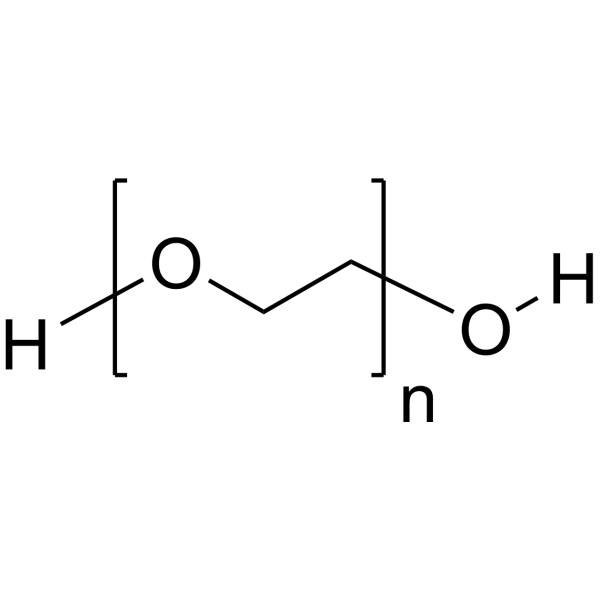
Physicochemical Properties
| Molecular Formula | (CH2CH2O)N |
| Molecular Weight | 300 |
| CAS # | 25322-68-3 |
| Related CAS # | PEG300;25322-68-3;PEG400;25322-68-3;PEG2000;25322-68-3 |
| Appearance | Colorless to light yellow liquid |
| Density | 1.125 |
| Boiling Point | 250ºC |
| Melting Point | -65ºC |
| Flash Point | 171ºC |
| Vapour Pressure | <0.01 mm Hg ( 20 °C) |
| Index of Refraction | 1.458-1.461 |
| LogP | 0 |
| SMILES | OCCCCOC[H].[n] |
| Synonyms | Polyethylene glycol 300; PEG-300; PEG300 |
| HS Tariff Code | 2934.99.9001 |
| Storage |
Powder-20°C 3 years 4°C 2 years In solvent -80°C 6 months -20°C 1 month |
| Shipping Condition | Room temperature (This product is stable at ambient temperature for a few days during ordinary shipping and time spent in Customs) |
Biological Activity
| Targets | solvent, plasticizer, surfactant, ointment and suppository base, and tablet and capsule lubricant |
| ln Vitro |
The water soluble polymers studied were; polyethylene glycol (PEG) (molecular weight, Mw, 300 and 1000) (neutral), polyamine (FL15) (Mw 5000) (cationic) and polyacrylic acid, PAA, (Mw 2000) (charge dependant on pH) to establish the effect of polymer charge on the nature and extent of adsorption. XRD and ATR-FTIR spectroscopy have shown that water soluble polymers adsorb onto clay dispersions and are stable when deposited as thin solid films. XRD indicates that PEG stacks as either one or two layers whereas PAA and FL15 are restricted to a single layer between the clay lamellae. ATR-FTIR spectroscopy showed that FL15 penetrated the Na–SWy-1 films which contained low loadings of PEG without displacing any of the resident PEG. When a bilayer of PEG was present, FL15 did not penetrate into the film. Both PAA and PEG adsorbed onto FL15 loaded Na–SWy-1 films irrespective of FL15 loading or the molecular weight of the PEG. ATR-FTIR indicated that significant adsorption occurred in under 30 s and the adsorption rate was not influenced by the presence of a second polymer preloaded into the clay. [1] The FDA has approved polyethylene glycol (PEG) as a carrier or matrix in food, cosmetics, and drugs, including injectable, topical, rectal, and nasal preparations. PEG is almost non-toxic and can be completely eliminated from the body through the kidneys (for PEG<30 kDa) or feces (for PEG>20 kDa). PEG lacks immunogenicity, and antibodies against PEG are only produced in rabbits when PEG binds to high immunogenic proteins. [2,3] - Adsorption on montmorillonite: PEG300 (Polyethylene glycol 300) can adsorb onto montmorillonite. The adsorption process involves interactions between the polymer chains and the clay surface, as observed through in situ ATR-FTIR studies which showed characteristic spectral changes corresponding to the presence of PEG300 on the montmorillonite surface [1] - Hydrogel formation: PEG300 can be used in the preparation of injectable silk-PEG hydrogels. When combined with silk fibroin, it forms a hydrogel network through physical crosslinking, which exhibits suitable mechanical properties and biocompatibility in vitro [4] |
| ln Vivo | Up to 50% of PEG300 can be used in intravenous and intramuscular injection forms, with no toxic effects. When taken orally, the maximum percentage of PEG300 can reach 90%.[4,5] |
| References |
[1]. Adsorption of polyamine, polyacrylic acid and polyethylene glycol on montmorillonite: An in situ study using ATR-FTIR. Volume 14, Issue 1, March 1997, Pages 19-34. [2]. Structural basis of polyethylene glycol recognition by antibody. J Biomed Sci. 2020 Jan 7;27(1):12. [3]. Effect of pegylation on pharmaceuticals. Nat Rev Drug Discov. 2003 Mar;2(3):214-21. [4]. Injectable silk-polyethylene glycol hydrogels. Acta Biomater. 2015 Jan;12:51-61. [5]. Beneficial effects of combining nilotinib and imatinib in preclinical models of BCR-ABL+ leukemias. Blood. 2007 Mar 1;109(5):2112-20. |
| Additional Infomation |
- PEG300 is a polyethylene glycol with an average molecular weight of approximately 300 Da. It is a hydrophilic polymer that is often used in pharmaceutical formulations as a solvent, solubilizer, or excipient due to its ability to enhance the solubility of poorly water-soluble drugs [3] - Pegylation, the process of attaching polyethylene glycol (including PEG300) to pharmaceuticals, can modify their pharmacokinetic properties, such as increasing circulation time, reducing immunogenicity, and improving stability. However, the specific effects depend on the molecular weight and structure of the PEG used [3] |
Solubility Data
| Solubility (In Vitro) |
DMSO: ~100 mg/mL (~333 mM) H2O : ≥ 50 mg/mL (~166 mM) |
| Solubility (In Vivo) |
Note: Listed below are some common formulations that may be used to formulate products with low water solubility (e.g. < 1 mg/mL), you may test these formulations using a minute amount of products to avoid loss of samples. Injection Formulations (e.g. IP/IV/IM/SC) Injection Formulation 1: DMSO : Tween 80: Saline = 10 : 5 : 85 (i.e. 100 μL DMSO stock solution → 50 μL Tween 80 → 850 μL Saline) *Preparation of saline: Dissolve 0.9 g of sodium chloride in 100 mL ddH ₂ O to obtain a clear solution. Injection Formulation 2: DMSO : PEG300 :Tween 80 : Saline = 10 : 40 : 5 : 45 (i.e. 100 μL DMSO → 400 μLPEG300 → 50 μL Tween 80 → 450 μL Saline) Injection Formulation 3: DMSO : Corn oil = 10 : 90 (i.e. 100 μL DMSO → 900 μL Corn oil) Example: Take the Injection Formulation 3 (DMSO : Corn oil = 10 : 90) as an example, if 1 mL of 2.5 mg/mL working solution is to be prepared, you can take 100 μL 25 mg/mL DMSO stock solution and add to 900 μL corn oil, mix well to obtain a clear or suspension solution (2.5 mg/mL, ready for use in animals). Injection Formulation 4: DMSO : 20% SBE-β-CD in saline = 10 : 90 [i.e. 100 μL DMSO → 900 μL (20% SBE-β-CD in saline)] *Preparation of 20% SBE-β-CD in Saline (4°C,1 week): Dissolve 2 g SBE-β-CD in 10 mL saline to obtain a clear solution. Injection Formulation 5: 2-Hydroxypropyl-β-cyclodextrin : Saline = 50 : 50 (i.e. 500 μL 2-Hydroxypropyl-β-cyclodextrin → 500 μL Saline) Injection Formulation 6: DMSO : PEG300 : castor oil : Saline = 5 : 10 : 20 : 65 (i.e. 50 μL DMSO → 100 μLPEG300 → 200 μL castor oil → 650 μL Saline) Injection Formulation 7: Ethanol : Cremophor : Saline = 10: 10 : 80 (i.e. 100 μL Ethanol → 100 μL Cremophor → 800 μL Saline) Injection Formulation 8: Dissolve in Cremophor/Ethanol (50 : 50), then diluted by Saline Injection Formulation 9: EtOH : Corn oil = 10 : 90 (i.e. 100 μL EtOH → 900 μL Corn oil) Injection Formulation 10: EtOH : PEG300:Tween 80 : Saline = 10 : 40 : 5 : 45 (i.e. 100 μL EtOH → 400 μLPEG300 → 50 μL Tween 80 → 450 μL Saline) Oral Formulations Oral Formulation 1: Suspend in 0.5% CMC Na (carboxymethylcellulose sodium) Oral Formulation 2: Suspend in 0.5% Carboxymethyl cellulose Example: Take the Oral Formulation 1 (Suspend in 0.5% CMC Na) as an example, if 100 mL of 2.5 mg/mL working solution is to be prepared, you can first prepare 0.5% CMC Na solution by measuring 0.5 g CMC Na and dissolve it in 100 mL ddH2O to obtain a clear solution; then add 250 mg of the product to 100 mL 0.5% CMC Na solution, to make the suspension solution (2.5 mg/mL, ready for use in animals). Oral Formulation 3: Dissolved in PEG400 Oral Formulation 4: Suspend in 0.2% Carboxymethyl cellulose Oral Formulation 5: Dissolve in 0.25% Tween 80 and 0.5% Carboxymethyl cellulose Oral Formulation 6: Mixing with food powders Note: Please be aware that the above formulations are for reference only. InvivoChem strongly recommends customers to read literature methods/protocols carefully before determining which formulation you should use for in vivo studies, as different compounds have different solubility properties and have to be formulated differently. (Please use freshly prepared in vivo formulations for optimal results.) |
| Preparing Stock Solutions | 1 mg | 5 mg | 10 mg | |
| 1 mM | 3.3333 mL | 16.6667 mL | 33.3333 mL | |
| 5 mM | 0.6667 mL | 3.3333 mL | 6.6667 mL | |
| 10 mM | 0.3333 mL | 1.6667 mL | 3.3333 mL |