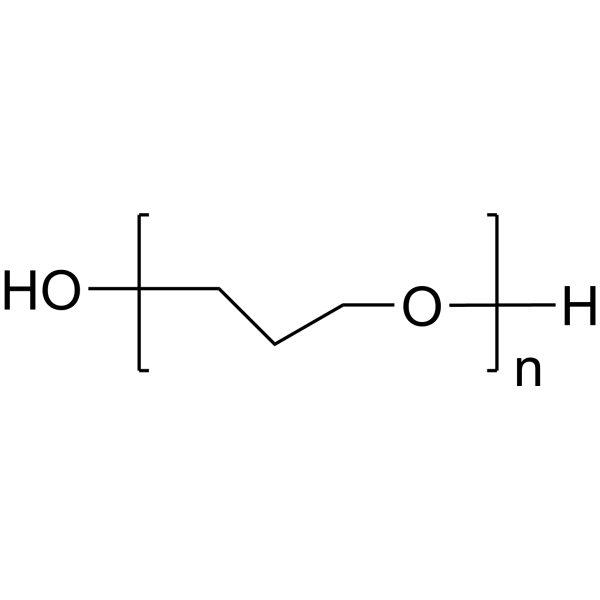
Physicochemical Properties
| Molecular Formula | (C2H4O)NH2O |
| Molecular Weight | 200 |
| CAS # | 25322-68-3 |
| Appearance | Colorless to light yellow liquid |
| Density | 1.125 |
| Boiling Point | 250ºC |
| Melting Point | -65ºC |
| Flash Point | 171ºC |
| Vapour Pressure | <0.01 mm Hg ( 20 °C) |
| Index of Refraction | 1.458-1.461 |
| LogP | 0 |
| HS Tariff Code | 2934.99.9001 |
| Storage |
Powder-20°C 3 years 4°C 2 years In solvent -80°C 6 months -20°C 1 month |
| Shipping Condition | Room temperature (This product is stable at ambient temperature for a few days during ordinary shipping and time spent in Customs) |
Biological Activity
| ln Vitro | Protein and peptide drugs hold great promise as therapeutic agents. However, many are degraded by proteolytic enzymes, can be rapidly cleared by the kidneys, generate neutralizing antibodies and have a short circulating half-life. Pegylation, the process by which polyethylene glycol chains are attached to protein and peptide drugs, can overcome these and other shortcomings. By increasing the molecular mass of proteins and peptides and shielding them from proteolytic enzymes, pegylation improves pharmacokinetics. This article will review how PEGylation can result in drugs that are often more effective and safer, and which show improved patient convenience and compliance. |
| References |
[1]. Adsorption of polyamine, polyacrylic acid and polyethylene glycol on montmorillonite: An in situ study using ATR-FTIR. Volume 14, Issue 1, March 1997, Pages 19-34. [2]. Structural basis of polyethylene glycol recognition by antibody. J Biomed Sci. 2020 Jan 7;27(1):12. [3]. Effect of pegylation on pharmaceuticals. Nat Rev Drug Discov. 2003 Mar;2(3):214-21. [4]. Injectable silk-polyethylene glycol hydrogels. Acta Biomater. 2015 Jan;12:51-61. [5]. Beneficial effects of combining nilotinib and imatinib in preclinical models of BCR-ABL+ leukemias. Blood. 2007 Mar 1;109(5):2112-20. |
| Additional Infomation |
Attenuated total reflectance Fourier transform infrared (ATR-FTIR) spectroscopy and X-ray diffraction (XRD) have been employed to investigate the adsorption of water soluble polymers from aqueous solution onto a clay mineral surface in situ, to gain an understanding of the interactions occurring at the microscopic level in water based muds (WBM). The water soluble polymers studied were; polyethylene glycol (PEG) (molecular weight, Mw, 300 and 1000) (neutral), polyamine (FL15) (Mw 5000) (cationic) and polyacrylic acid, PAA, (Mw 2000) (charge dependant on pH) to establish the effect of polymer charge on the nature and extent of adsorption. XRD and ATR-FTIR spectroscopy have shown that water soluble polymers adsorb onto clay dispersions and are stable when deposited as thin solid films. XRD indicates that PEG stacks as either one or two layers whereas PAA and FL15 are restricted to a single layer between the clay lamellae. ATR-FTIR spectroscopy showed that FL15 penetrated the Na–SWy-1 films which contained low loadings of PEG without displacing any of the resident PEG. When a bilayer of PEG was present, FL15 did not penetrate into the film. Both PAA and PEG adsorbed onto FL15 loaded Na–SWy-1 films irrespective of FL15 loading or the molecular weight of the PEG. ATR-FTIR indicated that significant adsorption occurred in under 30 s and the adsorption rate was not influenced by the presence of a second polymer preloaded into the clay. [1] Background: Polyethylene glycol (PEG) is widely used in industry and medicine. Anti-PEG antibodies have been developed for characterizing PEGylated drugs and other applications. However, the underlying mechanism for specific PEG binding has not been elucidated. Methods: The Fab of two cognate anti-PEG antibodies 3.3 and 2B5 were each crystallized in complex with PEG, and their structures were determined by X-ray diffraction. The PEG-Fab interactions in these two crystals were analyzed and compared with those in a PEG-containing crystal of an unrelated anti-hemagglutinin 32D6-Fab. The PEG-binding stoichiometry was examined by using analytical ultracentrifuge (AUC). Results: A common PEG-binding mode to 3.3 and 2B5 is seen with an S-shaped core PEG fragment bound to two dyad-related Fab molecules. A nearby satellite binding site may accommodate parts of a longer PEG molecule. The core PEG fragment mainly interacts with the heavy-chain residues D31, W33, L102, Y103 and Y104, making extensive contacts with the aromatic side chains. At the center of each half-circle of the S-shaped PEG, a water molecule makes alternating hydrogen bonds to the ether oxygen atoms, in a similar configuration to that of a crown ether-bound lysine. Each satellite fragment is clamped between two arginine residues, R52 from the heavy chain and R29 from the light chain, and also interacts with several aromatic side chains. In contrast, the non-specifically bound PEG fragments in the 32D6-Fab crystal are located in the elbow region or at lattice contacts. The AUC data suggest that 3.3-Fab exists as a monomer in PEG-free solution but forms a dimer in the presence of PEG-550-MME, which is about the size of the S-shaped core PEG fragment. Conclusions: The differing amino acids in 3.3 and 2B5 are not involved in PEG binding but engaged in dimer formation. In particular, the light-chain residue K53 of 2B5-Fab makes significant contacts with the other Fab in a dimer, whereas the corresponding N53 of 3.3-Fab does not. This difference in the protein-protein interaction between two Fab molecules in a dimer may explain the temperature dependence of 2B5 in PEG binding, as well as its inhibition by crown ether.[2] Silk hydrogels for tissue repair are usually pre-formed via chemical or physical treatments from silk solutions. For many medical applications, it is desirable to utilize injectable silk hydrogels at high concentrations (>8%) to avoid surgical implantation and to achieve slow in vivo degradation of the gel. In the present study, injectable silk solutions that formed hydrogels in situ were generated by mixing silk with low-molecular-weight polyethylene glycol (PEG), especially PEG300 and 400 (molecular weight 300 and 400g mol(-1)). Gelation time was dependent on the concentration and molecular weight of PEG. When the concentration of PEG in the gel reached 40-45%, gelation time was less than 30min, as revealed by measurements of optical density and rheological studies, with kinetics of PEG400 faster than PEG300. Gelation was accompanied by structural changes in silk, leading to the conversion from random coil in solution to crystalline β-sheets in the gels, based on circular dichroism, attenuated total reflection Fourier transform infrared spectroscopy and X-ray diffraction. The modulus (127.5kPa) and yield strength (11.5kPa) determined were comparable to those of sonication-induced hydrogels at the same concentrations of silk. The time-dependent injectability of 15% PEG-silk hydrogel through 27G needles showed a gradual increase of compression forces from ∼10 to 50N within 60min. The growth of human mesenchymal stem cells on the PEG-silk hydrogels was hindered, likely due to the presence of PEG, which grew after a 5 day delay, presumably while the PEG solubilized away from the gel. When 5% PEG-silk hydrogel was subcutaneously injected in rats, significant degradation and tissue in-growth took place after 20 days, as revealed by ultrasound imaging and histological analysis. No significant inflammation around the gel was observed. The features of injectability, slow degradation and low initial cell attachment suggests that these PEG-silk hydrogels are of interest for many biomedical applications, such as anti-fouling and anti-adhesion.[4] |
Solubility Data
| Solubility (In Vitro) | DMSO: ~100 mg/mL (~500 mM) |
| Solubility (In Vivo) |
Note: Listed below are some common formulations that may be used to formulate products with low water solubility (e.g. < 1 mg/mL), you may test these formulations using a minute amount of products to avoid loss of samples. Injection Formulations (e.g. IP/IV/IM/SC) Injection Formulation 1: DMSO : Tween 80: Saline = 10 : 5 : 85 (i.e. 100 μL DMSO stock solution → 50 μL Tween 80 → 850 μL Saline) *Preparation of saline: Dissolve 0.9 g of sodium chloride in 100 mL ddH ₂ O to obtain a clear solution. Injection Formulation 2: DMSO : PEG300 :Tween 80 : Saline = 10 : 40 : 5 : 45 (i.e. 100 μL DMSO → 400 μLPEG300 → 50 μL Tween 80 → 450 μL Saline) Injection Formulation 3: DMSO : Corn oil = 10 : 90 (i.e. 100 μL DMSO → 900 μL Corn oil) Example: Take the Injection Formulation 3 (DMSO : Corn oil = 10 : 90) as an example, if 1 mL of 2.5 mg/mL working solution is to be prepared, you can take 100 μL 25 mg/mL DMSO stock solution and add to 900 μL corn oil, mix well to obtain a clear or suspension solution (2.5 mg/mL, ready for use in animals). Injection Formulation 4: DMSO : 20% SBE-β-CD in saline = 10 : 90 [i.e. 100 μL DMSO → 900 μL (20% SBE-β-CD in saline)] *Preparation of 20% SBE-β-CD in Saline (4°C,1 week): Dissolve 2 g SBE-β-CD in 10 mL saline to obtain a clear solution. Injection Formulation 5: 2-Hydroxypropyl-β-cyclodextrin : Saline = 50 : 50 (i.e. 500 μL 2-Hydroxypropyl-β-cyclodextrin → 500 μL Saline) Injection Formulation 6: DMSO : PEG300 : castor oil : Saline = 5 : 10 : 20 : 65 (i.e. 50 μL DMSO → 100 μLPEG300 → 200 μL castor oil → 650 μL Saline) Injection Formulation 7: Ethanol : Cremophor : Saline = 10: 10 : 80 (i.e. 100 μL Ethanol → 100 μL Cremophor → 800 μL Saline) Injection Formulation 8: Dissolve in Cremophor/Ethanol (50 : 50), then diluted by Saline Injection Formulation 9: EtOH : Corn oil = 10 : 90 (i.e. 100 μL EtOH → 900 μL Corn oil) Injection Formulation 10: EtOH : PEG300:Tween 80 : Saline = 10 : 40 : 5 : 45 (i.e. 100 μL EtOH → 400 μLPEG300 → 50 μL Tween 80 → 450 μL Saline) Oral Formulations Oral Formulation 1: Suspend in 0.5% CMC Na (carboxymethylcellulose sodium) Oral Formulation 2: Suspend in 0.5% Carboxymethyl cellulose Example: Take the Oral Formulation 1 (Suspend in 0.5% CMC Na) as an example, if 100 mL of 2.5 mg/mL working solution is to be prepared, you can first prepare 0.5% CMC Na solution by measuring 0.5 g CMC Na and dissolve it in 100 mL ddH2O to obtain a clear solution; then add 250 mg of the product to 100 mL 0.5% CMC Na solution, to make the suspension solution (2.5 mg/mL, ready for use in animals). Oral Formulation 3: Dissolved in PEG400 Oral Formulation 4: Suspend in 0.2% Carboxymethyl cellulose Oral Formulation 5: Dissolve in 0.25% Tween 80 and 0.5% Carboxymethyl cellulose Oral Formulation 6: Mixing with food powders Note: Please be aware that the above formulations are for reference only. InvivoChem strongly recommends customers to read literature methods/protocols carefully before determining which formulation you should use for in vivo studies, as different compounds have different solubility properties and have to be formulated differently. (Please use freshly prepared in vivo formulations for optimal results.) |
| Preparing Stock Solutions | 1 mg | 5 mg | 10 mg | |
| 1 mM | 5.0000 mL | 25.0000 mL | 50.0000 mL | |
| 5 mM | 1.0000 mL | 5.0000 mL | 10.0000 mL | |
| 10 mM | 0.5000 mL | 2.5000 mL | 5.0000 mL |