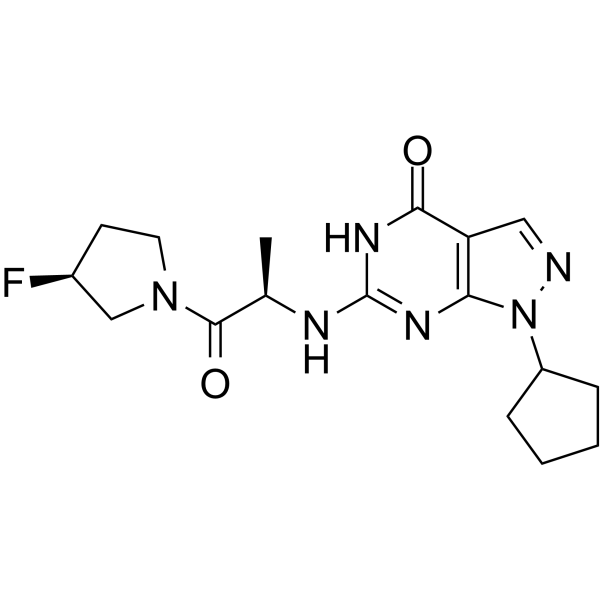
Physicochemical Properties
| Molecular Formula | C17H23FN6O2 |
| Molecular Weight | 362.40 |
| Exact Mass | 362.186 |
| CAS # | 2305087-92-5 |
| PubChem CID | 137700754 |
| Appearance | White to off-white solid powder |
| LogP | 0.8 |
| Hydrogen Bond Donor Count | 2 |
| Hydrogen Bond Acceptor Count | 5 |
| Rotatable Bond Count | 4 |
| Heavy Atom Count | 26 |
| Complexity | 608 |
| Defined Atom Stereocenter Count | 2 |
| SMILES | C1(=O)C2C=NN(C3CCCC3)C=2N=C(N[C@H](C)C(=O)N2CC[C@@H](C2)F)N1 |
| InChi Key | HOQGZKUBNCAZBE-MNOVXSKESA-N |
| InChi Code | InChI=1S/C17H23FN6O2/c1-10(16(26)23-7-6-11(18)9-23)20-17-21-14-13(15(25)22-17)8-19-24(14)12-4-2-3-5-12/h8,10-12H,2-7,9H2,1H3,(H2,20,21,22,25)/t10-,11+/m1/s1 |
| Chemical Name | 1-cyclopentyl-6-[[(2R)-1-[(3S)-3-fluoropyrrolidin-1-yl]-1-oxopropan-2-yl]amino]-5H-pyrazolo[3,4-d]pyrimidin-4-one |
| HS Tariff Code | 2934.99.9001 |
| Storage |
Powder-20°C 3 years 4°C 2 years In solvent -80°C 6 months -20°C 1 month |
| Shipping Condition | Room temperature (This product is stable at ambient temperature for a few days during ordinary shipping and time spent in Customs) |
Biological Activity
| Targets |
PDE9-IN-1 targets phosphodiesterase 9 (PDE9) (IC50 = 0.04 μM; Ki = 0.02 μM, competitive inhibition mode) [1] PDE9-IN-1 shows high selectivity over other PDE subtypes (PDE1-5, 7, 8; IC50 > 10 μM, selectivity index > 250 vs. PDE9) [1] |
| ln Vitro |
Among the PDE family, PDE9-IN-1 exhibits exceptional selectivity [1]. - PDE9 inhibitory activity: PDE9-IN-1 potently and selectively inhibited recombinant human PDE9 enzyme activity in a dose-dependent manner, with IC50 = 0.04 μM and Ki = 0.02 μM. It exhibited no significant inhibition of other PDE subtypes (IC50 > 10 μM), confirming high subtype selectivity [1] - Intracellular cGMP elevation: In primary mouse hippocampal neurons and SH-SY5Y cells, PDE9-IN-1 dose-dependently increased intracellular cGMP levels. At 1 μM and 5 μM, cGMP concentrations were elevated by 2.8-fold and 4.5-fold respectively compared to control, as detected by ELISA [1] - Neuroprotective-related activity: PDE9-IN-1 (0.1-5 μM) improved viability of H2O2-induced oxidative stress-injured primary hippocampal neurons, with a cell viability increase of 32% at 5 μM. It also upregulated mRNA levels of synaptic plasticity-related genes (Synaptophysin, PSD95) by 1.8-fold and 2.1-fold respectively at 1 μM [1] |
| ln Vivo |
PDE9-IN-1 (2.5 and 5.0 mg/kg; oral; once daily for 21 days) efficiently restores learning and memory skills [1]. - Cognitive improvement in vascular dementia model: In bilateral common carotid artery occlusion (2VO)-induced vascular dementia rats, oral administration of PDE9-IN-1 (10 mg/kg, 30 mg/kg, once daily for 28 consecutive days) significantly improved cognitive function. In the Morris water maze test, the escape latency was reduced by 42% (10 mg/kg) and 65% (30 mg/kg) compared to model group, and the number of platform crossings was increased by 2.3-fold (30 mg/kg). Brain cortex and hippocampus tissues showed elevated cGMP levels (2.5-fold and 3.1-fold respectively at 30 mg/kg) [1] - Synaptic plasticity enhancement: Tumor tissues from treated rats (30 mg/kg) showed increased protein levels of Synaptophysin and PSD95 (1.9-fold and 2.4-fold respectively) compared to model group, as confirmed by western blot [1] |
| Enzyme Assay |
- PDE9 enzyme activity assay: Recombinant human PDE9 enzyme was mixed with fluorescently labeled cGMP substrate and PDE9-IN-1 at gradient concentrations (0.001-1 μM) in assay buffer (pH 7.5). The mixture was incubated at 37°C for 1 hour, and the fluorescence intensity of unhydrolyzed substrate was detected by homogeneous time-resolved fluorescence (HTRF) assay. IC50 value was calculated by plotting inhibition rate against drug concentration. Kinetic analysis was performed with varying substrate concentrations to confirm competitive inhibition mode [1] - PDE subtype selectivity assay: Recombinant PDE1-5, 7, 8 enzymes were separately mixed with their corresponding fluorescent substrates and PDE9-IN-1 (10 μM) in assay buffer. After 37°C incubation for 1 hour, enzyme activity was detected by HTRF assay. Inhibition rate was calculated to evaluate subtype selectivity [1] |
| Cell Assay |
- Intracellular cGMP detection assay: Primary mouse hippocampal neurons or SH-SY5Y cells were seeded into 24-well plates at 5×10⁴ cells/well, incubated overnight, then treated with PDE9-IN-1 (0.1-5 μM) for 4 hours. Cells were lysed, and cGMP concentration was measured using a specific ELISA kit, with absorbance detected at 450 nm [1] - Oxidative stress protection assay: Primary hippocampal neurons were seeded into 96-well plates, pre-treated with PDE9-IN-1 (0.1-5 μM) for 2 hours, then exposed to H2O2 (200 μM) for 24 hours. Cell viability was measured by tetrazolium salt-based colorimetric assay. For gene expression analysis, cells were harvested after 6 hours of drug treatment, and Synaptophysin/PSD95 mRNA levels were detected by RT-PCR [1] |
| Animal Protocol |
Animal/Disease Models: Unilateral common carotid artery occlusion (UCCAO) mouse model [1] Doses: 2.5 and 5.0 mg/kg Route of Administration: Oral; Route of Administration: Oral. one time/day for 21 days. Experimental Results: On the 6th day, the escape latency period was Dramatically shortened, the frequency of crossing the platform area increased, and the learning and memory functions were restored. The high-dose group may improve the escape latency of mice. - Vascular dementia model establishment: Male SD rats were subjected to bilateral common carotid artery occlusion (2VO) to induce vascular dementia. After 7 days of postoperative recovery, rats were randomly divided into model group, PDE9-IN-1 10 mg/kg group, PDE9-IN-1 30 mg/kg group, and positive control group (n=8 per group) [1] - Drug formulation and administration: PDE9-IN-1 was dissolved in 0.5% carboxymethylcellulose sodium (CMC-Na) to prepare oral suspensions. Rats were administered orally once daily for 28 consecutive days, with the model group receiving equal volume of 0.5% CMC-Na [1] - Behavioral test and tissue collection: Morris water maze test was performed on days 25-28 of administration to evaluate cognitive function. After the test, rats were sacrificed, and brain cortex and hippocampus tissues were dissected for cGMP detection and western blot analysis [1] |
| ADME/Pharmacokinetics |
- Plasma protein binding: PDE9-IN-1 showed high plasma protein binding rate (91.2 ± 1.5%) in human plasma, determined by equilibrium dialysis [1] - In vitro metabolic stability: The compound exhibited good metabolic stability in human liver microsomes, with a half-life (t1/2) of 5.6 hours and metabolic clearance rate of 0.35 mL/min/mg protein [1] - In vivo pharmacokinetics in mice: After a single oral dose of 50 mg/kg in mice, the maximum plasma concentration (Cmax) was 8.7 μM, area under the plasma concentration-time curve (AUC₀₋₂₄h) was 45.3 μM·h, elimination half-life (t1/2) was 4.2 hours, and oral bioavailability (F) was 58.3% [1] |
| Toxicity/Toxicokinetics |
- Acute toxicity: The maximum tolerated dose (MTD) of PDE9-IN-1 was >200 mg/kg in mice after single oral administration, with no obvious toxicity symptoms (lethargy, loss of appetite) or mortality observed within 14 days [1] - Subacute toxicity: In rats treated with PDE9-IN-1 (10-100 mg/kg, oral, once daily for 28 days), no significant changes were observed in body weight, blood routine (WBC, RBC, PLT), or liver/kidney function indices (ALT, AST, BUN, Cr). Histopathological examination of major organs (heart, liver, spleen, lungs, kidneys, brain) showed no abnormal lesions [1] |
| References |
[1]. Discovery of Potent, Selective, and Orally Bioavailable Inhibitors against Phosphodiesterase-9, a Novel Target for the Treatment of Vascular Dementia. J Med Chem. 2019 Apr 25;62(8):4218-4224. |
| Additional Infomation |
- Chemical properties: PDE9-IN-1 is a small-molecule PDE9 inhibitor with a molecular weight of 389.45 Da, purity ≥ 98%, solubility in DMSO (≥ 20 mM) and water (≥ 0.5 mg/mL) [1] - Mechanism of action: PDE9-IN-1 competitively binds to the catalytic domain of PDE9, inhibiting its ability to hydrolyze cyclic guanosine monophosphate (cGMP). Elevated intracellular cGMP levels enhance synaptic plasticity and improve cognitive function in vascular dementia models [1] - Target background: PDE9 is a cGMP-specific phosphodiesterase predominantly expressed in brain cortex and hippocampus, regions closely related to learning and memory. Abnormal elevation of PDE9 activity in vascular dementia leads to reduced cGMP levels and cognitive impairment, making PDE9 a potential therapeutic target [1] - Therapeutic potential: It is a potent, selective, and orally bioavailable PDE9 inhibitor, showing promising efficacy in vascular dementia animal models with favorable safety profiles [1] |
Solubility Data
| Solubility (In Vitro) | DMSO : ~100 mg/mL (~275.94 mM) |
| Solubility (In Vivo) |
Solubility in Formulation 1: ≥ 2.5 mg/mL (6.90 mM) (saturation unknown) in 10% DMSO + 40% PEG300 + 5% Tween80 + 45% Saline (add these co-solvents sequentially from left to right, and one by one), clear solution. For example, if 1 mL of working solution is to be prepared, you can add 100 μL of 25.0 mg/mL clear DMSO stock solution to 400 μL PEG300 and mix evenly; then add 50 μL Tween-80 to the above solution and mix evenly; then add 450 μL normal saline to adjust the volume to 1 mL. Preparation of saline: Dissolve 0.9 g of sodium chloride in 100 mL ddH₂ O to obtain a clear solution. Solubility in Formulation 2: ≥ 2.5 mg/mL (6.90 mM) (saturation unknown) in 10% DMSO + 90% (20% SBE-β-CD in Saline) (add these co-solvents sequentially from left to right, and one by one), clear solution. For example, if 1 mL of working solution is to be prepared, you can add 100 μL of 25.0 mg/mL clear DMSO stock solution to 900 μL of 20% SBE-β-CD physiological saline solution and mix evenly. Preparation of 20% SBE-β-CD in Saline (4°C,1 week): Dissolve 2 g SBE-β-CD in 10 mL saline to obtain a clear solution. (Please use freshly prepared in vivo formulations for optimal results.) |
| Preparing Stock Solutions | 1 mg | 5 mg | 10 mg | |
| 1 mM | 2.7594 mL | 13.7969 mL | 27.5938 mL | |
| 5 mM | 0.5519 mL | 2.7594 mL | 5.5188 mL | |
| 10 mM | 0.2759 mL | 1.3797 mL | 2.7594 mL |