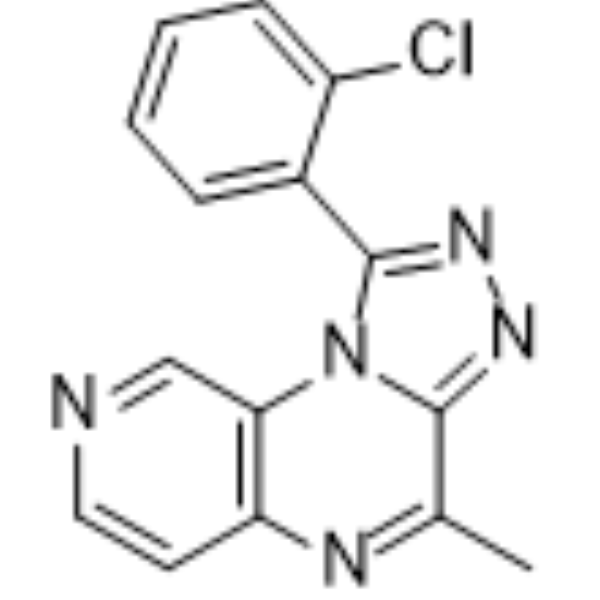
Physicochemical Properties
| Molecular Formula | C15H10CLN5 |
| Molecular Weight | 295.726400852203 |
| Exact Mass | 295.062 |
| CAS # | 1426833-08-0 |
| PubChem CID | 71295299 |
| Appearance | Off-white to brown solid powder |
| LogP | 3.2 |
| Hydrogen Bond Donor Count | 0 |
| Hydrogen Bond Acceptor Count | 4 |
| Rotatable Bond Count | 1 |
| Heavy Atom Count | 21 |
| Complexity | 381 |
| Defined Atom Stereocenter Count | 0 |
| SMILES | C12=NN=C(C3=CC=CC=C3Cl)N1C1C=NC=CC=1N=C2C |
| InChi Key | SNQXTEAQGLZIDL-UHFFFAOYSA-N |
| InChi Code | InChI=1S/C15H10ClN5/c1-9-14-19-20-15(10-4-2-3-5-11(10)16)21(14)13-8-17-7-6-12(13)18-9/h2-8H,1H3 |
| Chemical Name | 3-(2-chlorophenyl)-7-methyl-2,4,5,8,12-pentazatricyclo[7.4.0.02,6]trideca-1(9),3,5,7,10,12-hexaene |
| HS Tariff Code | 2934.99.9001 |
| Storage |
Powder-20°C 3 years 4°C 2 years In solvent -80°C 6 months -20°C 1 month |
| Shipping Condition | Room temperature (This product is stable at ambient temperature for a few days during ordinary shipping and time spent in Customs) |
Biological Activity
| ln Vitro | PDE2/PDE10-IN-1 (compound 6) has IC50 values of 29 and 480 nM, respectively, which indicate that it inhibits PDE2 and PDE10. Additionally, PDE2/PDE10-IN-1 inhibits PDE4D and PDE11A, with IC50 values of 5890 nM and 6920 nM, respectively. Additionally, PDE2/PDE10-IN-1 did not significantly inhibit any of the CYP450 enzymes (CYP1A2, 2C9, 2D6, 2C19, and 3A4). PDE2/PDE10-IN-1 was likewise inactive in bacterial mutagenicity tests at concentrations as high as 125 μg/mL [1]. |
| ln Vivo | Rats were given 2.5 mg/kg IV and 10 mg/kg po to study the PK characteristics of PDE2/PDE10-IN-1. Rapid clearance (t1/2=0.47 h) following intravenous administration was noted; this was surprising given the rat liver microsomes' (rLM) in vitro metabolic stability. It's interesting to note that PDE2/PDE10-IN-1 had good bioavailability and a maximum plasma concentration (Cmax) of 997 ng/mL following oral treatment, but with a longer clearance (t1/2=2.36 h). ). PDE2/PDE10-IN-1's ability to pass the blood-brain barrier was assessed in rats following a subcutaneous injection of 10 mg/kg. At pH > 3.5, PDE2/PDE10-IN-1 demonstrated satisfactory formulation with 10 to 20% HPβCD. Brain concentrations of PDE2/PDE10-IN-1, with high brain/plasma ratios and brain-free fractions, ranged from 370 to 895 ng/g one hour after treatment. More precisely, the 21 mg/kg PDE2 ED50 is occupied by the orally accessible PDE2/PDE10-IN-1 [1]. |
| References |
[1]. Pyrido[4,3-e][1,2,4]triazolo[4,3-a]pyrazines as Selective, Brain Penetrant Phosphodiesterase 2 (PDE2) Inhibitors. ACS Med Chem Lett. 2015 Jan 15;6(3):282-6. |
Solubility Data
| Solubility (In Vitro) | DMSO : ~12.5 mg/mL (~42.27 mM) |
| Solubility (In Vivo) |
Solubility in Formulation 1: ≥ 1.25 mg/mL (4.23 mM) (saturation unknown) in 10% DMSO + 40% PEG300 + 5% Tween80 + 45% Saline (add these co-solvents sequentially from left to right, and one by one), clear solution. For example, if 1 mL of working solution is to be prepared, you can add 100 μL of 12.5 mg/mL clear DMSO stock solution to 400 μL PEG300 and mix evenly; then add 50 μL Tween-80 to the above solution and mix evenly; then add 450 μL normal saline to adjust the volume to 1 mL. Preparation of saline: Dissolve 0.9 g of sodium chloride in 100 mL ddH₂ O to obtain a clear solution. Solubility in Formulation 2: ≥ 1.25 mg/mL (4.23 mM) (saturation unknown) in 10% DMSO + 90% (20% SBE-β-CD in Saline) (add these co-solvents sequentially from left to right, and one by one), clear solution. For example, if 1 mL of working solution is to be prepared, you can add 100 μL of 12.5 mg/mL clear DMSO stock solution to 900 μL of 20% SBE-β-CD physiological saline solution and mix evenly. Preparation of 20% SBE-β-CD in Saline (4°C,1 week): Dissolve 2 g SBE-β-CD in 10 mL saline to obtain a clear solution. Solubility in Formulation 3: ≥ 1.25 mg/mL (4.23 mM) (saturation unknown) in 10% DMSO + 90% Corn Oil (add these co-solvents sequentially from left to right, and one by one), clear solution. For example, if 1 mL of working solution is to be prepared, you can add 100 μL of 12.5 mg/mL clear DMSO stock solution to 900 μL of corn oil and mix evenly. (Please use freshly prepared in vivo formulations for optimal results.) |
| Preparing Stock Solutions | 1 mg | 5 mg | 10 mg | |
| 1 mM | 3.3815 mL | 16.9073 mL | 33.8146 mL | |
| 5 mM | 0.6763 mL | 3.3815 mL | 6.7629 mL | |
| 10 mM | 0.3381 mL | 1.6907 mL | 3.3815 mL |