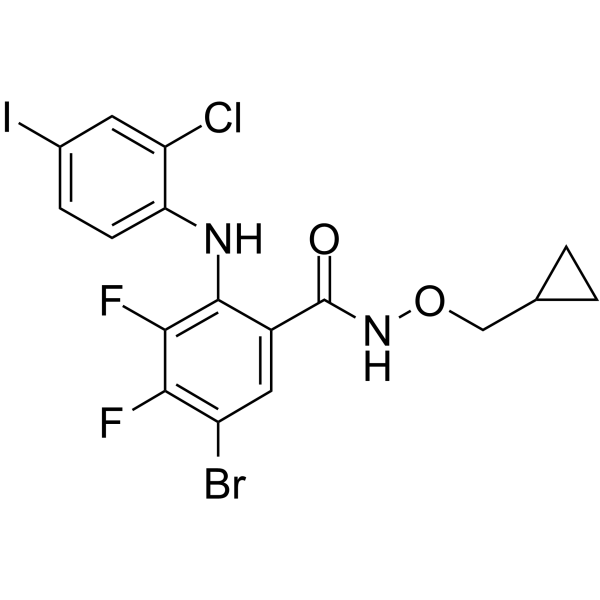
Physicochemical Properties
| Molecular Formula | C17H13BRCLF2IN2O2 |
| Molecular Weight | 557.55 |
| Exact Mass | 555.886 |
| CAS # | 212631-67-9 |
| PubChem CID | 9937619 |
| Appearance | Off-white to gray solid powder |
| Density | 1.9±0.1 g/cm3 |
| Index of Refraction | 1.670 |
| LogP | 9.28 |
| Hydrogen Bond Donor Count | 2 |
| Hydrogen Bond Acceptor Count | 5 |
| Rotatable Bond Count | 6 |
| Heavy Atom Count | 26 |
| Complexity | 505 |
| Defined Atom Stereocenter Count | 0 |
| InChi Key | VJNZMSLGVUSPCF-UHFFFAOYSA-N |
| InChi Code | InChI=1S/C17H13BrClF2IN2O2/c18-11-6-10(17(25)24-26-7-8-1-2-8)16(15(21)14(11)20)23-13-4-3-9(22)5-12(13)19/h3-6,8,23H,1-2,7H2,(H,24,25) |
| Chemical Name | 5-bromo-2-(2-chloro-4-iodoanilino)-N-(cyclopropylmethoxy)-3,4-difluorobenzamide |
| Synonyms | PD184161; PD 184161; PD184161 |
| HS Tariff Code | 2934.99.9001 |
| Storage |
Powder-20°C 3 years 4°C 2 years In solvent -80°C 6 months -20°C 1 month Note: This product requires protection from light (avoid light exposure) during transportation and storage. |
| Shipping Condition | Room temperature (This product is stable at ambient temperature for a few days during ordinary shipping and time spent in Customs) |
Biological Activity
| ln Vitro | Inducing apoptosis and inhibiting cell proliferation, PD184161 (1–20 μM) exhibits concentration- and time-dependent effects [1]. A one-hour dose of 0.1 and 1.0 μM PD184161,2 inhibits phosphorylation of ERK1,2 [1]. PD184161 (5 μM; 30 min) protects against the toxic effects of bicuculline [3]. |
| ln Vivo | After oral administration, PD184161 decreases P-ERK levels in tumor xenografts in 3–12 hours [1]. PD184161, administered orally twice daily for 38 days at a dose of 300 mg/kg, dramatically slowed the growth and implantation of tumors [1]. A single injection of PD184161, at a dose of 30 mg/kg, induces depressive-like symptoms [2]. After a stroke, PD184161, administered intravenously at a dose of 500 μg/kg, stops the progression of neurological impairments and brain damage [3]. |
| Cell Assay |
Cell Proliferation Assay[1] Cell Types: HCC cell lines (HepG2, Hep3B, PLC and SKHep) Tested Concentrations: 1-20 μM Incubation Duration: 24, 48 or 72 hrs (hours) Experimental Results: Cell proliferation was inhibited. Apoptosis analysis[1] Cell Types: HCC cell lines (HepG2, Hep3B, PLC and SKHep) Tested Concentrations: 1-20 μM Incubation Duration: 48 hrs (hours) Experimental Results: Induction of apoptosis. Western Blot Analysis[1] Cell Types: HCC cell lines (HepG2, Hep3B, PLC and SKHep) Tested Concentrations: 0.1 and 1.0 μM Incubation Duration: 1 hour Experimental Results: ERK1,2 phosphorylation is inhibited. Cell viability assay[3] Cell Types: Primary Mouse Neurons Tested Concentrations: 5 μM Incubation Duration: 30 min Experimental Results: Protection against toxic effects of bicuculline. |
| Animal Protocol |
Animal/Disease Models: Hep3B tumor xenograft BALB/c athymic nude mice [1] Doses: 300 mg/kg Route of Administration: Orogastric gavage, twice a day for 38 days Experimental Results: diminished early tumor growth. Animal/Disease Models: Male, 6weeks old C57Bl/6 mice [2] Doses: 500 μg/kg Route of Administration: intravenous (iv) (iv)injection 30 minutes before MCAO or PTZ administration Experimental Results: Prevent the progression of neurological deficits and brain damage after stroke. Animal/Disease Models: C57Bl/6 mice [3] Doses: 30 mg/kg Route of Administration: intraperitoneal (ip) injection, single injection Experimental Results:depressive-like behavior. |
| References |
[1]. The effects of a novel MEK inhibitor PD184161 on MEK-ERK signaling and growth in human liver cancer. Neoplasia. 2006 Jan;8(1):1-8. [2]. A role for MAP kinase signaling in behavioral models of depression and antidepressant treatment. Biol Psychiatry. 2007 Mar 1;61(5):661-70. [3]. ERK inhibition with PD184161 mitigates brain damage in a mouse model of stroke. J Neural Transm (Vienna). 2014 May;121(5):543-7. |
Solubility Data
| Solubility (In Vitro) | DMSO : ~100 mg/mL (~179.35 mM) |
| Solubility (In Vivo) |
Solubility in Formulation 1: 2.5 mg/mL (4.48 mM) in 10% DMSO + 40% PEG300 + 5% Tween80 + 45% Saline (add these co-solvents sequentially from left to right, and one by one), suspension solution; with sonication. For example, if 1 mL of working solution is to be prepared, you can add 100 μL of 25.0 mg/mL clear DMSO stock solution to 400 μL PEG300 and mix evenly; then add 50 μL Tween-80 to the above solution and mix evenly; then add 450 μL normal saline to adjust the volume to 1 mL. Preparation of saline: Dissolve 0.9 g of sodium chloride in 100 mL ddH₂ O to obtain a clear solution. Solubility in Formulation 2: ≥ 2.5 mg/mL (4.48 mM) (saturation unknown) in 10% DMSO + 90% Corn Oil (add these co-solvents sequentially from left to right, and one by one), clear solution. For example, if 1 mL of working solution is to be prepared, you can add 100 μL of 25.0 mg/mL clear DMSO stock solution to 900 μL of corn oil and mix evenly. (Please use freshly prepared in vivo formulations for optimal results.) |
| Preparing Stock Solutions | 1 mg | 5 mg | 10 mg | |
| 1 mM | 1.7936 mL | 8.9678 mL | 17.9356 mL | |
| 5 mM | 0.3587 mL | 1.7936 mL | 3.5871 mL | |
| 10 mM | 0.1794 mL | 0.8968 mL | 1.7936 mL |